Showing posts sorted by relevance for query cynical challenge. Sort by date Show all posts

Monday, 21 March 2011

Studs Alert: A Cynical Challenge

The following incident occurred during an English Premier League match between Manchester United and Bolton Wanderers on Saturday 19 March 2011. The match finished 1—0.

In the 75th minute, with the score locked at 0—0, Manchester United's Jonathan Evans and Bolton Wanderers' Stuart Holden engaged in a 50-50 challenge. However, Evans approached the challenge cynically with his studs up and directed towards his opponent.

Referee Andre Marriner was correct to send off Evans for serious foul play.

Both players are equally committed to the ball, but is one player more committed to endangering the safety of his opponent too?

Stuart Holden is injured during this cynical challenge by Jonathan Evans (Pic from here)


Media Analysis
Pundits Mark Lawrenson and Alan Hansen, on BBC's Match of the Day, had this to say:

Lawro: Both these two boys are so committed to the ball that's there absolutely no doubt about it. And (sigh), look at them, both their feet are off the floor. The problem is for Evans is he actually catches the ball with his knee but he catches the player with his studs up. And I think there's no hesitation for the referee. But I think both players actually went for the ball.

Hansen: Yeah, I thought he [Evans] was unlucky. I thought he is a bit high but he gets a lot of the ball and I don't think there's any intent there whatsoever.

Gary Lineker: OK.

Does anyone (sorry, I mean, do any referees) understand what these pundits are talking about? What's their argument? Something about "committed to the ball" and "getting the ball" and "unlucky to get a red card"? When pundits say they cannot see any intent in such challenges, then ... they have been well and truly hoodwinked.


Post-Match Comments
In some news articles, the two managers were reluctant to put any blame on Jonathan Evans (see BBC Sport and Daily Mail).

Man Utd boss Sir Alex Ferguson, as usual, tried to misdirect Evan's cynical challenge by saying: "Everyone knows Jonny is not a malicious player. I think the red card was probably given because of the injury. You can't have any real complaints, it was unfortunate, maybe."

Bolton boss Owen Coyle said: "In real time, it looked as though two players were committed going for the ball. There didn't seem any malice."

What's their argument? Something about "committed to the ball" and "not malicious" and "unlucky to get a red card, maybe"? When managers say they cannot see any malice in such challenges, then ... one manager is biased and defending his own player, and t'other manager has been hoodwinked.


Cynical is as Cynical does

The trouble with pundits and managers is that, in incidents when two players are both committed to the ball, they assume both players are acting in the same way when they engage in a 50-50 challenge. They assume both players are making a fair and sporting challenge for the ball. But is it fair when one player chooses to challenge by exposing his studs and the other player chooses to challenge with the side or top of his boot? Who is being fair and sporting, and who is being unfair, unsporting and cynical?

This blog has documented similar incidents where players become involved in 50-50 challenges.

In this example, Studs Alert: Stamp Out Stamping, one player is being fair and sporting, and the other is being unfair, unsporting and cynical.

And in this example, Webb's Weak Woeful Week (where there are also comments from readers), during the Tottenham Hotspurs and Sunderland match both players challenge fairly and sportingly because they both attempt to make contact with the ball using the side of their boots.

True, two readers have previously made the point that Sunderland's Lee Cattermole had both feet off the ground during the challenge. My (belated) reply is "so what" and "what else"? Players are allowed to jump and have their feet off the ground. But what is not allowed is when players expose their studs or perform other cynical actions that will, or have the potential to, endanger the safety of their opponent. Cattermole's challenge was not cynical, which is why that particular challenge was not serious foul play. Yes, Luka Modric was injured in the aftermath but Referees are not taught to assess the consequences or the potential outcomes of a challenge. Referees are taught to assess the nature of the challenge itself.

I hope this provides a reasonable answer to the two readers who previously gave their views (posted here).


Additional Tip:
For 50-50 challenges, to help Referees decide whether one player does not intend to play the ball but instead intends to injure his opponent (i.e. How to identify unfair, unsporting and cynical challenges), simply ask yourself whether the same player would do exactly the same if his opponent was actually his fellow team-mate, a relative or a good friend. So, would Jonathan Evans have jumped in with his studs up if another Manchester United player had also challenged for the ball?

Evans made an unfair, unsporting and cynical challenge and Referee Andre Marriner was correct to see that as serious foul play.

For the good of the game, let's Stamp Out Stamping

Related Posts (search: stamp)

Wednesday, 24 August 2011

Many Missed Red Card Incidents In One Match

For many years now, the leniency shown by Referees in the EPL has been and still is unhelpful, and possibly harmful, to all other Referees around the world. Experienced Referees all over the world will roll their eyes and heave a sigh, knowing that their jobs are made more difficult by the leniency shown by EPL Referees and broadcast regularly to all four corners of the world. And it's not just Referees who will suffer.

Players, coaches, fans and commentators will also suffer because they will not be able to understand why Referees from other countries "appear" to be harsher when the English Referees are more lenient. Players themselves will be quickly cautioned and even sent off for the exact same discretions that they have previously got away with in the EPL. See examples here of a Law-abiding decision (Referee in Brazil sends off player in the first minute for Offinabus) and a lenient decision here (from EPL Referee Mike Jones).


The leniency example in this post happens to be associated with Referee Howard Webb, but there are other EPL Referees who also show too much leniency. Remember: Professional Referees set the benchmark for the rest of us.

The following incidents, many lenient, occurred during the EPL match between Sunderland and Newcastle on Saturday 20 August 2011. The match finished 0—1.

Watching Howard Webb "manage" and officiate this North-East derby simply made me think about the plight of non-EPL Referees around the world. In a future post, I will address the stance of ex-EPL Referee Graham Poll who said of the North-East derby that the "game was absorbing and a great advert for the Premier League for which Webb deserves great credit".


Incident One: DOGSO with hand (unseen)

In the 13th minute, Sunderland's Sebastian Larsson stops the ball from entering the goal with his left arm.
Referee Howard Webb stoops to indicate that perhaps he did not have a clear and unobstructed view on the incident

Larsson (red#7) tries to influence AR Scott Ledger by claiming the ball hit his face. This is clearly dishonest behaviour (cheating) and the FA should perhaps consider charging players like Larsson for unsporting behaviour and for failing to uphold the principles of Fair Play

The BBC's Match of the Day has a new feature this season, where they attempt to give the Referee's View. NOTE: This is a great post-match analysis tool (to help match officials), but the software programmers must remember to do things properly ... for example, take a look at Sunderland's goalkeeper (yellow)


Incident Two: Studs up challenge (unseen? Lenient)

In the 25th minute, Newcastle's Yohan Cabaye (Black#4) makes a cynical challenge on Sunderland's Phil Bardsley (Red#2). Webb eventually cautioned Cabaye.


Cabaye's (Black#4) high and studs-up cynical challenge on Bardsley (Red#2)

Webb's position around the time of the incident


Incident Three: Studs up challenge (unseen? Lenient)

In the 89th minute, Sunderland's Phil Bardley makes a cynical challenge on Newcastle's Fabricio Coloccini. Again, Webb only gave a caution (it was Bardley's second caution of the match).

Bardsley (Red) goes over the top of the ball and into Coloccini's (Black) lower leg

Did Webb have the optimum angle? Should he have consulted with AR Ledger?


Incident Four: Elbow Used As A Weapon (unseen)

Newcastle's match-winner Ryan Taylor elbowed Asamoah Gyan. Since this was missed by the match officials, perhaps there should be another review of the evidence by TV replay?

[Apologies, I do not have a Pic of this incident]


Incident Five: Second caution (Lenient)

Sunderland's Lee Cattermole made some crunching tackles throughout the match. There was a reckless challenge on Joey Barton which Webb, rather predictably (even to the BBC commentator Guy Mowbray who said: "If I know Howard Webb, he will just have a word with Cattermole"), only gave a public warning to Cattermole. Later in the match, Cattermole recklessly scythed down Jonas Guiterrez and received a caution. That could have been his second caution.

Cattermole (Red) on Barton (Black)


SUMMARY

Throughout the North-East derby, Webb used his typical lenient approach by being reluctant to give out cards to players, physically man-handling them, and talking to the players (when it is plain for everyone to see that players who are familiar with Webb do not actually listen). Is this technique really what Referees throughout the world should learn to adopt?

Graham Poll says there could have been 4 players sent off with straight reds, and instead says that Howard Webb deserves great credit … presumably for not sending off several players in the feisty North-East derby. Hmmm ... is Poll correct?


Saturday, 17 December 2011

Martin Atkinson Up and Down Part 2

The remaining 2 of 5 incidents (see earlier post here) occurred during the EPL match between Norwich City and Newcastle United on Saturday 10 December 2011. The match finished 4—2.


Incident Four No Handball

In the 60', a Norwich cross hits a Newcastle player in the chest and possibly arm. Here are the freeze frames:
The ball has possibly touched the arm of a Newcastle (black/white) player

However, the arms were not outstretched in an unnatural position and the short distance and high speed that the ball travelled to hit the Newcastle player provides ample information that there was no deliberate handball. This incident is used as a comparison with Incident One (see earlier post here), where a deliberate handball occurred, but was somehow missed by the match officials.


Incident Five Cynical Challenge

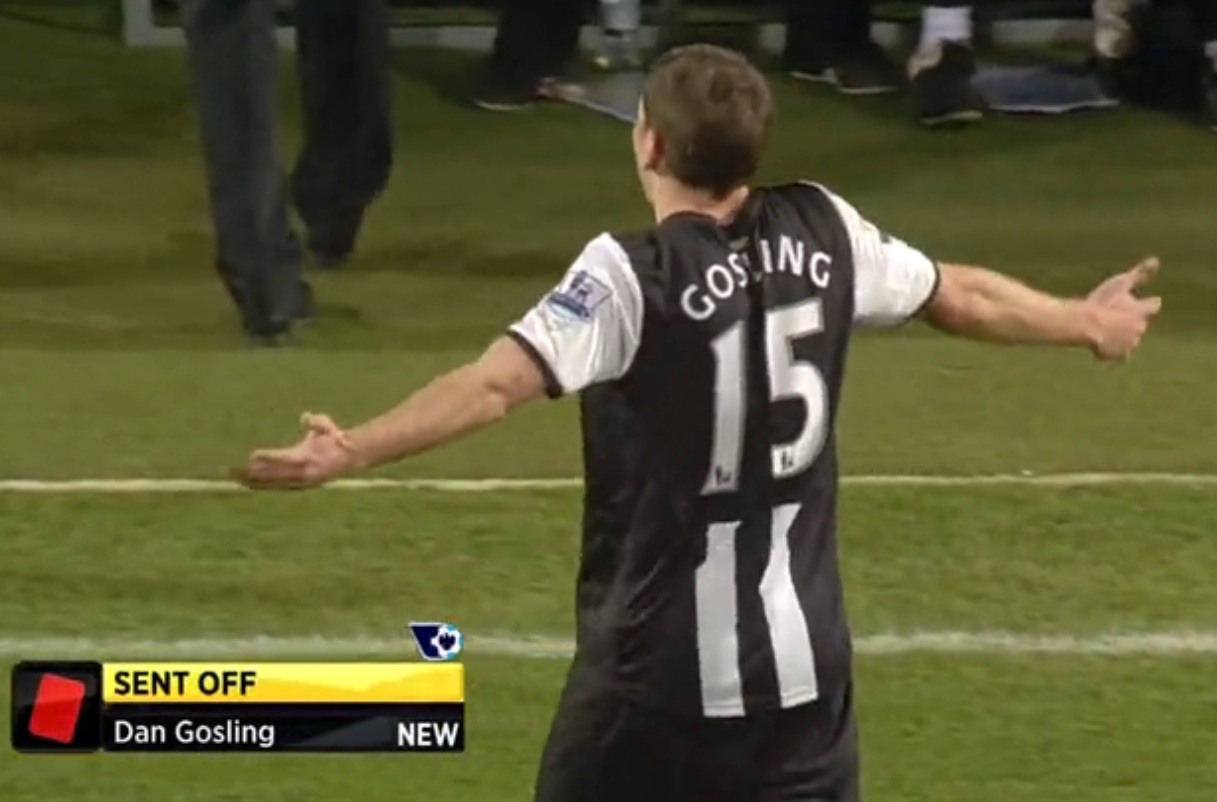
In the 66', Newcastle's Dan Gosling makes a cynical challenge (studs up and over the ball) on Norwich's Russell Martin.

Referee Atkinson does not hesitate to correctly send off Gosling for serious foul play

Referee Martin Atkinson was in a good position—at the right place at the right time—to see the incident. However, just how much of the contact did Atkinson see? Was his view obscured by another player? Perhaps or perhaps not? Nevertheless, experienced Referees in similar situations would also draw on their vast experience and knowledge to help them with their decision making.

Here are freeze frames from another camera angle:
Note how the excessive force of the cynical challenge makes Norwich's Russell Martin (yellow #2) pirouette

Here's Dan Gosling's reaction to his cynical challenge and send off:
The reaction of players who are sent off for blatant SFP or VC is often pathetic and is usually a shameless way to gain sympathy from their own team-mates and fans. How can players claim to be innocent when they know they are guilty? One possible reason is that many players lack taking responsibility for their own actions and lack a good sense of sportsmanship and fair play.


SUMMARY

It is likely that Martin Atkinson and Mike Mullarkey will be officiating at Euro 2012 next June. Let's hope they can iron out any controversies and missed incidents that are within their control, and simultaneously continue to get critical decisions (such as Incident Five) correct.

Sunday, 22 August 2010

Studs Alert: Stamp Out Stamping

The following incident occurred during a first-leg play-off round UEFA Champions League match between FK Partizan and RSC Anderlecht on Wednesday 18 August 2010. The match finished 2—2.

The five freeze frames show a cowardly act by Anderlecht player Mbark Boussoufa (dark blue #11). Unfortunately, this cynical, cowardly, and unsporting act appears to be occurring in matches with alarming frequency. Even more disturbing is the fact that referees do not appear to be taking the correct disciplinary action to curb this act. Do we want more legs to be broken before competition authorities, match officials, coaches, players, fans, commentators and the media take action to eliminate this cynical, cowardly, and unsporting act? For the good of the game, we must stamp out stamping.

In this 50-50 challenge, what is the difference between the approaches adopted by the two players? Hint: simply look at their left feet.

[Players showing or exposing their studs against opponents in challenges are cynical, cowardly, and unsporting. Note: in this instance, Partizan’s Almami Moreira (white#10) did not suffer a broken leg although his effectiveness in the match was hampered and he was duly substituted in the 53rd minute.]


Incredibly, a red card was not shown. A caution was not shown. A public talking to was probably not given. The only thing the referee gave was a direct free kick. How did the referee Claus Bo Larsen (Denmark) miss this? He was clearly in an optimum position (i.e. a position that gave him a clear, near and uninterrupted view).

[The referee has a clear, near and uninterrupted view of the challenge]


There used to be a time when challenges—although “meaty” and “fully committed”—were never cynical and cowardly. Back in those times, players going for a 50-50 ball (like the one pictured above) would always use either the front or side of their boot to challenge for the ball. It is only in recent times—which also rose to prominence during the 2010 World Cup … mainly because the referees in South Africa did not mete out the correct disciplinary action to send out the correct message—that players cynically expose their studs. Contrast this to the 2002 World Cup, when Brazil's Ronaldinho was correctly sent off for his cynical "over the top" challenge on England's Danny Murphy. For some reason, in the period between the 2002 and 2010 World Cups, this cynical, cowardly and unsporting act seems to have crept back into the game.

Referees should regard players who expose their studs or cleats at opponents as cynical, cowardly, and unsporting. We must stamp out stamping.

This culture of exposing studs as a way to intimidate and potentially inflict serious injury to an opponent needs to be eliminated from the game. In HKRef’s view, it is much more serious than the culture of diving (simulation) which has received a disproportionate amount of media attention. Let’s get our priorities in order. A player using studs in a challenge against an opponent should be sent-off for serious foul play; and a player guilty of simulation should be cautioned for unsporting behaviour. Both are cynical and unsporting acts, but the former also has the risk of ruining an opponent's career or livelihood. It is cowardly and it is a coward's challenge.


Related Posts (search: stamp)

Unpleasant Incidents During Hong Kong Division Three Playoff Match

Stamping incident

Emmanuel Adebayor Stamped And Kicked Robin Van Persie's Head

FA Hands Adebayor Three-match Ban For Stamp on van Persie

Belgian Player Gets 11-Match Ban For Shocking Horror Tackle

Stamping Incidents at AFC Champions League Match in Adelaide

Wednesday, 7 December 2011

Cynical Challenges Creeping In

From a safety point of view, I have never liked it when players use the bottom of their boots to play the ball. And for what it is worth, from an aesthetic perspective, it also looks rather ugly, uncouth and inelegant.

The following incident occurred during the EPL match between Manchester City and Norwich City on Saturday 3 December 2011. The match finished 5—1.

Early in the match, Norwich forward Steve Morison (yellow) steered the ball towards the penalty area but his heavy touch meant the ball was running away from his control. In seeing the Manchester City goalkeeper Joe Hart come off his line to intercept, Morison rather cynically challenged for the ball with his studs up. Here are the freeze frames:

Norwich forward Steve Morison (yellow) cynically challenges for the ball, thereby potentially endangering the safety of his opponent

At the very least, Referee Howard Webb should have awarded a free kick to Man City. It is technically correct to deem the goalkeeper had possession of the ball, since the ball is in contact with the goalkeepers' hand and the ground.

If enough Referees identify such challenges and act on them—by awarding a DFK or IFK plus any appropriate sanctions—players may eventually think twice before making cynical challenges. This blog advocates the message of "Studs Alert: Stamp Out Stamping".


For further consideration, let's have a look at previous examples posted on this blog.

Example One Evan's Eviction
This is an example of Manchester United defender Jonathan Evans maliciously stamping his presence in the game. Referee Andre Marriner correctly sent off Evans.

Example Two Nasty Tackles 2010-11 EPL Tackles Round 36
Unfortunately, these nasty tackles in various EPL matches were not appropriately dealt with by the respective Referees.

Example Three Sorensen's Safety
Chelsea's Salomon Kalou's cynical challenge ensured that Stoke's Danish goalkeeper Thomas Sorensen missed out on the 2010 World Cup finals.


Players making cynical challenges endanger the safety of their opponents. Such players will invariably use the excuse that they were "going for the ball", but Referees (and others who appreciate the Beautiful Game) understand the real reason why players make these cynical challenges. The reason is this: If the unsporting player loses out in the 50-50 challenge for the ball that is a mere inconvenience, but what really matters is that he has made sure he has not lost out in the real challenge that counts (i.e. the physical and/or psychological challenge with his opponent).

It is a player's choice whether he (and she) chooses to challenge for the ball either cynically or sportingly. A good rule of thumb for Referees to judge cynical challenges is to always consider whether the same player would do exactly the same if his opponent was actually his fellow team-mate, a relative or a good friend.

Let's Stamp Out Stamping

Related Posts (search for: stamp)

Recognizing Player Behaviour: 1991 FA Cup Final

Friday, 6 January 2012

Probing Lee Probert Part 3

The following incidents occurred during the EPL match between Liverpool and Newcastle United on Friday 30 December 2011. The match finished 3—1.

Related Parts: Probing Lee Probert Part 1 and Probing Lee Probert Part 2 and Probing Lee Probert Part 4.


Incident Five Player Safety — Head Injury from Leading Arm

In the 50' as a Liverpool player jumps up to head the ball, Newcastle's Cheick Tiote (black/white 24) jumps in sideways and leads with his arm. Tiote's arm makes contact with his opponent's face. Here are the freeze frames:
It appears Referee Probert does not know that there is a head injury right in front of him

Referee Lee Probert is in a great position and has a near and unobstructed view but does not do anything. Surely he must know that there is a head injury? But it does not appear so to him and so play continues ... and leads directly to Incident Six.


Incident Six Player Safety — Cynical Challenge

Immediately following Incident Five, Liverpool's Jay Spearing (red 20) and Newcastle's Yohan Cabaye (black/white 4) challenge for the loose ball. Here are the freeze frames:
Surely Referee Probert must know that there is an injury in front of him?

Again Referee Lee Probert is in a great position and has a near and unobstructed view but also does not do anything. Surely he must know that there is an injury? Instead Probert allows play to continue as the ball rolls forward toward the Newcastle United goalkeeper. Here are the freeze frames:
Probert allows play to continue as Liverpool's Spearing writhes in agony after Newcastle Cabaye's cynical studs-up challenge

Referee Probert only realizes that something is not quite right when Liverpool players have stopped playing and have asked him to do something about their injured players. Here are the freeze frames:
Has Probert woken up yet?


RECAP
Let's just take a look at these two dangerous challenges again, this time closer in and from different camera views. Remember, for both these incidents Referee Probert is in a great position and has a near and unobstructed view but does not do anything. It is puzzling why Probert did not respond to the first or the second dangerous challenge that occurred right in front of him.

Newcastle'sTiote jumps in leading with his left arm


Newcastle's Cabaye knows full well he is endangering his opponent

Note: Yohan Cabaye has escaped punishment before for this type of challenge (see Incident Two in Many Missed Red Card Incidents In One Match ... officiated by Howard Webb earlier this season)


In case there is any doubt that Referee Probert did not have a near and unobstructed view


These two incidents (Five and Six) should put all responsible people—and not just referees—on high alert. Are players being protected? And is the image of the game being protected? If you go back and look at Incident Two in Part 1, I mentioned my concern that Referee Lee Probert appeared to be unbothered about the welfare and safety of players. These incidents (Two, Five and Six) ... so far (!) ... are the reasons why I have this concern.


Furthermore in a recent post, I mentioned that there appeared to be more cynical challenges creeping in to the game, at least from what I can observe from the EPL (see Cynical Challenges Creeping In). Is this the case? And if so, what is the cause and what may be the likely remedy?

Related Posts: Cynical Challenges (search results)


Before contemplating the likely remedy, let's finish off this Probing Lee Probert post by looking next at Part 4.

Please see the other parts of Probing Lee Probert on this site (Part 1; Part 2; Part 4).