Monday, 14 November 2011

Wall Management, Encroachment, Handball

The following incident occurred during the 2012 European Cup playoff 1st leg match between Czech Republic and Montenegro on Saturday 12 November 2011. The match finished 2—0.

Referee Martin Atkinson (EPL Referee) correctly awards a DFK to Czech Republic (red) just outside the penalty area. However, his wall management is not optimum because it is clear the distance from the wall to the ball was not 10 yards. Next, there was additional encroachment and a handball, all of which were missed by the match officials. Here are the freeze frames:

Note: Don't trust the rather crude 10-yard distance arc from the TV, since it is clearly incorrect. Perhaps a better way is to look at the penalty mark (a Montenegro player in white is standing on it) as a frame of reference. The penalty mark is exactly 6 yards perpendicular to the edge of the penalty area, so if an imaginary line is drawn from the penalty mark parallel across the penalty area so that when it is directly perpendicular to where the ball is, then it should be obvious that the distance arc is not accurate. Worryingly even with an inaccurate "TV techno" arc, the players are still inside the arc.


The Referee was well positioned for the free kick but failed to spot the handball.


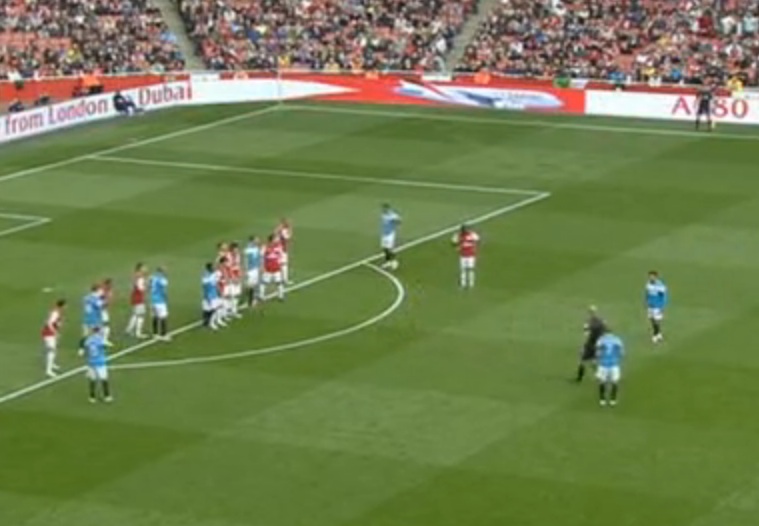
Late on in the match, Montenegro (white) were awarded a DFK and Referee Atkinson demonstrated the typical EPL standard of positioning during free kicks. Here it is:


Here is a previous example of this EPL type of positioning (see Webb Positioning).

From observation, the EPL standard of positioning during free kicks is not necessarily recognized or encouraged by FIFA or UEFA.

Note: It happens elsewhere too, for instance in the MLS (see here).

Friday, 11 November 2011

Violent Conduct by Thierry Henry

The following incident occurred during the MLS match between Sporting Kansas City and New York Red Bulls on Saturday 15 October 2011. The match finished 2—0.


In the 28', Referee Kevin Stott sent off New York Red Bulls Thierry Henry for violent conduct. Here are the freeze frames:


RED CARD: Thierry Henry sent off for foul (YouTube clip)


Instead of walking off the pitch, Henry protested his innocence to anyone who would listen but to no avail.

Considerations
1) What incident(s) led up to the act of violent conduct?
2) Could the offending player have avoided his actions?
3) Did the Referee have a good view of the act of violent conduct?


Conclusion
1) Immediately prior to the incident, New York Red Bulls' Thierry Henry became frustrated when challenged by a few opponents and eventually lost possession of the ball. This frustration boiled over when Henry saw the opportunity to mete out his emotions on an opponent who was on the ground (Roger Espinoza).

2) A good rule of thumb is for Referees to consider whether the offending player would perform the very same action toward his own team-mate. In such situations, the duty of care is with the player who is behind his opponent. It was quite possible for Henry to avoid running into the back of Espinoza but Henry chose not to and instead angled his knee toward Espinoza's back.

3) Referee Kevin Stott had a near and unobstructed view. There was no doubt in the Referee's mind that Henry's unsporting act was violent conduct.

Tuesday, 18 October 2011

Webb Positioning

The following incidents occurred during the English Premier League match between Arsenal and Sunderland on Sunday 16 October 2011. The match finished 2—1.

There are two incidents of positioning at ceremonial free kicks and one during free play.

Incident One: Webb's walk back

In the 30', a free kick is awarded to Sunderland (blue).

Webb whistles for restart at this point!
... and continues to walk blindly in between player and ball

Referee Howard Webb had his back to the ball at all times, which is not recommended because the attacking player can move the ball at anytime without the referee knowing. First, Webb walks forward towards the Arsenal (red) wall. Then he walks backward toward the Sunderland (blue) kicker. In doing so, Webb shows no concern or awareness of the Sunderland player (Larsson) who is about to take the free kick. He whistled for restart and then continued to walk backward and in between Larsson and the ball.

Webb then positions himself nearby and behind the ball.


Incident Two: Webb's wayward positioning

In the 82' minute, a free kick is awarded to Arsenal (red).


Referee Howard Webb again positions himself nearby and behind the ball.
Q: Is this the best place for him to see either a shot at goal or a cross into the penalty area?


Incident Three: Webb's central interference with play

In the 85' Referee Howard Webb gets caught up in the middle of the park and therefore interferes with Sunderland's possession and helps gift Arsenal an attacking opportunity.


All Webb can do is apologise to the Sunderland players.


Related

Avoid the Ampersand

Webb Scrutiny

Monday, 17 October 2011

Attwell Anticipation All Right

The following incidents occurred during the English Premier League match between Manchester United and Norwich on Saturday 1 October 2011. The match finished 2—0.

After some high profile blunders in the past couple of years (e.g. see here and Leading With Elbows Is Serious Foul Play), Referee Stuart Attwell appears to be feeling more at ease and established with his role as a Premiership Referee. This can be seen by his unorthodox and cheeky positioning at the second half kick off. Here are the freeze frames:

Attwell anticipates where the ball is going at kick off

Stuart Attwell displayed excellent anticipation at the kick off, and therefore put himself at the right place and at the right time. It would be interesting to know what his assessor said to him about this unorthodox, although, effective positioning at kick off.


For balance, in the first half Attwell should have been paying more attention to what is happening behind him. Here are the freeze frames:


Because Attwell is so focused on getting into position after an offside decision to Manchester United (red) he has forgotten to pay attention to the group of players behind him, and more importantly, to where the ball is. If something unexpected happens, such as the goalkeeper slipping and miskicking the ball, there is the danger of missing the subsequent play.

It would be better if Stuart Attwell can reduce the number of times he has to look over his shoulder. Overall, Attwell's anticipation has been very good.