Showing posts with label positioning. Show all posts

Wednesday, 29 April 2015

Rational Ref: McManaman tackle exposes flaws in retrospective action

McManaman tackle exposes flaws in retrospective action

FA's mishandling of Wigan player's challenge puts safety at risk, shows system needs review


Wigan's Callum McManaman horror tackle on Massadio Haidara. Pic Focus Images

The most horrible factor about the 2012-2013 season's worst challenge, by Callum McManaman of Wigan, is not the tackle itself, but the fact it has been surpassed by an even worse scenario: the FA's pathetic, retrospective review of the incident.

In incidents where a major injustice has occurred on the pitch and where match officials have, for whatever reasons, shown they have not properly dealt with the offence, taking retrospective action is a sensible process. It protects players, supports referees and safeguards the image of the game. It allows justice to be, and seen to be, done.

Unfortunately, the FA's challenge turned out to be a feeble sidestepping of the issue. The FA used a technicality to excuse itself from not taking retrospective action against 21-year-old McManaman for his awful tackle on Newcastle's 20-year-old defender Massadio Haidara.

It exposes serious flaws in the system and is not limited to England since all around the world, including Hong Kong, the retrospective review system is often ineffective. It doesn't successfully protect players, match officials or the image of the game. In hindsight, the retrospective review process needs to be reviewed itself, for justice's sake.

Here is the FA's statement on the McManaman incident: "Where one of the officials has seen a coming together of players, no retrospective action should be taken, regardless of whether he or she witnessed the full or particular nature of the challenge. This is to avoid the re-refereeing of incidents."

Referee Mark Halsey was honest enough to admit that he did not see the incident. Due to 51-year-old Halsey's poor positioning, his view of McManaman's challenge was blocked by another player. However, assistant referee Matthew Wilkes admitted seeing the "coming together" of the players and the FA has shamelessly used this as an excuse for not taking retrospective action against McManaman.

First, the claim that the FA wishes to avoid re-refereeing incidents is hypocritical. They do it often and they do it to undermine the credibility of match officials. For instance earlier this year, the FA rescinded referee Mike Dean's red card for Manchester City's Vincent Kompany. That is the very definition of re-refereeing.

Second, the FA's ignorance regarding the poor accuracy and credibility of the witness' view is embarrassing. Just because a linesman saw the incident does not mean he had a "good, near and clear view" to make a competent decision. In fact, the distance between the linesman and McManaman's challenge was at least 32 metres coupled to the reality that his main priorities lie elsewhere on the field. We know the linesman made a poor decision in assisting Halsey, so why not allow a retrospective review? If the FA is so willing to re-referee, say, Dean's perfectly clear and competent decision to send off Kompany, then why is it less enthused about re-refereeing the poor decision not to send off McManaman on the basis that the linesman vaguely saw the "coming together" of two players from a distance of over 35 yards?

Justice has not prevailed and the FA is seen to be hiding behind excuses. Newcastle, clearly outraged, officially announced the FA's disciplinary process to be "not fit for purpose" and have demanded a change in the rule that allowed McManaman to escape sanction.

If there is no perceived justice, then fans will be angry and jump at the chance to form their own kangaroo courts. Players, too, will sense the injustice and may take matters on themselves on the pitch.

In McManaman's case, he will be jeered in future matches particularly by Newcastle supporters and, as is the nature of the game, when he eventually falls victim to a nasty tackle, there inevitably will be those who will cheer and claim that it is "justice" served. No one deserves an injury or to be put at risk of danger, but because the public perception is that McManaman has escaped a previous sanction then these very real human feelings may come to the fore among some fans. Therefore, the FA urgently needs to demonstrate that its retrospective review system is "fit for purpose". As it stands, the FA's mishandling of McManaman's challenge has endangered player safety, left match officials out to dry and tarnished the image of the game.

In the modern professional era, on the pitch there are 22 millionaire mercenaries all trying to harass, hound and hoodwink a standard salaryman referee trying his utmost to be correct, impartial and consistent. Since video replays are unacceptable in a game, the post-match retrospective review is the second-best means available to sanction players, act as a deterrent to unsavoury behaviour and ultimately protect the image of the game.

However, competition organisers around the world are failing the game with their pathetic process of retrospective reviews.


PUBLISHED : Friday, 29 March, 2013


POST ARTICLE: Have things changed at the FA?

Tuesday, 25 June 2013

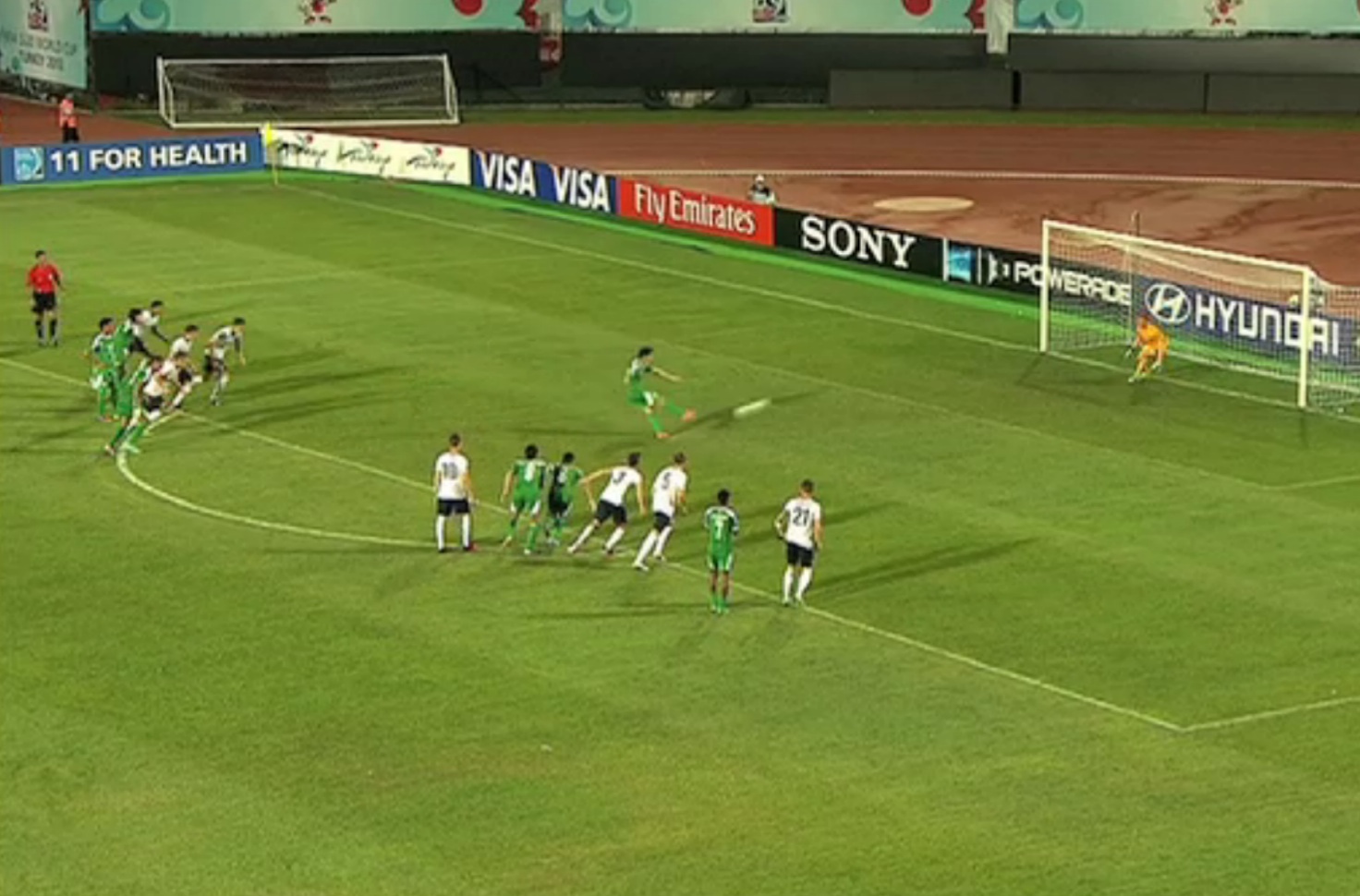
FIFA Guidelines For Referees: Positioning for a Penalty Kick

The following incident occurred during the FIFA U20 World Cup group match between England and Irag on 23 June 2013. The match finished 2—2, with 5 YCs.

In the 74', with the score at 2—0, Referee Roberto Garcia (Mexico) correctly awards a penalty to Iraq. Here is his correct positioning for the penalty kick.


Some of the comments from readers (who I assume are referees) for the recent post Positioning Guidelines for FIFA Referees reveal a surprising lack of basic knowledge of the LOTG.

Please consider why FIFA recommends Referees to stand approximately in this position for penalty kicks.

Next, consider why FIFA recommends Referees to stand in a different position for Kicks from the Penalty Mark.


FIFA Referees are supposed to have attained a certain standard of competency. Therefore, whenever inconsistencies are observed, the purpose of raising its awareness is so that the rest of us can learn from the mistakes of high-profile Referees (without, hopefully, performing the error ourselves).

We should also be concerned about why FIFA Referees are not consistent in their knowledge of the LOTG.
Who are the ones instructing the Referee instructors and assessing the Referee assessors?

The match officials were:
Referee: Roberto GARCIA (MEX)
Assistant Referee 1: Jose Luis CAMARGO (MEX)
Assistant Referee 2: Alberto MORIN (MEX)
Fourth official: Wilmar ROLDAN (COL)


Saturday, 18 May 2013

Great Assistance From AR

The following incident occurred during the Copa del Rey final between Real Madrid and Atletico Madrid on Friday 17 May 2013. The Spanish Cup Final finished 1—2 aet. There were 6(?)YCs, 2RCs and Real Madrid coach Jose Mourinho was sent from the technical area.

In the 114th minute, Atletico Madrid's Gabi (red 4) fouls Real Madrid's Cristiano Ronaldo (white 7) by kicking him from behind and taking his legs out. Ronaldo reacts by flicking his left leg at the face of his opponent (which we will label the second foul). Initially, the Referee saw the first foul (Gabi's foul on Ronaldo) and played advantage because Real Madrid still had possession of the ball. Here are the freeze frames:


Referee plays advantage following a foul on Ronaldo (white 7)
AR1 looks toward Referee, who did not see Ronaldo kicking his opponent, and therefore flagged

Video can also be seen here:
Red card to Cristiano Ronaldo (Daily Motion)

Notice that the Referee did not know anything about the violent conduct even as he walked up to Ronaldo, and had to get confirmation from AR1 before showing the red card … to Ronaldo's back! Here are the freeze frames:


Never show a card to a player's back

When the Referee played advantage, Atletico Madrid's Adrian (red 7) then immediately fouled Real Madrid's Sergio Ramos (white 4), again from behind. This was Atletico's game plan since they were now winning 1—2, and wanted to wind down the clock and stop their opponents from playing football. Of course Ronaldo had to go for violent conduct, but the match officials should have been acutely aware of the negative tactics from Atletico Madrid, especially in the time after Atletico had taken the lead with their second goal.

However, this third foul was missed by the match officials because AR1 had flagged the second foul after carefully watching the Referee. AR1 was correct in his actions in assisting the Referee. Unfortunately, a side effect of this is that it actually compounded the situation because as the Referee played advantage he was then distracted by his AR1's flag and therefore missed this third foul.

After the third foul, the two players clash heads (Adrian and Ramos headbutt each other) and Ramos falls back theatrically. However, this piece of the action is completely missed by the match officials because of all the commotion coming from the technical areas. Here are the freeze frames:


In the aftermath of Ronaldo's violent conduct, Atletico's Adrian (red 7) fouls Real's Ramos (white 4) from behind. The two players then clash heads.

The funny thing about these incidents is that players and coaches only want to focus on the one incident that they perceive to have gone against them. They ignore everything else … even the major incidents like violent conduct. Players and coaches are so biased toward their own team, that they miss the bigger picture and only want the match officials to see only the foul and misconduct that has gone against their own team. It is funny, laughable and all so very sad when viewed from the armchair.

For example, let's look at the discussion between Ramos and Adrian about the third foul. Ramos simply wanted Adrian to acknowledge that he had fouled him from behind (which is a true fact). Adrian acts all innocent (many guilty players know how to do this) and says he didn't think it was a foul. Ramos insists it was a foul and shows Adrian the back of his foot where Adrian kicked him. Adrian continues to play innocent. Here are the freeze frames:


Players are liars

Notice also during this whole time, Red 8 is hovering next to Ramos to distract him and to support his teammate Adrian. Red 8 then talks about Ronaldo's kick at his captain because, yes, that was an injustice done to his captain Gabi. But that's already been taken care of because the Referee had already shown the red card. It's actually very entertaining watching all this; millionaires acting like children and only wanting things to go their own way without thought about the bigger picture.

In summary, match officials can only do what they can do (which is based on what they can actually see). This means AR1 did a great job in identifying the violent conduct.
Perhaps the 4th Official could have spotted the third foul? Had the 4th Official seen that and assisted the Referee, then that would have been great too. As it is, for this incident, only AR1 comes out looking good.

For all that other stuff (i.e. spotting misconduct in the technical area), it should be the responsibility of the competition organizer to use video footage to identify the players retrospectively and fine them for their unsporting behavior.
From the video, we see Real Madrid's Kaka stopping Atletico coach Diego Simeone. Simeone pushes Kaka back but then Real Madrid's Pepe gets in Simeone's face. Pepe is then pushed away by an Atletico substitute, and another Atletico substitute (red 16, I think) swings a punch at Pepe.

Looking at the positions of the match officials (R, AR1 and 4O) during all the commotion, it is quite impossible for them to see all the incidents that are happening. It is ridiculous to expect match officials to see and record everything. And this is why competition organizers should use video evidence to take retrospective action … and support match officials.

The 4th Official (red jacket) is to the left of the screen and the R & AR1 (blue) are to the right

Do not blame match officials for not being able to see everything that happens in and around the pitch. Instead, competition organizers should be helping and assisting match officials so that correct disciplinary action is awarded correctly to the offenders. By working together (i.e. competition organizers supporting match officials), offenders will not escape punishment and therefore will always think twice about their behaviour if they understand that video evidence will always be used to take retrospective disciplinary action.

Competition organizers should acknowledge that match officials are human and therefore cannot see and report everything that occurs in and around the field of play. They should therefore send a clear message to players and coaches that unsporting behaviour will not be tolerated by supporting match officials and using video evidence to take retrospective action against offenders.


Monday, 18 March 2013

McManaman: Mistimed or Malicious Tackle?

The following incident occurred during the EPL match between Wigan Athletic and Newcastle United on Sunday 17 March 2013. The match finished 2—1; there were 2 YCs.

In the first half, Wigan forward Callum McManaman (blue) challenges for the ball against Newcastle's Massadio Haidara (yellow). Here are the dynamic frames (courtesy of The Telegraph):


Here is Referee Mark Halsey's position.
Apparently, Halsey did not (or could not) see the incident and actually stopped play moments later with a DFK to Newcastle for an infringement made by Wigan. It is hoped the FA will therefore take retrospective action against McManaman.


The pitch location of the incident means that both ARs were too far away (i.e. in excess of 30 yards) to attain a close view. There have been suggestions that AR2 Matthew Wilkes had a clear view (see here). However, this is likely to be incorrect. In addition, AR2 probably did not have a good angle of view.

AR2's View


The best angle of view (i.e. the X-Factor) is seen from this following dynamic frame:


Looking at this shocking challenge, I suspect there will be a diverse range of opinions.
In one corner, Wigan manager Roberto Martinez defends his 21-year-old player:
Remember it's Callum's full debut in the Premier League. I haven't seen the replay, I believe that he touches the ball and then it's a bad challenge, but it's nothing malicious, he's not that sort of boy.

I can't really comment too much because I haven't seen the action but I can guarantee that Callum McManaman is a young man full of talent and in his debut probably showed the enthusiasm that you expect, but he's not a malicious player.

In the other corner, ex-Referee Graham Poll believes it to be serious foul play:
[McManaman's] straight-legged lunge over the top of the ball, with his studs up, caused his opponent to be stretchered off.


So, was McManaman's shocking challenge mistimed or malicious !!??


Monday, 25 February 2013

EARs Ineffective Again

Once again Additional Assistant Referees, or EARs, have shown themselves up by their ineffectiveness.

The following incident occurred during the UCL Round of 16 first-leg match between Celtic and Juventus on Tuesday 12 February 2013. The match finished 0—3; there were 6YCs.

In the 3', the whole of the ball crossed the goal line between the posts and under the crossbar. Here are the freeze frames:


The goal was given to Juventus player Alessandro Matri (black 32) although it was not clear which match official actually saw the whole of the ball cross the goal line. The EAR did not give a signal, and media reports suggest it was the AR who made the call. However, it is not clear.

If the match officials are not 100% sure then they cannot give the goal. Perhaps in real time the true goalscorer was Juventus player Marchisio (8) who followed up and convincingly put the ball into the back of the net.

Former EPL referee Dermot Gallagher said:
"The problem for me is I don’t think there is any tangible evidence that they [EARs] do anything. But for a Juventus player [Marchisio (8)] following up a shot very, very quickly we could have had another Holocaust last night. I am convinced that the assistant and the guy on the goal line don’t know the ball is in."

HKRef is also convinced that the EAR and AR did not know the ball is in … although HKRef would not be so bold as to use the term "Holocaust" to describe such fallout incidents.

The match officials were:
Referee  Alberto Undiano Mallenco (ESP)
Assistant referees  Roberto Díaz Pérez del Palomar (ESP), Jesús Calvo Guadamuro (ESP)
Fourth official  Raúl Cabanero Martínez (ESP)
Additional assistant referees  Fernando Teixeira (ESP), César Muñiz (ESP)


Note: In this match, the amount of holding, pulling and blocking in and around the penalty area during corner kicks and free kicks was absurd. Remember, UEFA made the claim, without any real evidence, that the presence of EARs helps to reduce the amount of holding, pulling and blocking in and around the penalty area. How ridiculous. If match referees consistently do their jobs properly, then the amount of holding, pulling and blocking will drop because players would be afraid to give away penalties or free kicks at every corner kick.


Friday, 15 February 2013

One Stamp, Not Two, And You're Out

The following incident occurred during the UCL Round of 16 first-leg match between Valencia and Paris Saint Germain on Tuesday 12 February 2013. The match finished 1—2; there were 2YCs and 1RC.


Incident One: Offside? Foul? What?

In 72', Referee Paolo Tagliavento whistles for an infringement. Here are the freeze frames:


In some media accounts, it was an offside call (even from the commentary on the UEFA website, it stated offside). The way Referee Tagliavento walks over and positions himself indicates that he has called offside. However, this is far from certain because his arm signal is NOT straight up to indicate an IFK. It appears to be angled to indicate a DFK (and therefore, a foul). But if it was for a foul, the Referee's position to indicate restart is wayward.

This is soft-option officiating because there was a more important decision that the Referee did not call.

PSG striker Zlatan Ibrahimovic stamped on his opponent.
Incredibly, Valencia João Pereira (12) did not appear to be affected by the stamp and got up immediately because he was actually protesting the goal. From his perspective, he was the one who was fouled (and incidentally had played the ball forward, which meant technically PSG's Chantôme (20) was not offside). Here are the freeze frames:

How can Ibrahimovic (blue) play the ball forward?
Instead, it was a stamp ... a cynical stamp


No matter how we look at this incident, the actions of the Referee and his assistants do not appear competent or professional.


Incident Two: Stamp Number Two

In the 90'+2', PSG striker Ibrahimovic has been dispossessed of the ball and makes a lunge at an opponent. Here are the freeze frames:


The AR and EAR both have a good angle of view of the foul. Where is the Referee?


AR signals a foul. Where is the Referee?


AR takes action. Is the EAR effective and doing anything useful?


AR puts up his flag up using his right (why?) hand. Why the right hand? Where is the Referee?


At last here comes the Referee ...

Referee Tagliavento with the whistle in his mouth ... does not look very good!


AR did well to signal this serious foul play

That's two studs-up stamps missed by Referee Tagliavento. In the first incident, the match officials' actions did not look good. With the second incident, although the AR did a great job in assisting the Referee, the EAR is not visibly doing anything (except just standing there and staring) and the Referee is nowhere near the incident. The Referee was not near, and did not have a clear view of the incident. His credibility is low and the Referee further cuts down his credibility by keeping the whistle in his mouth as he approached and sanctioned Ibrahimovic. Very poor impression.


The match officials were:

Referee:  Paolo Tagliavento (ITA)
Assistant referees:  Mauro Tonolini (ITA), Lorenzo Manganelli (ITA)
Fourth official:  Riccardo Di Fiore (ITA)
Additional assistant referees:  Andrea De Marco (ITA), Antonio Damato (ITA)