Wednesday, 21 September 2011

AR Positioning and Tight Calls

Assistant Referees are expected to perform their duties diligently, especially because high precision is needed.

The following incidents from two EPL matches played on Sunday 18 September 2011— the first being Manchester United against Chelsea and the second being Fulham against Manchester City — demonstrate the fine line between making good calls and making poor decisions.


Two Tight Calls and Two Poor Decisions

The match between Manchester United against Chelsea finished 3—1. Here are the freeze frames of two incidents which each resulted in goals scored by Manchester United:

In the 8', Chris Smalling of Manchester United (red #12) scored Manchester United's first goal from an offside position (he is the offside player nearest the AR).


In the 37', Nani of Manchester United (red #17, player nearest the AR) scored the second goal from being in an offside position when the ball was flighted to him from United's defence.


Two Tight Calls and Two Good Decisions

The match between Fulham against Manchester City finished 2—2. City felt aggrieved in not getting all 3 points (because City's Dzeko was fouled moments before Fulham's Danny Murphy scored the equalizer in the 75'), however it could have been a lot worse for City if the AR had not had an excellent match to allow two really tight and perfectly legitimate goals to stand. Here are the freeze frames:


In the 18', Aguero of Manchester City (red/black #16) scored Manchester City's first goal. Although extremely tight, Aguero was not offside.

In the 45+1', Aguero of Manchester City scored City's second goal. Again, Aguero was not offside.


SUMMARY
In some ways, ARs are under more pressure than Referees because their performances are usually always judged by video review. Also having the crowd "on their back" (i.e. criticizing match officials in real time), plus the fact that the vast majority of spectators are not in the best position to precisely see the line, is a good test of the AR's mettle.

The incidents above demonstrate the fine line between making good calls and poor decisions. Granted, some luck is needed in extremely tight decisions but ARs can make their own good luck by first ensuring that they are in the right place at the right time. AR's need to be in the correct position in order to make good calls.

Note: Incidentally, an earlier Post about an EPL match in August means that Manchester United have now benefited from scoring at least 3 goals that should have been called offside. Sir Alex Ferguson of Manchester United has not complained about the poor officiating or poor ARs. However, as sure as the sun rises, later on in the season when tight offside calls go against Manchester United, we can be certain that there will be uproar and outrage aimed at the match officials.

Wednesday, 14 September 2011

Calculating Corner Flags

What a great game the Champions League group match between Barcelona and AC Milan was on Tuesday 13 September 2011. The match finished 2—2.

In the 19', one of the corner flagposts was knocked out of its position. When AR Mike Mullarkey reinserted the flagpost, it gave an opportunity to indirectly measure its height. The reason for this is because the corner flagposts in Camp Nou appeared to be rather short, particularly when viewed against tall professional football players.

AR Mike Mullarkey stands next to the corner flagpost

Based on available statistics, AR Mike Mullarkey is 1.78m tall. This means the calculation of the height of the corner flagpost comes to about 1.54m tall. This height exceeds the minimum required height by 4cm.
Note: this calculation is just an approximation, and it would be interesting if anyone can provide the exact measurements of the flagposts used at Camp Nou ... or whether Mike Mullarkey is 1.78m tall.


This post also gives an excuse to mention who the match officials were. They were:
Referee
Martin Atkinson (ENG)
Assistant referees
Michael Mullarkey (ENG), Peter Kirkup (ENG)
Fourth official
Michael Jones (ENG)
Additional assistant referees
Mark Clattenburg (ENG), Andre Marriner (ENG)

Looking at the high-profile names of the additional ARs (or EARs), this UEFA experiment highlights the complete waste of resources and inappropriate use of manpower in return for the supposed "benefit" of having EARs present in these matches.

Furthermore, based on the above list of 6 match officials, who would be the reserve Referee?

Tuesday, 13 September 2011

Poor Teamwork

The following incident occurred during the MLS match between NE Revolution and NY Red Bulls on Saturday 20 August 2011. The match finished 2—2.

In the 44', with NE Revolution leading 2—0, NY Red Bull attacker Dax McCarty (white) is through on goal. The Revolution goalkeeper (green) comes out, does not get the ball, and the NY Red Bull attacker goes down. This incident was a significant moment in the match because, had the penalty decision stood, then the Referee would have had to show his mettle and send off the goalkeeper for DOGSO. Here are the freeze frames:

Penalty … no penalty

Referee (Juan Guzman) whistles long and hard, runs into the penalty area and points to the penalty spot. By this time, AR (Fabio Tovar) has reached the corner flag, and stands to attention there. The Referee has begun to reach toward his left breast pocket but then the Referee stops and tells the players to wait. He goes over to the AR. After consulting with his AR, the Referee overturns his decision and cautions McCarty for simulation.

This is poor officiating and also gives the impression of weak refereeing. Decisions have to be made confidently, calmly and competently.

First, the Referee has made a decisive call (foul in the penalty area). Second, although he has made the decisive call, the Referee has not taken any steps towards giving sanctions. Third, this appearance of indecisiveness is further fueled by hearing a call from his AR, which means the Referee had to tell players to wait. Four, the Referee approaches the AR to confirm what he has been told over the comm system.

This is poor teamwork. The AR has undermined the Referee's authority and credibility. When the Referee whistled and signalled to the penalty spot, the AR had continued his run to the corner flag thus indicating that he was not at odds with the Referee's foul identification in the penalty area. If the AR had believed it was simulation by the attacker, the AR should have taken appropriate action instead of running towards the corner flag. Therefore, why did the AR overrule the Referee's decision so late?

This incident is very similar to the one made by Russian match officials in a Champions League match in December 2010. In that match, the AR undermined the authority and credibility of the Referee too.

Another factor for Referees to consider is to understand what would the attacking player have gained from attempting to deceive the Referee as opposed to the potential consequences in failing to deceive the Referee.

Successfully deceiving the Referee would mean a player gaining a penalty (which does not necessarily mean a goal will be scored) and getting the opposing goalkeeper sent off.
Unsuccessfully deceiving Referee means losing out on scoring a goal in a one-on-one situation and getting cautioned.
All this should be weighed against the attacking player successfully rounding the goalkeeper and scoring a goal to take the match to 2—1 going into the halftime break.

That is, would the attacking player jeopardize the likelihood of scoring a goal in a one-on-one situation with the goalkeeper, which would have helped haul his side from being two goals down to 2—1, all for the risk in attempting to gain a penalty and getting the goalkeeper sent off just before the halftime break?

Granted, Referees will not realistically be calculating (all) the odds over in their minds during the heat of the match. But this thought experiment can be taken as a useful reflective exercise and also helps us to understand why, in this instance, there was poor decision-making and poor teamwork by the match officials.

Thursday, 8 September 2011

Ceremonial Free Kick Considerations

The following incidents occurred during the MLS match between LA Galaxy and FC Dallas on Saturday 6 August 2011. The match finished 3—1.


Incident One: Ceremonial FK 1

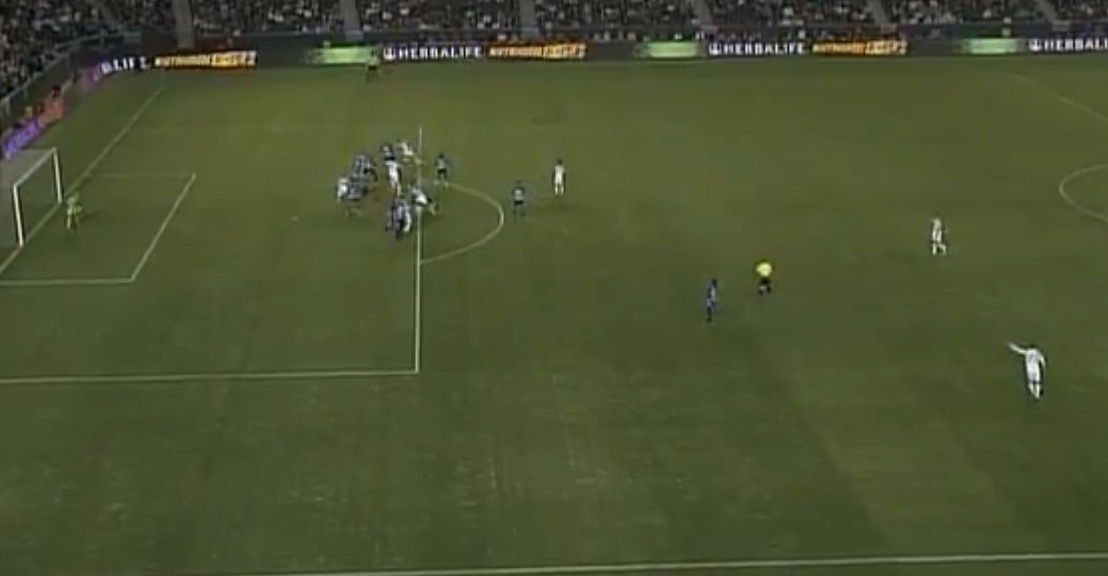
In the 32' the Referee whistles and then, just as the ball is about to be kicked by Galaxy's David Beckham, he runs across the likely path of the ball towards the middle of the pitch. Here are the freeze frames:

It is not a good idea to run across the path of the ball

A goal results from the free kick. Where is the Referee?

Another camera view

Yet another camera view

The Referee appears to be about 30 yards away from where the ball lands (i.e. in the goal area).

CONSIDERATIONS
Where is the ball likely to go?
Where should the Referee go to get the best view?


Incident Two: Ceremonial FK 2

In the 60', play is moving towards the AR's corner. The Referee remains central. Ultimately, the ball and various players end up in the corner of the pitch nearest the AR. Here are the freeze frames:

Play moves towards the corner flag

At 60:03, the Referee whistles and a foul is awarded to the attacking team LA Galaxy (white)

There is a delay in restart and the AR, by making his presence known, does a good job in preventing a potential pushing and shoving contest which could have got out of control

At 60:14, the Referee finally arrives on the scene
(this is at least 11 seconds after the whistle has been blown for a free kick to LA Galaxy)


At 61:05, the Referee eventually whistles for restart and David Beckham takes the free kick
(this is 51 seconds after the Referee arrived at the scene of the incident, and 62 seconds after first whistling for the free kick)


CONSIDERATION
The setting up of the wall in this MLS match took twice as long as Dowd's Doodle or Dowd's Dawdle that occurred recently in the EPL

Could anything have been done by the match officials to prevent any delay in the restart of play?


SUMMARY
For Ceremonial Free Kicks, the Referee's positioning and timing are important considerations. In this MLS match, the Referee's positioning (Incident One) and time to restart the match (Incident Two) appeared rather strange.

The match Referee was Michael Kennedy, an experienced MLS Referee and the current presenter of US Soccer's Referee Week in Review.

Friday, 2 September 2011

Passing on the Backpass Rule

The following incidents occurred during the EPL match between Liverpool and Bolton on Saturday 27 August 2011. The match finished 3—1.


Incident One: Handball outside Penalty Area

In the 44th minute, with Liverpool leading 1—0, Bolton's Gretar Rafn Steinsson (white #2) deliberately handled the ball.


Obviously, Liverpool players claimed it was inside the penalty area and wanted a penalty. Referee Probert had a clear and unobstructed view to make his call. It was a great call.


Incident Two: Foul inside Penalty Area

In the 47th minute with Liverpool leading 1—0, Bolton's Zat Knight used his hand to bring down Liverpool's Luis Suarez in the penalty area.

If Referee Lee Probert did not believe it was a penalty, should he have cautioned Suarez for simulation?

Zat Knight gives a cheeky smile when he realizes he got away with his sneaky swipe on Luis Suarez

The fact that Referee Probert did nothing, especially since Suarez was claiming a penalty, demonstrates poor officiating.


Incident Three: Backpass

In the 74th minute with Liverpool leading 3—0, Bolton's Paul Robinson kicks the ball back to his goalkeeper Jussi Jaaskelainen, who handles the ball.

Bolton defender Robinson (white) deliberately kicks the ball back to his goalkeeper (orange)

Again, the fact that Referee Probert did nothing demonstrates poor officiating.


SUMMARY

If a Referee sees an incident and incorrectly interprets the Law (e.g. Mike Jones and the Beach Ball incident), then that is considered a major blunder.

Lee Probert saw a Bolton defender kick the ball, deliberately, to his goalkeeper, who then handled the ball (Incident Three). But Lee Probert did not consider this to be a backpass. It will be interesting to know what Probert's response is to the match assessor about this incident (just as it would be interesting to know what Mike Jones' response was to the Beach Ball incident). Unfortunately, it is unlikely these responses will ever be made public.

In addition, Referee Probert saw an incident in the penalty area (Incident Two) but did not do anything. This again shows an incorrect interpretation of the Law.

So, did Lee Probert have a good game?

According to ex-EPL Referee Graham Poll:
"Probert was excellent in refereeing Liverpool’s win over Bolton. There was a borderline handball by Steinsson right on the edge of the penalty area. Probert was perfectly positioned to see that the offence was just outside – a great call."

In isolation, yes Incident One was a great call. But in the context of the match, did Probert get the big calls right? Did Probert interpret the Laws correctly? Incidents Two and Three showed that Probert performed unsatisfactory, particularly because he is a professional referee who sets the benchmark for the rest of us.