The following incident occurred in the 31st minute of the UEFA Champions League semifinal first-leg match between Tottenham Hotspur and Ajax on Tuesday 30 April 2019.
From a direct free kick, two attacking players from Tottenham (white 4 and 5) both come together with Ajax goalkeeper (blue 24). Jan Vertonghen's face (white 5) smashes into the back of Toby Alderweireld's head (white 4), leaving Vertonghen lying on the ground in an awkward position. Blood pours from a cut on his nose.
Question 1: At the free kick restart, is Vertonghen in an offside position?
Question 2a: Who is challenging for the ball?
Question 2b: Who is interfering with play?
This is a difficult incident to assess, discuss and manage because first, some will claim Alderweireld was onside and had every right to challenge for the ball. Second, others will also add that in situations where there is a mix of onside and offside players, ARs must wait to see who touches the ball.
Third, UEFA, as the competition organizer, plus the Head of Referees have GUIDELINES instructing ARs to KEEP THEIR FLAGS DOWN in offside situations
or tight offside situations until either a goal is scored, a penalty
kick is awarded or the ball goes out of play. The reasoning for this guideline is simple: since there is now video
technology, match officials can allow the game to flow until there is a
convenient break in the game to allow a review.
However, it is this reasoning (to allow the game to flow and to be an entertaining spectacle) where it can be argued that UEFA and the Head of Referees must take responsibility for this collision and ALL OTHER collisions where their instructions have downgraded the safety of players.
The VAR guidelines ignore players safety because, as in Vertonghen's case, an offside player is allowed to challenge and potentially collide with opposition players (and even their own teammates). Essentially, ARs who keep their flags down on offside players are permitting a potential collision between charging attacking players and onrushing defending players or goalkeepers.
The question is, are the current VAR guidelines a good thing or not?
Showing posts with label Champions League. Show all posts
Thursday, 2 May 2019
Sunday, 10 May 2015
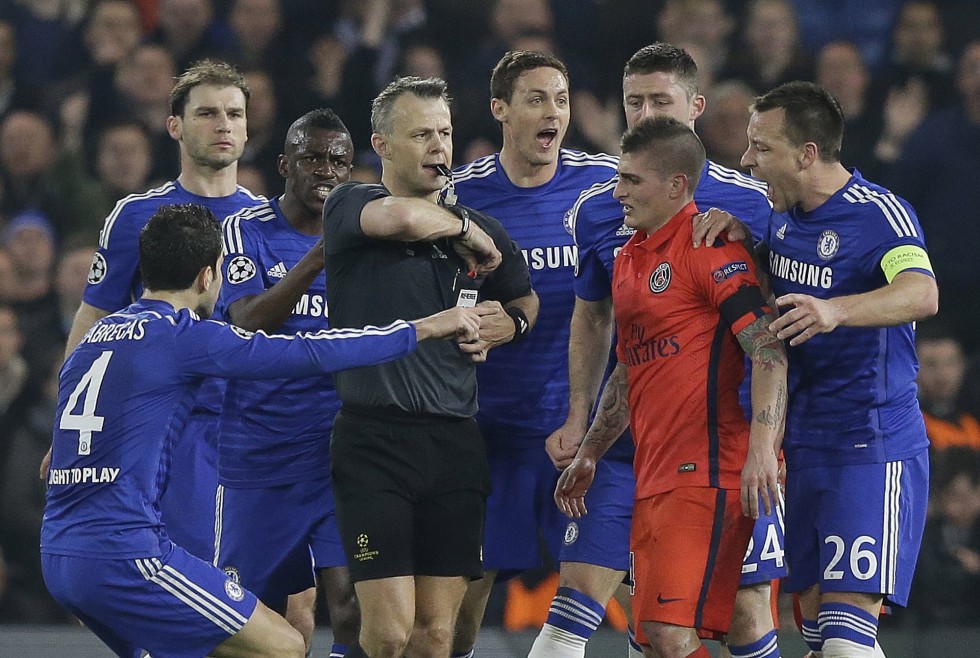
Rational Ref: Chelsea's masters of the dark arts highlight a win-at-all-costs mentality
Chelsea's masters of the dark arts highlight a win-at-all-costs mentality
Chelsea's siege on Kuipers shows intimidation and bullying are acceptable in quest for glory
In
sport what is more important: playing the game or playing games?
Nowhere else but in soccer is this distinction more apparent, with
plenty of cheating and gamesmanship instead of genuine sportsmanship and
model behaviour.
Chelsea's siege on Dutch referee Bjorn Kuipers during their Champions League exit to Paris Saint-Germain last week comes as no huge surprise. It is simply the logical consequence of the ugly, unethical and underhanded approach that has been allowed to fester and flourish to alarming levels.
The dark arts—comprising cheating, provocation, intimidation,
faking injury and childish behaviour—is now so endemic it is
considered the main source of entertainment, with media reports barely
touching on the final score and team performances.
In one camp, John Terry, Jose Mourinho, Gary Neville and others believe the dark arts are entirely acceptable, whereas the likes of Graeme Souness, Jamie Carragher and most referees prefer a cleaner, honest and straightforward approach. Spectators will probably support whichever camp so long as it benefits their favourite team.
Zlatan
Ibrahimovic gestures to the referee after a tackle on Chelsea
midfielder Oscar, who appeared badly hurt, but was on his feet moments
after a red card was issued. Photo: AFP
Chelsea captain Terry defended his hounding of referees, saying: "Every other side is as bad as each other."
"It's part of the game. Once they're charging the ref, the only thing we can do is respond. You can't as a group of players let them surround the ref, trying to get our players booked. Once I go [to influence the referee], four or five go with me. It doesn't look good, but that's part of the game."
Mourinho, obviously, backs his captain since he instils this kind of attitude in all the teams he has coached. As a manager, he upholds his reputation as the master of dark arts, with eye gouging a particular speciality.
In contrast, Souness labelled Chelsea players "pathetic" for their antics. Souness, who cemented his reputation at Liverpool as a tough but honest player, harks back to the old-fashioned era when sportsmanship and camaraderie took priority over rivalry and winning at all costs.
However, in the modern era of professional athletes and ludicrous salaries, the game's values have become ridiculously warped.
When Oscar was apparently seriously injured in his clash with Zlatan Ibrahimovic, notice how none of the Chelsea players showed any genuine concern to the well-being of their Brazilian teammate.
Not one of them went to see how Oscar was because they were all focused on pressuring the referee. Oscar was exaggerating the seriousness of his injury and as soon as Ibrahimovic was sent off, he was back on his feet as if nothing had happened.
Suppose you and a friend are involved in a car crash with another driver, what would be the natural reaction? Would you be jumping and screaming at the traffic policeman to reprimand the driver causing the accident or would you be more concerned about your friend?
Chelsea manager Jose Mourinho, a 'master of the dark arts'? Photo: AP
Chelsea's behaviour reveals the sad, twisted values that have taken over the game, where gaining a favourable decision is more important than the safety of teammates and fellow professionals.
In a match I refereed recently, two players jumped up for the ball and collided in a fair challenge, with one player apparently coming off worse for wear. Because he screamed loudly and made a big fuss about having an injury to his face, I whistled to stop play so he could be checked.
When I told him there was no foul, he became even more animated and miraculously forgot about his so-called "injury".
As a referee, I was more concerned about his safety. However, this player was all about getting a free kick for himself and a card for his opponent.
Liverpool captain Steven Gerrard summed up the game's warped value
systems by saying: "I think it's normal when you play games at that
level. Players and managers want to win so much - players will try every
trick in the book to try to get over the line and win matches.
"We've all been guilty of it throughout our careers by not always abiding by the rules."
The only way to appreciate this sentiment is that if we have all been taught to value only the destination and not to care about the journey in the "beautiful" game.
Chelsea's siege on Dutch referee Bjorn Kuipers during their Champions League exit to Paris Saint-Germain last week comes as no huge surprise. It is simply the logical consequence of the ugly, unethical and underhanded approach that has been allowed to fester and flourish to alarming levels.
In one camp, John Terry, Jose Mourinho, Gary Neville and others believe the dark arts are entirely acceptable, whereas the likes of Graeme Souness, Jamie Carragher and most referees prefer a cleaner, honest and straightforward approach. Spectators will probably support whichever camp so long as it benefits their favourite team.
Zlatan
Ibrahimovic gestures to the referee after a tackle on Chelsea
midfielder Oscar, who appeared badly hurt, but was on his feet moments
after a red card was issued. Photo: AFP Chelsea captain Terry defended his hounding of referees, saying: "Every other side is as bad as each other."
"It's part of the game. Once they're charging the ref, the only thing we can do is respond. You can't as a group of players let them surround the ref, trying to get our players booked. Once I go [to influence the referee], four or five go with me. It doesn't look good, but that's part of the game."
Mourinho, obviously, backs his captain since he instils this kind of attitude in all the teams he has coached. As a manager, he upholds his reputation as the master of dark arts, with eye gouging a particular speciality.
In contrast, Souness labelled Chelsea players "pathetic" for their antics. Souness, who cemented his reputation at Liverpool as a tough but honest player, harks back to the old-fashioned era when sportsmanship and camaraderie took priority over rivalry and winning at all costs.
However, in the modern era of professional athletes and ludicrous salaries, the game's values have become ridiculously warped.
When Oscar was apparently seriously injured in his clash with Zlatan Ibrahimovic, notice how none of the Chelsea players showed any genuine concern to the well-being of their Brazilian teammate.
Not one of them went to see how Oscar was because they were all focused on pressuring the referee. Oscar was exaggerating the seriousness of his injury and as soon as Ibrahimovic was sent off, he was back on his feet as if nothing had happened.
Suppose you and a friend are involved in a car crash with another driver, what would be the natural reaction? Would you be jumping and screaming at the traffic policeman to reprimand the driver causing the accident or would you be more concerned about your friend?
Chelsea manager Jose Mourinho, a 'master of the dark arts'? Photo: APChelsea's behaviour reveals the sad, twisted values that have taken over the game, where gaining a favourable decision is more important than the safety of teammates and fellow professionals.
In a match I refereed recently, two players jumped up for the ball and collided in a fair challenge, with one player apparently coming off worse for wear. Because he screamed loudly and made a big fuss about having an injury to his face, I whistled to stop play so he could be checked.
When I told him there was no foul, he became even more animated and miraculously forgot about his so-called "injury".
As a referee, I was more concerned about his safety. However, this player was all about getting a free kick for himself and a card for his opponent.
"We've all been guilty of it throughout our careers by not always abiding by the rules."
The only way to appreciate this sentiment is that if we have all been taught to value only the destination and not to care about the journey in the "beautiful" game.
This article appeared in the South China Morning Post print edition as Masters of dark arts cast aside integrity
PUBLISHED : Thursday, 19 March, 2015
Sunday, 12 April 2015
Rational Ref: Professionals must remember only the ref can stop a match
Professionals must remember only the ref can stop a match
Professionals need to remember that only the referee can stop a match, even when a player goes down injured
Whatever happened to "play to the whistle"? By taking matters into their own hands and stopping play, players are only putting themselves in the dock, on the block, and up the proverbial garden path.
When a player apparently suffers an injury during play, referees are the only ones who have the authority to decide whether or not to stop a match. Players ignore this at their peril.
Tuesday's (20 November 2012) controversial goal by Shakhtar Donetsk against Nordsjaelland in the Champions League is a prime example. When a Nordsjaelland player went down injured, players voluntarily stopped play in the middle of the park. After the player had been taken off the pitch to receive treatment, the referee restarted play with a drop ball. It was uncontested and Shakhtar Donetsk midfielder Willian gently booted the ball back to his opponents' half. However, Willian's teammate, Brazilian Luiz Adriano, apparently did not realise a sporting gesture was being played out, and so ran on to the "pass" to the amazement of the static Nordsjaelland defenders, rounded the dismayed goalkeeper, and promptly scored.
Uefa has now charged Adriano with unsporting behaviour and he has been suspended for their next Champions League match (for "violation of the principles of conduct").
There are many levels of inquiry here, and one easy solution. First, in return for what most people perceive to be an unsporting goal, why did the Shakhtar Donetsk defenders refuse to allow their opponents a walk-in goal immediately after that misunderstanding?
"Half their team seemed to think [it would be fair], but the other half didn't," Nordsjaelland captain Nicolai Stokholm said. At that moment, Shakhtar Donetsk had no leader to tell the whole team what they should do. This would explain the team's mixed stance.
It also explains how seriously some players take their profession, with many having differing interpretations of how sporting behaviour fits into the game, if at all.
Second, why was Adriano seemingly unrepentant about his actions? "It was instinct, I see the ball and I dribbled and I scored a goal," he said. Adriano is basically saying a professional soccer player is supposed to win matches. Does this mindset override sporting gestures such as stopping play for an injured opponent?
Third, why did players stop play in first place? How did they know the player was injured and not faking injury? Are players trained in medical triage? With all these risks, why would professional players compromise themselves by taking up the referee's responsibility? It's not simply a matter of being sporting, since stopping play can also be trying to gain "brownie points" in the public eye.
And, why did the players not kick the ball out of play? They just stopped and looked around aimlessly, which reveals they really did not know what to do and were probably seeking guidance. Therefore, they should always "play to the whistle".
Players stopping play first came to prominence at the 1986 World Cup in Mexico, when Belgium played Spain in the quarter-finals. Even in the baking summer heat, and having to play extra time, whenever a player from any team went down his opponents would refuse to take advantage, and instead opted to kick the ball out of play. This was genuine and sincere "fair play".
But things have moved on since then, most notably professionalism and monetary rewards have brought increased cynicism and gamesmanship to the modern game.
This is why it is important to let one person, the match referee, decide whether or not to call a halt when a player is apparently injured. Referees will stop play only if, in their opinion, a player is seriously injured. A serious injury is something of the magnitude of a broken limb. However, judging by many players' reactions, it would seem a little knock or slap is plenty enough to stop a match.
At the amateur and parks level, stopping the game works beautifully for almost any injury, either real or apparent. But at the competitive and professional level, it is best left to the man in the middle to decide whether or not to stop play. This prevents players from duping opponents.
Remember the 2010 World Cup final between the Netherlands and Spain? No love was lost in this ultimately competitive match. With Spain eventually taking a 1-0 lead during extra-time, the Netherlands were frantically trying to find the equalizer. In the 120th minute, Spain's Fernando Torres pulled up apparently with a hamstring injury. The sporting thing to do would have been to kick the ball out of play. History shows the Netherlands did not give a fig about sportsmanship, as they continued to attack Spain's goal.
This week's lesson: At the professional level, sportsmanship is for suckers.
This article appeared in the South China Morning Post print edition as At the very top, only losers are sporting
PUBLISHED : Friday, 23 November, 2012
Monday, 9 March 2015
Rational Ref: Where do we draw the line on persistent fouling?
Where do we draw the line on persistent fouling?
Talented players will always be a target for 'special' treatment, but when must it be stopped?
What's the best way to stop Eden from passing you by? Hazard a guess? Several kicks ought to do it.
Eden Hazard is the most fouled player in the English Premier League this season. The Chelsea star was on the receiving end of some "special" treatment in last week's Champions League encounter with Paris Saint-Germain, when he was fouled nine times in a match where the referee issued only two cautions.
Everyone knows a team's best attacking player is both a godsend and a liability. Such a player can turn a match in a heartbeat, but if he is repeatedly targeted and injured, the team will struggle with other options.
Specifically targeting an opponent is all part of the game and the rules are there to help referees discipline offending players for persistent fouls. Persistent infringements are repeated offences by one player on several others and also by several players on one opponent. Since there is no defined frequency on what is persistent, it depends on the referee's judgment to determine when enough is enough.
Is nine times enough, or five or two? Every player and coach has their own opinion. For instance, when a substitute enters the pitch, immediately fouls an opponent with a careless trip and gets cautioned, the referee is criticised for giving a card for the player's "first foul".
Eden Hazard has come in for some rough treatment this season. Photo: AFPOthers may also be puzzled by the yellow card for an innocuous foul.
However, what players, coaches and spectators often fail to realise is the referee has recognised that the team as a whole has repeatedly fouled an opponent and has therefore correctly penalised one player as a warning to his teammates.
Experienced referees are alert to the time-old tactic that players like Hazard — who Chelsea manager Jose Mourinho has compared favourably to Lionel Messi and Cristiano Ronaldo — will always receive more than their fair share of special attention from the opposing team.
Even Mourinho has admitted he instructs his players to target talented opponents.
Messi is also pure, preferring to ride through challenges and letting the referee or competition organiser deal with errant players.
In contrast, Ronaldo has a quick temper and when challenged will prefer to go down easily. Earlier this year the Real Madrid star kicked out and slapped Cordoba's Edimar Fraga after enduring some special attention in a La Liga match. He was sent off and banned for two matches.
Real
Madrid's Cristiano Ronaldo (left) hit out at Cordoba's Edimar Fraga
after some rough treatment during their La Liga match in January and
received a two-match ban. Photo: ReutersChelsea's Nemanja Matic has a similar temperament. Last weekend against Burnley he was on the receiving end of a horrendous tackle by Ashley Barnes. Referee Martin Atkinson did not have the best angle to see the incident and did not whistle for a foul.
But Matic reacted angrily by violently pushing Barnes to the ground, leaving Atkinson with no choice but to show him a red card.
Mourinho, forgetting that the foundation of his managerial career is based on using loyal but limited players in similar hard-grafting roles, blasted Barnes saying: "The player, if I can call him a player, should have been in the shower in minute 31."
In these modern times, even if the referee does not see a sending-off incident, the FA supposedly has a process to be able to take retrospective action. It depends on whether the FA has the will and wherewithal to help protect the safety of players and referees alike, as well as to uphold the image of the game.
Ashley
Barnes' horror challenge, and Nemanja Matic was red-carded for his
retaliation during Chelsea's draw with Burnley last weekend. Photo:
ReutersThis also does not excuse Matic and Mourinho for their reactions. Players taking the law into their own hands and managers, who have the benefit of video replays criticising referees for making honest mistakes, are revealing the egotistical nature of the individuals involved.
If only there could be a way to stop, or at least minimise, this obstinate behaviour. On the pitch, referees have rules to help tackle persistent infringements. Off the pitch, competition organisers should similarly apply the rules and discipline all persistent offenders, thus allowing everyone to focus on playing ball without the media circus.
Agree or disagree? Contact Rational Ref at rationalref@gmail.com
This article appeared in the South China Morning Post print edition as Drawing the line on persistent fouls
PUBLISHED : Thursday, 26 February 2015
UPDATE
The statistics show Eden Hazard "wins" a yellow card for every 11 fouls against him, compared with Arsenal's Alexis Sanchez "winning" a card for every 6 fouls (see Why Eden Hazard Really Does Need More Protection From Referees).
Wednesday, 18 February 2015
Rational Ref: Humble coin toss a match-fixer's dream
Humble coin toss will confound fight against football graft
Seemingly
simple flip of a disc will confound those battling graft in football,
since there are no rules on how refs must conduct it
How much is a coin toss worth? Can foolishly faking a frivolous flip and flick of a thin metallic disc prove financially tempting? You bet. Five years ago, the going rate was 100,000 yuan (US$16,000).
This was the amount Chinese referee Huang Junjie accepted from fellow referee Zhou Weixin to rig the coin toss between Manchester United and FC Shenzhen in 2007. Huang fixed the flip to ensure Shenzhen kicked off the match in Macau.
Huang and Zhou admitted this in court when they became the first referees to face trial in December 2011, following a two-year crackdown on soccer corruption in China. Soon after, Lu Jun, a former World Cup referee, stood trial. Lu was previously considered China's most respected referee, nicknamed the "golden whistle" for his impartiality.
Lu was found guilty of accepting 350,000 yuan for fixing a match in 2003 and subsequently received a five-and-a-half year jail sentence. In an instant, China's golden match official joined the ranks of corrupt referees on the mainland, who are dubbed "black whistles". These infamous black whistles also received life bans.
In recent weeks, major organisations have declared match-fixing to be widespread. A report by Europol revealed about 700 matches worldwide, including Champions League ties and World Cup qualifiers, were suspected of having been fixed.
And last week, Interpol met with Fifa officials at a conference in Kuala Lumpur jointly hosted by the Asian Football Confederation to set tougher laws in the battle against criminal syndicates suspected of match-fixing.
The AFC announced it had established a task force that would collaborate with all stakeholders and educate member associations on ways to tackle match-fixing in Asia.
Rational Ref is keen to see what kind of role, and support, match officials will be given in this initiative to combat suspect practices. Take, for example, the rigging of the seemingly straightforward coin toss.
The tradition of the coin toss is based on Western culture. Observe most Western referees and they will place the coin on top of their thumb and forefinger to flick the coin up in the air. The coin will twist and twirl in a blur and then be caught in the same hand that flipped it. Without looking at the coin and in one smooth movement, the coin is slapped onto the back of the other hand and then revealed.
This is the standard protocol of the coin toss, providing you are British, Australian, Canadian or American. Last Tuesday night, Australian referee Chris Beath performed the standard coin toss as expected during the AFC Cup match between Kitchee and Churchill Brothers from India.
But watch referees from continental Europe, Asia or South America, and the coin toss action varies considerably. Some cannot flip the coin using their thumbs, some catch the coin with both hands, some catch and reveal using only one hand, some let the coin land on an open palm, and others will let the coin fall to the ground after throwing the coin up without imparting any spin. Some referees are just clumsy and fumble the coin toss.
Furthermore, the rulebook assumes all referees know how to flip a coin. It states: "a coin is tossed and the team that wins the toss decides which goal it will attack and the other team takes the kick-off".
Since there is no accepted coin toss protocol, criminal syndicates have benefited. For instance, what's to prevent referees from catching the coin in an open palm, seeing the result and then deciding whether or not to slap it over on the other hand, depending on the desired outcome? There have been occasions where Chinese referees catch the coin in the open palm, with the wrist slap being optional.
Details are unknown about the infamous coin toss at the Manchester United versus FC Shenzhen match. If the referee did not rig the actual toss, he could have easily used another suspect method.
Hypothetically, the referee, having gone through the motions of the coin toss, could quickly look at the result and declare Manchester United would choose ends, thus leaving FC Shenzhen to kick off, which was the prearranged outcome.
Any visiting player to China, such as 33-year-old Ryan Giggs five seasons ago, could easily dismiss this as a cultural peculiarity and in any case would just want to get the match started without fuss. In hindsight, we know it was an easy 100,000 yuan for a black whistle to make.
Hence, this simple example of a corrupt coin toss is just the tip of the iceberg for AFC's new task force.
Rational Ref reckons referees on the right side of the law can assist the task force in its fight against match-fixing. After all, referees are whistleblowers.
This article appeared in the South China Morning Post print edition as Humble coin toss a match-fixer's dream
PUBLISHED : Friday, 01 March, 2013
Labels:
AFC,
AFC Champions League,
Asia,
Champions League,
China,
corruption,
FIFA
Tuesday, 30 April 2013
EARs Do Not See … or Hear … or Assist!
There is a dedicated Referees' Blog called The Third Team which produces excellent insight, great comments and useful assessment reports that can help any match official improve themselves. I thoroughly recommend The Third Team.
One example from The Third Team is an excellent analysis regarding Referee Victor Kassai's handling of the Bayern Munich and Barcelona Champions League semifinal first-leg match on Wednesday 24 April 2013. The match finished 4—0; there were 7 YCs.
HKRef would just like to highlight the incident leading up to Bayern Munich's third goal in the 73'. Here are the freeze frames:
Let's look at the Additional Assistant Referee or EAR (blue). During the play, what is he looking at?
The Additional Assistant Referee (or EAR) is simply ball-watching. He does not appear to take in the overall event that is developing in front of him. Only when Barcelona's Jordi Alba hits the ground does EAR1 turn his head quickly to glance back before following the ball again.
This is yet another example—to add to many others accumulated from nearly 1,000 matches (e.g. here, here and here)—that demonstrate the ineffectiveness of EARs. Players secretly laugh at UEFA's claim that the presence of extra match officials act as a deterrent to unsporting behaviour in and around the penalty area.
This blog's central thesis about EARs is:
Central Thesis
I feel sorry for Pierluigi Collina, chief refereeing officer at UEFA, having the task of promoting the use of EARs simply because his boss Michel Platini insists on using extra match officials. The use of EARs (and goal-line technology) is more a political agenda amongst those in the upper echelons of power, rather than a genuine attempt to really help match officials.
Ultimately, match officials require clear, consistent and credible support from competition organizers (e.g. taking effective retrospective action to punish players and clubs for unsporting behaviour) so that all players and clubs will eventually think twice before deciding to deceive Referees. If UEFA, FIFA and other competition organizers fully support Referees, and are seen to fully support Referees, by being willing to take retrospective action then in general players and clubs will automatically behave themselves and there will be more Respect for Match Officials. It is that simple.
The match officials were:
Referee Viktor Kassai (HUN)
Assistant referees Robert Kispal (HUN), Gabor Erös (HUN)
Fourth official György Ring (HUN)
Additional assistant referees Tamás Bognar (HUN), Mihaly Fabian (HUN)
NOTE
Although this blog is highly critical of the use of EARs, HKRef has thought about situations where EARs may indeed prove useful. Take a look at this analysis where EARs May Be Useful.
One example from The Third Team is an excellent analysis regarding Referee Victor Kassai's handling of the Bayern Munich and Barcelona Champions League semifinal first-leg match on Wednesday 24 April 2013. The match finished 4—0; there were 7 YCs.
HKRef would just like to highlight the incident leading up to Bayern Munich's third goal in the 73'. Here are the freeze frames:
Arjen Robben (red 10) scores Bayern Munich's third goal
Let's look at the Additional Assistant Referee or EAR (blue). During the play, what is he looking at?
Thomas Muller (red 25) deliberately bodychecks Jordi Alba (blue 18) who was focused on chasing Robben (red 10)
The Additional Assistant Referee (or EAR) is simply ball-watching. He does not appear to take in the overall event that is developing in front of him. Only when Barcelona's Jordi Alba hits the ground does EAR1 turn his head quickly to glance back before following the ball again.
This is yet another example—to add to many others accumulated from nearly 1,000 matches (e.g. here, here and here)—that demonstrate the ineffectiveness of EARs. Players secretly laugh at UEFA's claim that the presence of extra match officials act as a deterrent to unsporting behaviour in and around the penalty area.
This blog's central thesis about EARs is:
Central Thesis
My main argument is not the fact that EARs are ineffective and redundant (which, in many incidents, they are ) or that EARs do not help or enhance the game. It is worse than that and much more serious.
My main argument is the fact that EARs can have a detrimental effect on the performance of the match Referee and hence can contribute to ruining the game since match officials will be perceived to be making more, instead of less, errors.
I feel sorry for Pierluigi Collina, chief refereeing officer at UEFA, having the task of promoting the use of EARs simply because his boss Michel Platini insists on using extra match officials. The use of EARs (and goal-line technology) is more a political agenda amongst those in the upper echelons of power, rather than a genuine attempt to really help match officials.
Ultimately, match officials require clear, consistent and credible support from competition organizers (e.g. taking effective retrospective action to punish players and clubs for unsporting behaviour) so that all players and clubs will eventually think twice before deciding to deceive Referees. If UEFA, FIFA and other competition organizers fully support Referees, and are seen to fully support Referees, by being willing to take retrospective action then in general players and clubs will automatically behave themselves and there will be more Respect for Match Officials. It is that simple.
The match officials were:
Referee Viktor Kassai (HUN)
Assistant referees Robert Kispal (HUN), Gabor Erös (HUN)
Fourth official György Ring (HUN)
Additional assistant referees Tamás Bognar (HUN), Mihaly Fabian (HUN)
NOTE
Although this blog is highly critical of the use of EARs, HKRef has thought about situations where EARs may indeed prove useful. Take a look at this analysis where EARs May Be Useful.
Labels:
Champions League,
FIFA,
referee system,
referee teamwork,
UEFA
Friday, 22 March 2013
Was Cuneyt Cakir Conscious Of Colluding With Collina?
Some readers have asked for an account on this blog regarding the highly-publicized fallout (see BBC Sport, The Telegraph) from Turkey Referee Cuneyt Cakir's decision to send off Nani in the UCL Round of 16 2nd Leg match between Manchester United and Real Madrid on Tuesday 5 March 2013. The match finished 1—2, with Real Madrid progressing 2—3 on aggregate. There were 5YCs and 1RC.
It is noticeable that many Referees (see here) have sided with Cakir's decision, claiming that it was a send off for serious foul play, while other Referees did not think the incident warranted a red card (see Dermot Gallagher). Also, with the exception of Roy Keane, the majority of players, ex-players and fans thought Cakir's decision was harsh. Here's HKRef's take on the incident:
First Consideration
Cakir sent off Nani for serious foul play, which means a player is dismissed for using "excessive force or brutality against an opponent when challenging for the ball when it is in play". The laws further state: "A tackle that endangers the safety of an opponent must be sanctioned as serious foul play."
Following these Laws to the letter, it is easy for everyone to understand why Cakir was not wrong to send off Nani. Cakir's view is Nani endangered the safety of his opponent.
Second Consideration
However, only a few days earlier in the English Premier League match between Stoke City and West Ham United on 2 March 2013, Stoke's Peter Crouch launched into a bicycle kick and connected flush with Matt Taylor's face, and knocked him out for a few seconds.
Referee Jon Moss awarded a free kick to West Ham and was wrong not to caution Crouch.
To many referees this was a reckless challenge. "Reckless" is defined as a player who has "acted with complete disregard to the danger to, or consequences for, his opponent. A player who plays in a reckless manner must be cautioned."
The Laws state: "A scissors or bicycle kick is permissible provided that, in the opinion of the referee, it is not dangerous to an opponent."
Further Considerations
The Crouch—Taylor scenario also technically fits the criteria of serious foul play because the offender endangered the safety of his opponent. But Crouch's action had no malice or any intent to injure. Plus players react to and accept bicycle kicks all the time; we know this because such kicks are used frequently by players.
It is these two definitions — one for a sending-off, the other for a caution — that appear to contradict each other. For bicycle kicks, players intuitively know it is reckless because there is no intent to kick an opponent, only a complete disregard to, since the offender does not look at his opponent before executing the kick.
Q: Did Crouch's bicycle kick endanger the safety of an opponent? If yes, then RC.
Now consider the Nani—Arbeloa challenge; was it reckless or serious foul play? Did Nani intend to kick Arbeloa with his studs exposed and was Nani looking at Arbeloa? Also, the reactions of the players told us that, at most, it was a reckless challenge. Had Cakir cautioned Nani for being reckless, he would not have been wrong.
Q: Did Nani act with complete disregard to the danger to, or consequences for, his opponent? If Yes, then YC.
Conclusion
The problem perhaps lies with the Laws and the way different competition organisers interpret them. The argument that "Nani deserves a red card on the continent and only a caution in England" is ignorant.
We can see from the reaction of Real Madrid's players that in Spain Nani would not have expected to be sent off either. The respective Football Associations in England, Spain, Germany, France and the Netherlands would likely interpret Nani's challenge to be reckless.
But UEFA is the competition organiser of the Champions League. Its referees committee, headed by Pierluigi Collina, manages its interpretation of the Laws and relies on top FIFA match officials from Europe to implement them publicly. Apparently, Collina and his Committee view this type of challenge as serious foul play.
Therefore, Cakir had an incentive to exhibit boldness and send off Nani at Old Trafford because he knew Collina was assessing him, probably with May's Wembley final in mind. Collusion?
A Final Note
Looking at the slow motion replays, did anyone detect Nani apparently straightening his right leg in the split-second after the coming together of both players? In real time, it is hard to detect, but this could be Cakir's proper justification in issuing a straight red (providing, of course, that Cakir saw it in real time).
Referee Cuneyt Cakir sends off Manchester United's Nani (red 17). Pic courtesy of PA.
It is noticeable that many Referees (see here) have sided with Cakir's decision, claiming that it was a send off for serious foul play, while other Referees did not think the incident warranted a red card (see Dermot Gallagher). Also, with the exception of Roy Keane, the majority of players, ex-players and fans thought Cakir's decision was harsh. Here's HKRef's take on the incident:
First Consideration
Cakir sent off Nani for serious foul play, which means a player is dismissed for using "excessive force or brutality against an opponent when challenging for the ball when it is in play". The laws further state: "A tackle that endangers the safety of an opponent must be sanctioned as serious foul play."
The Nani—Arbeloa challenge. Pic courtesy of EPA.
Following these Laws to the letter, it is easy for everyone to understand why Cakir was not wrong to send off Nani. Cakir's view is Nani endangered the safety of his opponent.
Second Consideration
However, only a few days earlier in the English Premier League match between Stoke City and West Ham United on 2 March 2013, Stoke's Peter Crouch launched into a bicycle kick and connected flush with Matt Taylor's face, and knocked him out for a few seconds.
Stoke's Peter Crouch (red/white 25) connects with West Ham's Matt Taylor's jaw. Pics courtesy of PA.
West Ham's Demel (maroon 20) reacts in anger towards Crouch
Referee Jon Moss awarded a free kick to West Ham and was wrong not to caution Crouch.
To many referees this was a reckless challenge. "Reckless" is defined as a player who has "acted with complete disregard to the danger to, or consequences for, his opponent. A player who plays in a reckless manner must be cautioned."
The Laws state: "A scissors or bicycle kick is permissible provided that, in the opinion of the referee, it is not dangerous to an opponent."
Further Considerations
The Crouch—Taylor scenario also technically fits the criteria of serious foul play because the offender endangered the safety of his opponent. But Crouch's action had no malice or any intent to injure. Plus players react to and accept bicycle kicks all the time; we know this because such kicks are used frequently by players.
It is these two definitions — one for a sending-off, the other for a caution — that appear to contradict each other. For bicycle kicks, players intuitively know it is reckless because there is no intent to kick an opponent, only a complete disregard to, since the offender does not look at his opponent before executing the kick.
Q: Did Crouch's bicycle kick endanger the safety of an opponent? If yes, then RC.
Now consider the Nani—Arbeloa challenge; was it reckless or serious foul play? Did Nani intend to kick Arbeloa with his studs exposed and was Nani looking at Arbeloa? Also, the reactions of the players told us that, at most, it was a reckless challenge. Had Cakir cautioned Nani for being reckless, he would not have been wrong.
Q: Did Nani act with complete disregard to the danger to, or consequences for, his opponent? If Yes, then YC.
Conclusion
The problem perhaps lies with the Laws and the way different competition organisers interpret them. The argument that "Nani deserves a red card on the continent and only a caution in England" is ignorant.
We can see from the reaction of Real Madrid's players that in Spain Nani would not have expected to be sent off either. The respective Football Associations in England, Spain, Germany, France and the Netherlands would likely interpret Nani's challenge to be reckless.
But UEFA is the competition organiser of the Champions League. Its referees committee, headed by Pierluigi Collina, manages its interpretation of the Laws and relies on top FIFA match officials from Europe to implement them publicly. Apparently, Collina and his Committee view this type of challenge as serious foul play.
Therefore, Cakir had an incentive to exhibit boldness and send off Nani at Old Trafford because he knew Collina was assessing him, probably with May's Wembley final in mind. Collusion?
A Final Note
Looking at the slow motion replays, did anyone detect Nani apparently straightening his right leg in the split-second after the coming together of both players? In real time, it is hard to detect, but this could be Cakir's proper justification in issuing a straight red (providing, of course, that Cakir saw it in real time).
Monday, 4 March 2013
Shinpads Guard Against Stupidity From Others
The following observation occurred during the UCL Round of 16 first-leg match between Celtic and Juventus on Tuesday 12 February 2013. The match finished 0—3; there were 6YCs.
Juventus player Martín Cáceres (black #4) and his pithy pathetic shinpads
Related Posts
Shinguards Should Protect Properly
EARs Ineffective Again
Related News
Ronaldinho survives two-footed horror tackle (The Telegraph; Daily Mail)
Arsenal Sarandi player Diego Braghieri lunges at Atletico Mineiro's Ronaldinho (YouTube link)
The match referee only saw fit to award a penalty to Atletico Mineiro ... and nothing else. Does anyone know whether Arsenal Sarandi player Diego Braghieri received any retrospective sanction for his two-footed lunge at Ronaldinho?
Monday, 25 February 2013
EARs Ineffective Again
Once again Additional Assistant Referees, or EARs, have shown themselves up by their ineffectiveness.
The following incident occurred during the UCL Round of 16 first-leg match between Celtic and Juventus on Tuesday 12 February 2013. The match finished 0—3; there were 6YCs.
In the 3', the whole of the ball crossed the goal line between the posts and under the crossbar. Here are the freeze frames:
The goal was given to Juventus player Alessandro Matri (black 32) although it was not clear which match official actually saw the whole of the ball cross the goal line. The EAR did not give a signal, and media reports suggest it was the AR who made the call. However, it is not clear.
If the match officials are not 100% sure then they cannot give the goal. Perhaps in real time the true goalscorer was Juventus player Marchisio (8) who followed up and convincingly put the ball into the back of the net.
Former EPL referee Dermot Gallagher said:
HKRef is also convinced that the EAR and AR did not know the ball is in … although HKRef would not be so bold as to use the term "Holocaust" to describe such fallout incidents.
The match officials were:
Referee Alberto Undiano Mallenco (ESP)
Assistant referees Roberto Díaz Pérez del Palomar (ESP), Jesús Calvo Guadamuro (ESP)
Fourth official Raúl Cabanero Martínez (ESP)
Additional assistant referees Fernando Teixeira (ESP), César Muñiz (ESP)
Note: In this match, the amount of holding, pulling and blocking in and around the penalty area during corner kicks and free kicks was absurd. Remember, UEFA made the claim, without any real evidence, that the presence of EARs helps to reduce the amount of holding, pulling and blocking in and around the penalty area. How ridiculous. If match referees consistently do their jobs properly, then the amount of holding, pulling and blocking will drop because players would be afraid to give away penalties or free kicks at every corner kick.
The following incident occurred during the UCL Round of 16 first-leg match between Celtic and Juventus on Tuesday 12 February 2013. The match finished 0—3; there were 6YCs.
In the 3', the whole of the ball crossed the goal line between the posts and under the crossbar. Here are the freeze frames:
The goal was given to Juventus player Alessandro Matri (black 32) although it was not clear which match official actually saw the whole of the ball cross the goal line. The EAR did not give a signal, and media reports suggest it was the AR who made the call. However, it is not clear.
If the match officials are not 100% sure then they cannot give the goal. Perhaps in real time the true goalscorer was Juventus player Marchisio (8) who followed up and convincingly put the ball into the back of the net.
Former EPL referee Dermot Gallagher said:
"The problem for me is I don’t think there is any tangible evidence that they [EARs] do anything. But for a Juventus player [Marchisio (8)] following up a shot very, very quickly we could have had another Holocaust last night. I am convinced that the assistant and the guy on the goal line don’t know the ball is in."
HKRef is also convinced that the EAR and AR did not know the ball is in … although HKRef would not be so bold as to use the term "Holocaust" to describe such fallout incidents.
The match officials were:
Referee Alberto Undiano Mallenco (ESP)
Assistant referees Roberto Díaz Pérez del Palomar (ESP), Jesús Calvo Guadamuro (ESP)
Fourth official Raúl Cabanero Martínez (ESP)
Additional assistant referees Fernando Teixeira (ESP), César Muñiz (ESP)
Note: In this match, the amount of holding, pulling and blocking in and around the penalty area during corner kicks and free kicks was absurd. Remember, UEFA made the claim, without any real evidence, that the presence of EARs helps to reduce the amount of holding, pulling and blocking in and around the penalty area. How ridiculous. If match referees consistently do their jobs properly, then the amount of holding, pulling and blocking will drop because players would be afraid to give away penalties or free kicks at every corner kick.
Friday, 15 February 2013
One Stamp, Not Two, And You're Out
The following incident occurred during the UCL Round of 16 first-leg match between Valencia and Paris Saint Germain on Tuesday 12 February 2013. The match finished 1—2; there were 2YCs and 1RC.
Incident One: Offside? Foul? What?
In 72', Referee Paolo Tagliavento whistles for an infringement. Here are the freeze frames:
In some media accounts, it was an offside call (even from the commentary on the UEFA website, it stated offside). The way Referee Tagliavento walks over and positions himself indicates that he has called offside. However, this is far from certain because his arm signal is NOT straight up to indicate an IFK. It appears to be angled to indicate a DFK (and therefore, a foul). But if it was for a foul, the Referee's position to indicate restart is wayward.
This is soft-option officiating because there was a more important decision that the Referee did not call.
PSG striker Zlatan Ibrahimovic stamped on his opponent. Incredibly, Valencia João Pereira (12) did not appear to be affected by the stamp and got up immediately because he was actually protesting the goal. From his perspective, he was the one who was fouled (and incidentally had played the ball forward, which meant technically PSG's Chantôme (20) was not offside). Here are the freeze frames:
No matter how we look at this incident, the actions of the Referee and his assistants do not appear competent or professional.
Incident Two: Stamp Number Two
In the 90'+2', PSG striker Ibrahimovic has been dispossessed of the ball and makes a lunge at an opponent. Here are the freeze frames:
That's two studs-up stamps missed by Referee Tagliavento. In the first incident, the match officials' actions did not look good. With the second incident, although the AR did a great job in assisting the Referee, the EAR is not visibly doing anything (except just standing there and staring) and the Referee is nowhere near the incident. The Referee was not near, and did not have a clear view of the incident. His credibility is low and the Referee further cuts down his credibility by keeping the whistle in his mouth as he approached and sanctioned Ibrahimovic. Very poor impression.
The match officials were:
Referee: Paolo Tagliavento (ITA)
Assistant referees: Mauro Tonolini (ITA), Lorenzo Manganelli (ITA)
Fourth official: Riccardo Di Fiore (ITA)
Additional assistant referees: Andrea De Marco (ITA), Antonio Damato (ITA)
Incident One: Offside? Foul? What?
In 72', Referee Paolo Tagliavento whistles for an infringement. Here are the freeze frames:
In some media accounts, it was an offside call (even from the commentary on the UEFA website, it stated offside). The way Referee Tagliavento walks over and positions himself indicates that he has called offside. However, this is far from certain because his arm signal is NOT straight up to indicate an IFK. It appears to be angled to indicate a DFK (and therefore, a foul). But if it was for a foul, the Referee's position to indicate restart is wayward.
This is soft-option officiating because there was a more important decision that the Referee did not call.
PSG striker Zlatan Ibrahimovic stamped on his opponent. Incredibly, Valencia João Pereira (12) did not appear to be affected by the stamp and got up immediately because he was actually protesting the goal. From his perspective, he was the one who was fouled (and incidentally had played the ball forward, which meant technically PSG's Chantôme (20) was not offside). Here are the freeze frames:
How can Ibrahimovic (blue) play the ball forward?
Instead, it was a stamp ... a cynical stamp
No matter how we look at this incident, the actions of the Referee and his assistants do not appear competent or professional.
Incident Two: Stamp Number Two
In the 90'+2', PSG striker Ibrahimovic has been dispossessed of the ball and makes a lunge at an opponent. Here are the freeze frames:
The AR and EAR both have a good angle of view of the foul. Where is the Referee?
AR signals a foul. Where is the Referee?
AR takes action. Is the EAR effective and doing anything useful?
AR puts up his flag up using his right (why?) hand. Why the right hand? Where is the Referee?
At last here comes the Referee ...
Referee Tagliavento with the whistle in his mouth ... does not look very good!
AR did well to signal this serious foul play
That's two studs-up stamps missed by Referee Tagliavento. In the first incident, the match officials' actions did not look good. With the second incident, although the AR did a great job in assisting the Referee, the EAR is not visibly doing anything (except just standing there and staring) and the Referee is nowhere near the incident. The Referee was not near, and did not have a clear view of the incident. His credibility is low and the Referee further cuts down his credibility by keeping the whistle in his mouth as he approached and sanctioned Ibrahimovic. Very poor impression.
The match officials were:
Referee: Paolo Tagliavento (ITA)
Assistant referees: Mauro Tonolini (ITA), Lorenzo Manganelli (ITA)
Fourth official: Riccardo Di Fiore (ITA)
Additional assistant referees: Andrea De Marco (ITA), Antonio Damato (ITA)
Subscribe to:
Posts (Atom)