Friday, 22 April 2011

Nicky Butt Sees Red in Hong Kong

The following incident occurred during a Hong Kong league match between Kitchee and South China on Sunday 3 April 2011. The match finished 2—0.

Butt Off!

Serbian Mateja Kezman (red #38) should know better

In a highly-charged encounter between the two leading teams in Hong Kong, the winner of this crucial league match would top the table and, with three matches remaining to play, would be in pole position to become league champions. In total, there were 10 YCs and 2 RCs in the match.

In the 65', English midfielder Nicky Butt was sent off for violent conduct after he swung his right elbow at Kitchee's Spanish defender Ubay Luzardo Santana. You can just see Butt swing his elbow toward Ubay's face at 02:31 of the videoclip before it goes off screen.

YouTube link from scaawebtv2


What followed after is woeful and shows the lack of discipline and respect among football players to one another and to match officials in Hong Kong.

YouTube link from WaiKuenHo (part 1)

YouTube link from WaiKuenHo (part 2)


Admittedly, the match officials perhaps could have managed the mass confrontations better (e.g. see here). But nevertheless, there is no excuse for the disrespectful behaviour of both teams.

After the HKFA Disciplinary Task Force reviewed the sending off incident on 19 April (16 days post-match), Butt received a two-match ban (i.e. an immediate one-match ban plus an additional one-match ban).

However, it is perhaps a reflection of the power wielded by the big clubs in Hong Kong that disrespectful comments from South China chairman Steven Lo Kit-sing to the media about the match officials are allowed to go unpunished by the HKFA Disciplinary Task Force (e.g. see here). Also, here is a news article excerpt:
South China boss Steven Lo Kit-sing accused the referee of making unfair decisions, which led to his side's second defeat by Kitchee in the league this season.

"No one will invest in Hong Kong soccer if the refereeing standard is so terrible," said Lo. "The poor decisions provoked the players and as a result, the players failed to control their heads on the field and could not play their game."

Compare this with the EPL, where the FA handed Sir Alex Ferguson a five-match touchline ban plus a fine of £30,000 for his disrespectful comments about referee Martin Atkinson during the EPL encounter between Manchester United and Chelsea on 1 March 2011.** Here's what Ferguson said:
"You want a fair referee, or a strong referee anyway - and we didn't get that."


Here's another example where the FA took action against managers who made inflammatory post-match comments about referees.


** Considering the fact that Stephen Lo is reported to be paying both Nicky Butt and Mateja Kezman £30,000 each every week (see here), why not fine him for his comments? If the aim is to raise the standard of Hong Kong soccer, then everyone with a vested interest needs to pull together, buck up their ideas and improve as a whole. It is little use simply pumping money into clubs whilst simultaneously neglecting the development of match officials. If finances are limited at the HKFA, then why not impose fines? Subsequently, part of those finances may be put towards the development of match officials in Hong Kong. Then, everyone wins.

Friday, 8 April 2011

In Tackles, Goalkeepers Are Usually Reckless

The following incident occurred during the Champions League quarterfinal first leg match between Barcelona and Shakhtar Donetsk on Wednesday 6 April 2011. The match finished 5—1.

Let's face it, goalkeepers in general are very poor at tackling. They are not trained or expected to tackle, to defend without using their hands, or to have good technical skills using their feet. As soon as goalkeepers are out of their penalty areas, they are like fish out of water ... and Referees should be alert whenever this happens.

Here are four freeze frames of Barcelona keeper Victor Valdes (green) racing out of his area, following a poor back pass by team-mate Daniel Alves. At this time, the score was 1—0.


The Shakhtar Donetsk forward (white) was lucky to escape injury, considering the excessive force of Valdes' two-footed lunge with two extended legs. In fact, the forward saw what the goalkeeper was doing and opted to side-step and avoid a direct head-on collision with the onrushing Valdes.

Even though the Referee (Craig Thomson from Scotland) was near the halfway line, he still had a clear uninterrupted view of the challenge. Nothing was given and, with that, Valdes scored another triumph for all goalkeepers who usually tackle recklessly and sometimes with excessive force.

Referees must be alert to the safety of players whenever goalkeepers charge out of their areas.

Note: Considering the passion with which some readers comment (thank you!) about players jumping in with both feet (or jumping off the ground) in challenges, goalkeepers do not deserve any special treatment or privileges compared with outfield players. Goalkeepers should be called on and penalized for their reckless tackles as well as for their use of excessive force.

Saturday, 2 April 2011

China's Golden Whistle Admits Accepting US$44,000 Bribe

Lu Jun, China's most prominent referee to have fallen from grace, has admitted to match-fixing corruption charges in China's domestic league during the 2003 season. This a year following his historic achievement in becoming the first Chinese from mainland China to officiate at the World Cup in the 2002 tournament hosted by South Korea and Japan.

Having previously been dubbed the "Golden Whistle", Lu Jun now joins the dodgy ranks of the "Black Whistles" that have tarnished the reputation of Chinese soccer (see here and here).

Referee Lu Jun during the 2002 World Cup group match between Poland and USA (pic from here)


Top soccer referee admits he got 350,000 yuan for fixing match (paywall)
Choi Chi-yuk
Mar 31, 2011

One of the mainland's top soccer referees confessed to fixing a match in the country's top league in return for 350,000 yuan (HK$415,450), state media reported yesterday.

Clad in orange prisoner's garb, former leading referee Lu Jun , who used to be a household name for millions of soccer fans across the nation, told China Central Television that under instructions from Zhang Jianqiang , the top football official overseeing referees in China at the time, he favoured Shanghai Shenhua in a derby match against Shanghai International in late 2003.

"He dropped me some hints that the Shenhua side might do me some favours if they managed to win the game," Lu said.

Lu showed one of International's players a red card, sending him from the pitch with 30 minutes left in the game. The sending off was controversial, with Shenhua eventually beating 10-man International 4-1, the report said. Lu later got 350,000 yuan in cash in a paper bag, with Zhang also getting the same amount.

Liu Xiaoxin , the newly appointed publisher of Soccer News, a Guangzhou-based newspaper, said yesterday that the match Lu fixed was one of the most important games in the top league that season.

"The Shanghai squads were the two strongest contenders for the League A title that year," he said.

"Maybe it was as a result of the fixing, maybe not, but the fact was that the Shenhua side lifted the trophy in the top league in 2003 and International finished second."

Liu said Lu had taken more money than other corrupt referees because he was prominent in his profession at that time. Dubbed "the golden whistler", Lu officiated in two matches at the 2002 World Cup, one in Japan and one in South Korea.

Two other referees, Huang Junjie and Zhou Weixin , allegedly rigged matches between Beijing Hyundai and Shenyang Ginde in 2004, and Guangzhou Pharmaceutical and Qingdao Zhongneng in 2009, the report said.


More news articles:

Details of soccer referee Lu Jun' s corruption case revealed (Xinhua)

Prestigious Chinese referee could face death penalty for match-fixing


Related Post:

CFA Chief says China Referees to Blame for Bad Reputation

Friday, 1 April 2011

Education, Education, Education

When I first read this news story (Premier League to curb player behaviour), my initial thought was: "I hope this is not an April Fool story". We've had them before don't forget! Wheelie.

But seriously, the amount of abuse, vitriol and violence hurled at match officials is really quite incredible. And frequently, children are witness to these uncivil, uneducated and irrational acts. Such behaviour is quite clearly anti-social (see ASBO).

Here's what Premier League chief executive Richard Scudamore regards as unacceptable behaviour:
"As to what we think is unacceptable; it's vitriolic abuse towards match officials and that has on occasions gone unpunished; the surrounding of referees is unacceptable; the goading of referees into trying to get opponents sanctioned we think is unacceptable; and also the undue criticism, where it spills over into questioning the referee's integrity or his honesty is also unacceptable."


I wonder what they will call this new campaign?


El Hadji Diouf and Neil Lennon

On a related note, the following are some pathetic comments from Blackburn player El Hadji Diouf who is currently on loan at Rangers (news articles here and here). Senegal international Diouf is infamous for abusing match officials, as well as other people who don't happen to see things exactly his way!

"The Celtic match where I got a red card was incredible. At first I went to see the ref as I was being kicked all over the park. The ref said to me 'You don't have the right to speak to me', which annoyed me."

HKRef: What the Referee said was correct. The fact that Diouf became annoyed is irrelevant, and therefore is no argument at all.

"The Celtic manager [Neil Lennon] insulted me, I answered back and I got a yellow card whereas he got nothing at all."

HKRef: What the Referee did was correct.

"You have to say the ref messed up the game with cards flying everywhere. I know it must be tough for him but still, I guess some refs find it hard to handle these type of games."

HKRef: Diouf's only comeback. Such disrespectful comments and criticisms are exactly what needs to be curbed.

"At the end I told the ref he was the worst ref I've ever had so he gave me another card. I said 'you can give me as many cards as you like, the match is over now'."

HKRef: I'm sure Diouf used much more colourful language than that. What the Referee did was correct.


As match officials, we can only hope that someday, somewhere and somehow there will be proper protection and proper measures in place to minimize the amount of abuse, vitriol and violence directed at officials. In the meantime, we have to rely on our resilience, tolerance, inner-strength and education to rise above the uncouth behaviour of players, managers, fans and commentators.

Saturday, 26 March 2011

Webb Scrutiny

The following incidents occurred during the English Premier league match between Blackburn and Blackpool on Saturday 19 March 2011. The match finished 2—2.

Incident One Poor Penalty Call
Referee Howard Webb awards a penalty to Blackpool's Gary Taylor-Fletcher (#12). And it appears everyone was taken by surprise.

Taylor-Fletcher gets his shot away and although technically the Blackburn defender (blue) makes contact, it is minimal and in a genuine attempt to play the ball (not the opponent) his foot is angled into the ground

Experienced referees would not put themselves in such awkward situations by awarding a penalty. This is why it is surprising that Webb, with all his experience, whistled for a penalty. Yes there was contact, but not every contact between players are fouls. It is difficult to justify giving a penalty in such an incident, and this may have affected how players regarded Webb during the remainder of the match.


Compare this with a very similar incident that occurred on the same day in a La Liga match between Athletico Madrid and Real Madrid on Saturday 19 March 2011. The match finished 1—2.

Here, Referee Fernando Teixeira Vitienes does the expected and does not award a penalty.

Real Madrid's Sami Khedira (white #24) gets his shot away

Although Sami Khedira rests up (and perhaps is trying to get sympathy from the Referee), the Referee correctly continues with play and (hopefully) does not allow the behaviour of players to influence the officiating.


Incident Two Good Offside Call
From a Blackpool free kick, the ball is put into the goal. The AR raises his flag for offside.


BBC Sport commentator Alistair Mann said he was:
Just not quite sure why the flag went up so late

This just goes to show that commentators are not up to speed with the LOTG and the principle of Wait and See. It is always better to be late and correct rather than quick and incorrect.


Incident Three Good Offside Call
Referee Webb plays advantage but unfortunately he cannot anticipate the resulting offside, which the AR correctly called.

AR Andy Garrett


Incident Four Getting into Unfortunate Situations
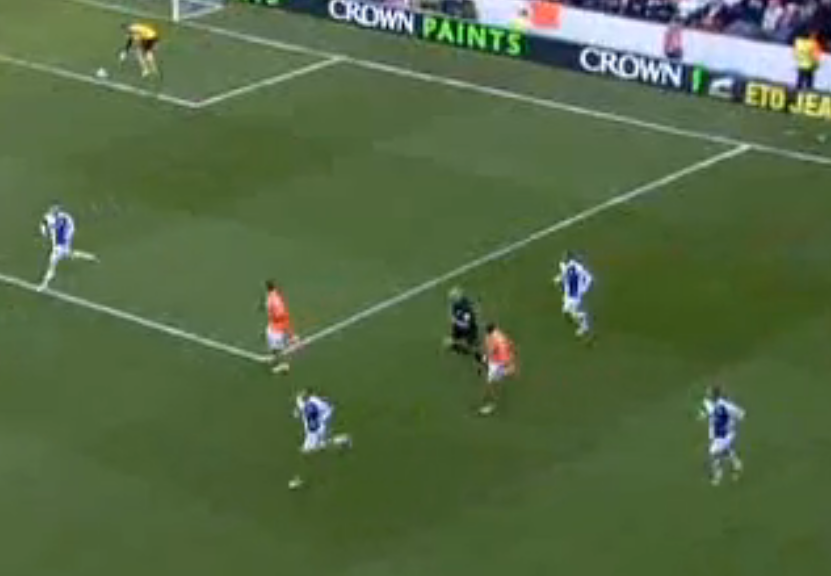
In the final two minutes of the match, Howard Webb put himself in an unfortunate situation. With Blackpool leading 2—1, the tactic was for Blackpool players to run down the clock. This meant taking the ball to the corner flag and holding up play as much as possible. This is a common tactic which experienced referees should be aware of and capable of handling well. It was just surprising that Webb did not handle the situation well.

Blackpool's Taylor-Fletcher (orange #12) evades two Blackburn players by the corner flag but is then sandwiched by two others. The ball is also kicked out over the goal-line by a Blackburn player. Webb awards a goal kick to Blackburn.

Taylor-Fletcher (orange #12) is clearly frustrated by what he perceives to be the wrong decision. He thought he should have been awarded a free kick, or at least a corner kick to his team. Webb is having none of it, but unfortunately since both are running back towards the halfway line Taylor-Fletcher continues to harangue Webb. This, as can be seen immediately in the next phase of play, influences Webb's thoughts about Taylor-Fletcher.

From the goal kick, Taylor-Fletcher (orange #12) fouls a Blackburn player by the halfway line. But Taylor-Fletcher is still incensed with Webb's earlier incorrect call down by the goal-line and therefore reacts with dissent towards Webb. Webb correctly cautions him.


And from the resulting free kick, Blackburn knock the ball into the Blackpool goal to make it 2—2.

Overall Howard Webb had a poor game. Let's hope Webb can bounce back for the remainder of the season!

Monday, 21 March 2011

Studs Alert: A Cynical Challenge

The following incident occurred during an English Premier League match between Manchester United and Bolton Wanderers on Saturday 19 March 2011. The match finished 1—0.

In the 75th minute, with the score locked at 0—0, Manchester United's Jonathan Evans and Bolton Wanderers' Stuart Holden engaged in a 50-50 challenge. However, Evans approached the challenge cynically with his studs up and directed towards his opponent.

Referee Andre Marriner was correct to send off Evans for serious foul play.

Both players are equally committed to the ball, but is one player more committed to endangering the safety of his opponent too?

Stuart Holden is injured during this cynical challenge by Jonathan Evans (Pic from here)


Media Analysis
Pundits Mark Lawrenson and Alan Hansen, on BBC's Match of the Day, had this to say:

Lawro: Both these two boys are so committed to the ball that's there absolutely no doubt about it. And (sigh), look at them, both their feet are off the floor. The problem is for Evans is he actually catches the ball with his knee but he catches the player with his studs up. And I think there's no hesitation for the referee. But I think both players actually went for the ball.

Hansen: Yeah, I thought he [Evans] was unlucky. I thought he is a bit high but he gets a lot of the ball and I don't think there's any intent there whatsoever.

Gary Lineker: OK.

Does anyone (sorry, I mean, do any referees) understand what these pundits are talking about? What's their argument? Something about "committed to the ball" and "getting the ball" and "unlucky to get a red card"? When pundits say they cannot see any intent in such challenges, then ... they have been well and truly hoodwinked.


Post-Match Comments
In some news articles, the two managers were reluctant to put any blame on Jonathan Evans (see BBC Sport and Daily Mail).

Man Utd boss Sir Alex Ferguson, as usual, tried to misdirect Evan's cynical challenge by saying: "Everyone knows Jonny is not a malicious player. I think the red card was probably given because of the injury. You can't have any real complaints, it was unfortunate, maybe."

Bolton boss Owen Coyle said: "In real time, it looked as though two players were committed going for the ball. There didn't seem any malice."

What's their argument? Something about "committed to the ball" and "not malicious" and "unlucky to get a red card, maybe"? When managers say they cannot see any malice in such challenges, then ... one manager is biased and defending his own player, and t'other manager has been hoodwinked.


Cynical is as Cynical does

The trouble with pundits and managers is that, in incidents when two players are both committed to the ball, they assume both players are acting in the same way when they engage in a 50-50 challenge. They assume both players are making a fair and sporting challenge for the ball. But is it fair when one player chooses to challenge by exposing his studs and the other player chooses to challenge with the side or top of his boot? Who is being fair and sporting, and who is being unfair, unsporting and cynical?

This blog has documented similar incidents where players become involved in 50-50 challenges.

In this example, Studs Alert: Stamp Out Stamping, one player is being fair and sporting, and the other is being unfair, unsporting and cynical.

And in this example, Webb's Weak Woeful Week (where there are also comments from readers), during the Tottenham Hotspurs and Sunderland match both players challenge fairly and sportingly because they both attempt to make contact with the ball using the side of their boots.

True, two readers have previously made the point that Sunderland's Lee Cattermole had both feet off the ground during the challenge. My (belated) reply is "so what" and "what else"? Players are allowed to jump and have their feet off the ground. But what is not allowed is when players expose their studs or perform other cynical actions that will, or have the potential to, endanger the safety of their opponent. Cattermole's challenge was not cynical, which is why that particular challenge was not serious foul play. Yes, Luka Modric was injured in the aftermath but Referees are not taught to assess the consequences or the potential outcomes of a challenge. Referees are taught to assess the nature of the challenge itself.

I hope this provides a reasonable answer to the two readers who previously gave their views (posted here).


Additional Tip:
For 50-50 challenges, to help Referees decide whether one player does not intend to play the ball but instead intends to injure his opponent (i.e. How to identify unfair, unsporting and cynical challenges), simply ask yourself whether the same player would do exactly the same if his opponent was actually his fellow team-mate, a relative or a good friend. So, would Jonathan Evans have jumped in with his studs up if another Manchester United player had also challenged for the ball?

Evans made an unfair, unsporting and cynical challenge and Referee Andre Marriner was correct to see that as serious foul play.

For the good of the game, let's Stamp Out Stamping

Related Posts (search: stamp)