In the 11' of the France versus Argentina World Cup Round of 16 match on 30 June 2018, AFC's Iranian referee Alireza Faghani whistles for a foul and points to the penalty spot.
France successfully dispatch the penalty kick and the score is 1 - 0.
In the 19' minute Faghani whistles for a foul and points to the penalty spot ...
And when the YC was shown, I thought the Referee's decision was a penalty kick for DOGSO.
However, it becomes apparent that Faghani has awarded a direct free kick outside
the penalty area and not, as many people initially believed, a penalty.
The Referee is pointing to a spot outside the penalty area. To
avoid any misunderstanding he should perhaps not use this pointing
signal (which is exactly the same as the signal for pointing to the
penalty spot, which he used 8 minutes earlier) or otherwise use another
signal to indicate the location.
Now, this leads on to the consideration whether this was a DOGSO incident ...
The France attacker Kylian Mbappé controls the ball and is then tripped by Nicolas Tagliafico, who is the second-last defender. This therefore meets the criteria for DOGSO. Faghani's AR did well to tell the Referee that the foul was outside the penalty area, however could the AR also have given his recommendation for DOGSO? If the unfair challenge by the second-last defender was outside the penalty area, then it should have been a RC to Tagliafico and a direct free kick to France.
Furthermore, with VAR used for "clear and obvious mistakes" (specifically with Red Card incidents being one of the four main uses) why did the Referee not use (or hear recommendations from) the VAR?
Showing posts with label yellow card. Show all posts
Sunday, 1 July 2018
Wednesday, 7 August 2013
RefCam: A Referee's Perpective
The following incidents occurred from the Referee's Perspective during the MLS All Stars match against Roma on Thursday 1 August 2013. The match finished 1—3, with 2 YCs.
Ref Cam: Sights and Sounds from the 2013 ATT MLS All-Star Game (YouTube)
Here's what Referee Hilario Grajeda looked like rigged up with the RefCam (which appears rather bulky).
From the start, Roma midfielder Miralem Pjanic (red 15) appears to be one of those players who persistently badger the referee to give things in their favour. Experienced Referees can spot these type of players a mile away.
Later, Pjanic (red 15) fouls MLS All Stars captain Thierry Henry (blue 14). Pjanic looks at the Referee apologetically to make sure that he is not booked.
Roma goalkeeper Morgan De Sanctis (grey) catches the ball and Referee Grajeda raises his ams with all fingers splayed out. He waits a second or two and then gives two thumbs up. What is this signal? What message is the Referee trying to communicate and are players paying attention to him?
In the 54', Pjanic (red 15) fouls Landon Donovan (blue 7) and Referee Grajeda, who appears (at least from the RefCam perspective) to be quite a distance away, cautions Pjanic.
Is it clear to the players, match officials and spectators who the Referee has given a yellow card to?
The RefCam is a great experience that the MLS (or PRO?) is offering to soccer fans. Letting people see what the referee sees … or doesn't see … can only be a good thing if we want to provide a better understanding of the important and fantastic work that Referees do. Let's see more RefCams!
Related Post
Able Referee Assistants Must Assist Referees Ably
Ref Cam: Sights and Sounds from the 2013 ATT MLS All-Star Game (YouTube)
Here's what Referee Hilario Grajeda looked like rigged up with the RefCam (which appears rather bulky).
From the start, Roma midfielder Miralem Pjanic (red 15) appears to be one of those players who persistently badger the referee to give things in their favour. Experienced Referees can spot these type of players a mile away.
C'mon Ref, what are you doing?
Later, Pjanic (red 15) fouls MLS All Stars captain Thierry Henry (blue 14). Pjanic looks at the Referee apologetically to make sure that he is not booked.
Nice, clear and firm signal to indicate a direct free kick
Don't book me Ref! I'm a good boy ... honest ...
Notice also the big screen from the Referee's view. A simultaneous double whammy!
Roma goalkeeper Morgan De Sanctis (grey) catches the ball and Referee Grajeda raises his ams with all fingers splayed out. He waits a second or two and then gives two thumbs up. What is this signal? What message is the Referee trying to communicate and are players paying attention to him?
Wait ... wait ... goalkeeper has the ball ... wait ... thumbs up ...
In the 54', Pjanic (red 15) fouls Landon Donovan (blue 7) and Referee Grajeda, who appears (at least from the RefCam perspective) to be quite a distance away, cautions Pjanic.
Is it clear to the players, match officials and spectators who the Referee has given a yellow card to?
Donovan takes exception to Pjanic's unfair challenge.
The RefCam is a great experience that the MLS (or PRO?) is offering to soccer fans. Letting people see what the referee sees … or doesn't see … can only be a good thing if we want to provide a better understanding of the important and fantastic work that Referees do. Let's see more RefCams!
Related Post
Able Referee Assistants Must Assist Referees Ably
Wednesday, 29 August 2012
Smarter Than The Average Player
IMHO, generally speaking match officials are a given here but the theme of this post is not about Referees but about players. So, who are the smart players?
They are the ones who take time to look at the Laws and then adapt with reference to them. When it comes to goal celebrations, Manchester City's Carlos Tevez leads the pack ...
When it comes to goal celebrations without picking up silly cautions, Carlos Tevez shows he is clearly smarter than the average player.
BTW, I had been meaning to mention this incident:
This was the moment when Bayern Munich's Bastian Schweinsteiger scored the winning penalty in the shootout to advance to the 2012 Champions League Final against Chelsea. Referee Viktor Kassai (Hungary) did not caution Schweinsteiger; had he been shown a YC then the German international would have missed the Final.
The specific post was drafted in June but never published. I have now posted it so that it can be linked with this post should anyone wish to research or consider the mitigating details.
ACKNOWLEDGEMENT: The idea for this post about mandatory cautions for removing shirts during goal celebrations mostly came from the inspirational comments mentioned in Kicking Back.
Also, Kicking Back's statement that "FIFA, or the relevant competition authority should have the ability to correct decisions after the fact" is worth considering seriously. See an earlier related post about this called "The Reciprocal Appeal".
They are the ones who take time to look at the Laws and then adapt with reference to them. When it comes to goal celebrations, Manchester City's Carlos Tevez leads the pack ...
When it comes to goal celebrations without picking up silly cautions, Carlos Tevez shows he is clearly smarter than the average player.
BTW, I had been meaning to mention this incident:
This was the moment when Bayern Munich's Bastian Schweinsteiger scored the winning penalty in the shootout to advance to the 2012 Champions League Final against Chelsea. Referee Viktor Kassai (Hungary) did not caution Schweinsteiger; had he been shown a YC then the German international would have missed the Final.
The specific post was drafted in June but never published. I have now posted it so that it can be linked with this post should anyone wish to research or consider the mitigating details.
ACKNOWLEDGEMENT: The idea for this post about mandatory cautions for removing shirts during goal celebrations mostly came from the inspirational comments mentioned in Kicking Back.
Also, Kicking Back's statement that "FIFA, or the relevant competition authority should have the ability to correct decisions after the fact" is worth considering seriously. See an earlier related post about this called "The Reciprocal Appeal".
Labels:
Champions League,
English Premier League,
FIFA,
IFAB,
Law 12,
punishment,
UEFA,
yellow card
Monday, 18 June 2012
Another Missed Opportunity For EARs
The following incident occurred during the Euro 2012 final group match between Greece and Russia on Saturday 16 June 2012. The match finished 1—0, with Greece progressing to the quarterfinals at the expense of Russia. There were 6 YCs.
In the 61' with the score at 1—0 Greece captain 35-year-old Giorgos Karagounis (white 10), on his record-equalling 120th cap for his country, dances into the penalty area and is tripped by a Russia defender Sergei Ignashevich (red 4). Referee Jonas Eriksson immediately whistles for an IFK to Russia and cautions Karagounis for simulation. As a result, Greece were denied a penalty and Karagounis, who was cautioned in a previous group match, misses the next match which is the quarterfinal stage. Here are the freeze frames:
If Referee Eriksson had positioned himself behind play, and hence had this angle of view, he would have clearly seen contact between the players*: Here are the freeze frames:
It is noticeable that the Referee's positioning did not provide a good clear angled view of the incident. Nevertheless, the Referee convinced himself that what he saw was a dive … since he did not (and could not) see any contact between the players.
[*Note: Had Referee Eriksson been optimally positioned, then this would still negate the usefulness of having EARs (or at least those positioned behind the goal line on the side of the goal nearest the AR) because they would both have the optimal angle of view of the incident, albeit from either side of the players.]
In such circumstances, would it not be better for the Referee to first take the opportunity to solicit feedback, if any, from his assistants before making a decision? It is always better to be late and correct, than quick and wrong.
Granted, this is a tough question to ask a Referee. But at this level with their extensive preparation, training and experience plus their use of communications technology, it is a legitimate question to ask. Are such Referees considered skilled, experienced and adaptable enough to deal with such situations? Can and should an experienced Referee recognise when he does not have an optimal position to make a good call and hence solicit assistance from his team? This of course has to be balanced with how well a Referee can "sell a decision", whether correct or not.
It should be evident that:
a) AR2 (Mathias Klasenius) would not have had a good view; and
b) EAR2 (Stefan Johannesson) had the better view out of the three match officials (R, AR2 and EAR2) closest to the incident.
This is what EAR2 saw, or should have seen:
It is easy to say now but this is what we are here for ... to learn and improve. The best thing for the Referee to have done was to prepare his assistants (ARs, EARs and 4thO) well with a thorough briefing and then to make use of everyone's skill and experience by allowing active participation and working as a team. What is the use of UEFA claiming "Now we see more" when the facts show that they do not do enough to encourage Referees to act on this claim. This is just another form of soft-option officiating.
In any case, this is yet another example that demonstrates the ineffectiveness of EARs (the evidence against EARs continues to accumulate). EAR2 could have been effective by providing useful and crucial information to the Referee. It didn't happen, and subsequently the Referee made an incorrect and controversial decision.
The match officials were:
Referee: Jonas Eriksson (SWE)
Assistant referees: Stefan Wittberg (SWE), Mathias Klasenius (SWE)
Fourth official: Hüseyin Göçek (TUR)
Additional assistant referees: Markus Strömbergsson (SWE), Stefan Johannesson (SWE)
In the 61' with the score at 1—0 Greece captain 35-year-old Giorgos Karagounis (white 10), on his record-equalling 120th cap for his country, dances into the penalty area and is tripped by a Russia defender Sergei Ignashevich (red 4). Referee Jonas Eriksson immediately whistles for an IFK to Russia and cautions Karagounis for simulation. As a result, Greece were denied a penalty and Karagounis, who was cautioned in a previous group match, misses the next match which is the quarterfinal stage. Here are the freeze frames:
Does Referee Eriksson have a good, clear and angled view?
Karagounis (Greece 10) cannot believe he is booked for simulation
If Referee Eriksson had positioned himself behind play, and hence had this angle of view, he would have clearly seen contact between the players*: Here are the freeze frames:
It is noticeable that the Referee's positioning did not provide a good clear angled view of the incident. Nevertheless, the Referee convinced himself that what he saw was a dive … since he did not (and could not) see any contact between the players.
[*Note: Had Referee Eriksson been optimally positioned, then this would still negate the usefulness of having EARs (or at least those positioned behind the goal line on the side of the goal nearest the AR) because they would both have the optimal angle of view of the incident, albeit from either side of the players.]
In such circumstances, would it not be better for the Referee to first take the opportunity to solicit feedback, if any, from his assistants before making a decision? It is always better to be late and correct, than quick and wrong.
Granted, this is a tough question to ask a Referee. But at this level with their extensive preparation, training and experience plus their use of communications technology, it is a legitimate question to ask. Are such Referees considered skilled, experienced and adaptable enough to deal with such situations? Can and should an experienced Referee recognise when he does not have an optimal position to make a good call and hence solicit assistance from his team? This of course has to be balanced with how well a Referee can "sell a decision", whether correct or not.
It should be evident that:
a) AR2 (Mathias Klasenius) would not have had a good view; and
b) EAR2 (Stefan Johannesson) had the better view out of the three match officials (R, AR2 and EAR2) closest to the incident.
This is what EAR2 saw, or should have seen:
Russia defender Ignashevich (red 4) trips Greece captain Karagounis (white 10) in the box
Notice Referee Eriksson had a poor angle of view
It is easy to say now but this is what we are here for ... to learn and improve. The best thing for the Referee to have done was to prepare his assistants (ARs, EARs and 4thO) well with a thorough briefing and then to make use of everyone's skill and experience by allowing active participation and working as a team. What is the use of UEFA claiming "Now we see more" when the facts show that they do not do enough to encourage Referees to act on this claim. This is just another form of soft-option officiating.
In any case, this is yet another example that demonstrates the ineffectiveness of EARs (the evidence against EARs continues to accumulate). EAR2 could have been effective by providing useful and crucial information to the Referee. It didn't happen, and subsequently the Referee made an incorrect and controversial decision.
The match officials were:
Referee: Jonas Eriksson (SWE)
Assistant referees: Stefan Wittberg (SWE), Mathias Klasenius (SWE)
Fourth official: Hüseyin Göçek (TUR)
Additional assistant referees: Markus Strömbergsson (SWE), Stefan Johannesson (SWE)
Labels:
EURO,
Law 12,
referee system,
soft-option officiating,
UEFA,
yellow card
Sunday, 10 June 2012
All EARs: Could Clattenburg's Cowboy Crouch Become A Classic?
For the first day at EURO 2012, I thought I would focus on the additional assistant referees or EARs because, well …
a) for one thing, there appears to be plenty of people discussing and focusing on the Referees and major match incidents; and
b) for another, there doesn't seem to be any well-defined guidelines for these extra match officials which means there will likely be plenty of strange impressions and/or odd-looking actions coming from the EARs.
For example, take a look at extra assistant referee (EAR2) Mark Clattenburg during the first goal of the group match between Russia and Czech Republic on Friday 8 June 2012. The match finished 4—1.
Clattenburg crouching, and looking as though he is straddling an imaginary saddle strapped right on top of the goal line
There are plenty more examples of Clattenburg's Cowboy Crouch during the match. Apparently, this is how England's EARs will be approaching their duties (... but it seems no one told EAR1 Martin Atkinson!).
The match officials are:
Referee: Howard Webb (ENG)
Assistant referees: Michael Mullarkey (ENG), Peter Kirkup (ENG)
Fourth official: Manuel De Sousa (POR)
Additional assistant referees: Martin Atkinson (ENG), Mark Clattenburg (ENG)
Now let's take a look at Spain's EARs during the tournament's opening match; a group match between Poland and Greece on Friday 8 June 2012. The match finished 1—1. There were 4 YCs and 2 RCs (one RC for 2nd caution).
In the 71', Greece have a penalty kick. Notice the position and stance of EAR2.
Notice that AR2 stands at the touch line in line with the 18-yard penalty area. The AR stands there, apparently, to watch for any encroachment. The AR does not appear to be particularly effective standing there during penalty kicks.
The reason why the EARs' "Crouching Cowboy" stance gives a strange impression (mainly, to other match officials and Referee observers) is because when compared with ARs who stand on (yes, "on") the goal line during penalty kicks they stand upright as though 'at attention'. Therefore, the contrast between an EAR's Cowboy's Crouch and an AR's Soldier's Stance is significant.
During penalty kicks, to observe whether the whole of the ball has crossed the goal line under the crossbar and between the posts, should match officials assisting the Referee adopt the:
a) Cowboy Crouch positioned behind the goal line; or
b) Cowboy Crouch positioned on the goal line; or the
c) Soldier's Stance positioned on the goal line?
At present, it seems EARs can do as they like since there are no established guidelines or interpretations.
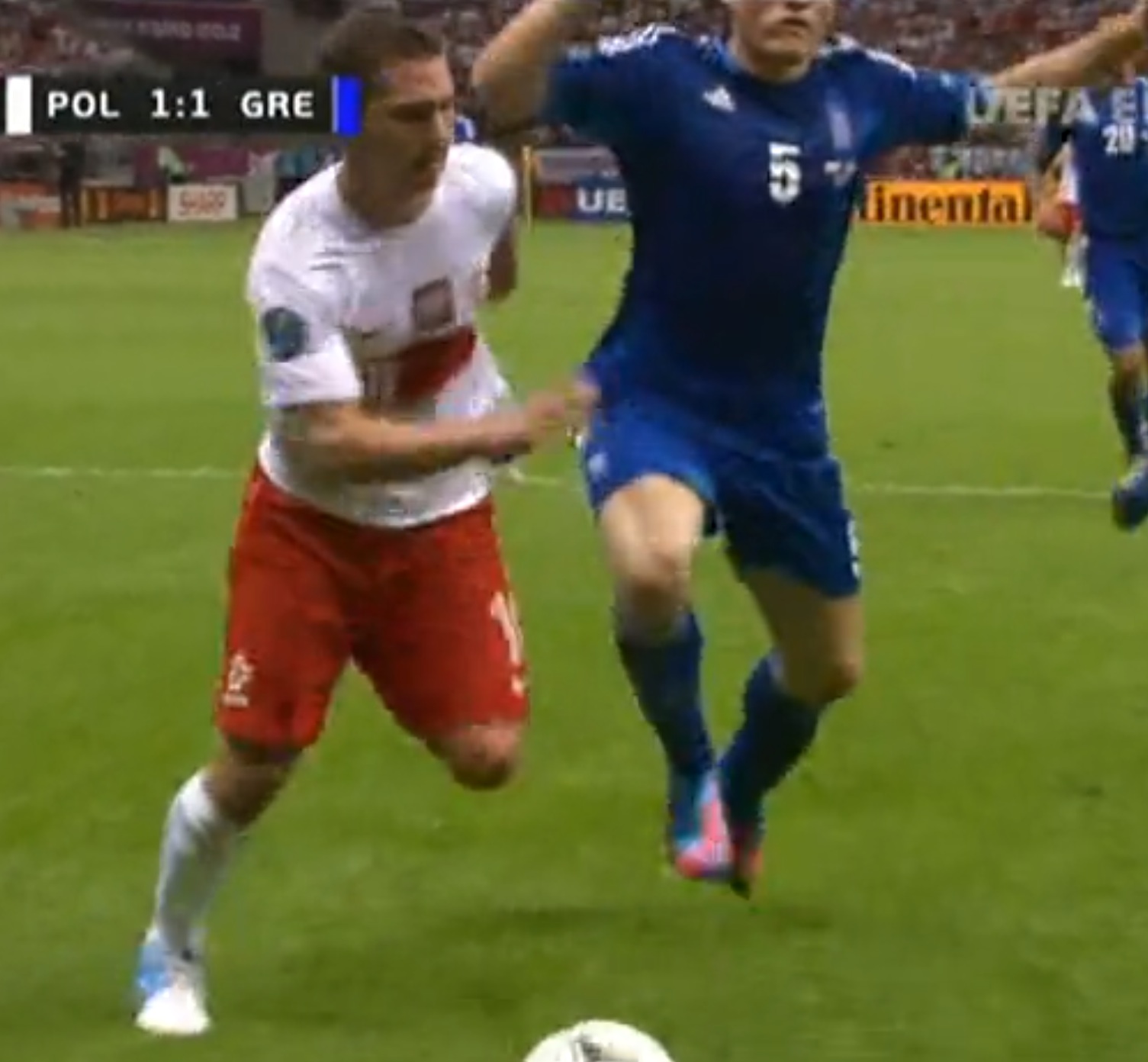
In the 79', Poland attacker Ludovic Obraniak (white 10) charges into the Greece penalty area with the ball. Greece defender Kyriakos Papadopoulos (blue 5) also charges in and uses his arm unfairly to push his opponent off balance and off the ball. Here are the freeze frames:
Poland's Obraniak asks EAR1 why he did not give a foul and hence penalty?
Unfortunately, Obraniak does not know about the ineffectiveness of EARs.
Here's the view from another camera angle:
This is basic foul detection. Did Blue 5 make an unfair challenge? Did Blue 5 attempt to play the ball?
Remember, the stated original purpose of EARs was that they would:
1) promote better decision making on suspected fouls in the penalty area; and
2) have a deterrent effect, as players will be aware that they are being closely watched.
This incident in the 79' clearly shows that EARs:
1) do NOT promote better decision making on suspected fouls in the penalty area; and
2) do NOT have a deterrent effect.
What use EARs (even if they see more)?
The match officials are:
Referee: Carlos Velasco Carballo (ESP)
Assistant referees: Roberto Alonso Fernández (ESP), Juan Carlos Yuste Jiménez (ESP)
Fourth official: Gianluca Rocchi (ITA)
Additional assistant referees: David Fernández Borbalán (ESP), Carlos Clos Gómez (ESP)
Not-So-Good Impressions
In the 69', Referee Carlos Velasco Carballo (Spain) sends off Poland goalkeeper Wojciech Szczesny for DOGSO and Greece's Vassilis Torossidis (blue 15) approaches the Referee and pats and praises him.
Referee Carballo then shares a moment with Torossidis (blue 15), laughing, which doesn't come across well.
Especially since if we go back to first half, when in the 45'+2' Greece are claiming a handball in Poland's penalty area. The handball incident was clearly not deliberate but some Greece players harangue Referee Carballo.
Referee Carballo correctly cautions José Holebas (blue 20). But notice Torossidis (blue 15) is present and exerting prolonged pressure on the Referee too. We can see what kind of a person Torossidis is, in that Torossidis can only appreciate and accept decisions that are in favour of his own team.
Why an experienced Referee like Carballo would "share a moment" with a player like Torossidis is simply astonishing.
a) for one thing, there appears to be plenty of people discussing and focusing on the Referees and major match incidents; and
b) for another, there doesn't seem to be any well-defined guidelines for these extra match officials which means there will likely be plenty of strange impressions and/or odd-looking actions coming from the EARs.
For example, take a look at extra assistant referee (EAR2) Mark Clattenburg during the first goal of the group match between Russia and Czech Republic on Friday 8 June 2012. The match finished 4—1.
Clattenburg crouching, and looking as though he is straddling an imaginary saddle strapped right on top of the goal line
There are plenty more examples of Clattenburg's Cowboy Crouch during the match. Apparently, this is how England's EARs will be approaching their duties (... but it seems no one told EAR1 Martin Atkinson!).
The match officials are:
Referee: Howard Webb (ENG)
Assistant referees: Michael Mullarkey (ENG), Peter Kirkup (ENG)
Fourth official: Manuel De Sousa (POR)
Additional assistant referees: Martin Atkinson (ENG), Mark Clattenburg (ENG)
Now let's take a look at Spain's EARs during the tournament's opening match; a group match between Poland and Greece on Friday 8 June 2012. The match finished 1—1. There were 4 YCs and 2 RCs (one RC for 2nd caution).
In the 71', Greece have a penalty kick. Notice the position and stance of EAR2.
EAR2 is crouching, legs wide apart, just behind the goal line
Notice that AR2 stands at the touch line in line with the 18-yard penalty area. The AR stands there, apparently, to watch for any encroachment. The AR does not appear to be particularly effective standing there during penalty kicks.
The reason why the EARs' "Crouching Cowboy" stance gives a strange impression (mainly, to other match officials and Referee observers) is because when compared with ARs who stand on (yes, "on") the goal line during penalty kicks they stand upright as though 'at attention'. Therefore, the contrast between an EAR's Cowboy's Crouch and an AR's Soldier's Stance is significant.
During penalty kicks, to observe whether the whole of the ball has crossed the goal line under the crossbar and between the posts, should match officials assisting the Referee adopt the:
a) Cowboy Crouch positioned behind the goal line; or
b) Cowboy Crouch positioned on the goal line; or the
c) Soldier's Stance positioned on the goal line?
At present, it seems EARs can do as they like since there are no established guidelines or interpretations.
In the 79', Poland attacker Ludovic Obraniak (white 10) charges into the Greece penalty area with the ball. Greece defender Kyriakos Papadopoulos (blue 5) also charges in and uses his arm unfairly to push his opponent off balance and off the ball. Here are the freeze frames:
Poland's Obraniak asks EAR1 why he did not give a foul and hence penalty?
Unfortunately, Obraniak does not know about the ineffectiveness of EARs.
Here's the view from another camera angle:
This is basic foul detection. Did Blue 5 make an unfair challenge? Did Blue 5 attempt to play the ball?
Remember, the stated original purpose of EARs was that they would:
1) promote better decision making on suspected fouls in the penalty area; and
2) have a deterrent effect, as players will be aware that they are being closely watched.
This incident in the 79' clearly shows that EARs:
1) do NOT promote better decision making on suspected fouls in the penalty area; and
2) do NOT have a deterrent effect.
What use EARs (even if they see more)?
The match officials are:
Referee: Carlos Velasco Carballo (ESP)
Assistant referees: Roberto Alonso Fernández (ESP), Juan Carlos Yuste Jiménez (ESP)
Fourth official: Gianluca Rocchi (ITA)
Additional assistant referees: David Fernández Borbalán (ESP), Carlos Clos Gómez (ESP)
Not-So-Good Impressions
In the 69', Referee Carlos Velasco Carballo (Spain) sends off Poland goalkeeper Wojciech Szczesny for DOGSO and Greece's Vassilis Torossidis (blue 15) approaches the Referee and pats and praises him.
Referee Carballo then shares a moment with Torossidis (blue 15), laughing, which doesn't come across well.
Especially since if we go back to first half, when in the 45'+2' Greece are claiming a handball in Poland's penalty area. The handball incident was clearly not deliberate but some Greece players harangue Referee Carballo.
The ball hits a Poland player (white) on the arm but it was not deliberate handball
Referee Carballo cautions José Holebas (blue 20)
Referee Carballo correctly cautions José Holebas (blue 20). But notice Torossidis (blue 15) is present and exerting prolonged pressure on the Referee too. We can see what kind of a person Torossidis is, in that Torossidis can only appreciate and accept decisions that are in favour of his own team.
Why an experienced Referee like Carballo would "share a moment" with a player like Torossidis is simply astonishing.
Labels:
EURO,
Law 12,
Law 14,
red card,
referee system,
UEFA,
unsporting behaviour,
yellow card
Subscribe to:
Posts (Atom)