Showing posts with label unsporting behaviour. Show all posts

Sunday, 10 May 2015

Rational Ref: Chelsea's masters of the dark arts highlight a win-at-all-costs mentality

Chelsea's masters of the dark arts highlight a win-at-all-costs mentality

Chelsea's siege on Kuipers shows intimidation and bullying are acceptable in quest for glory
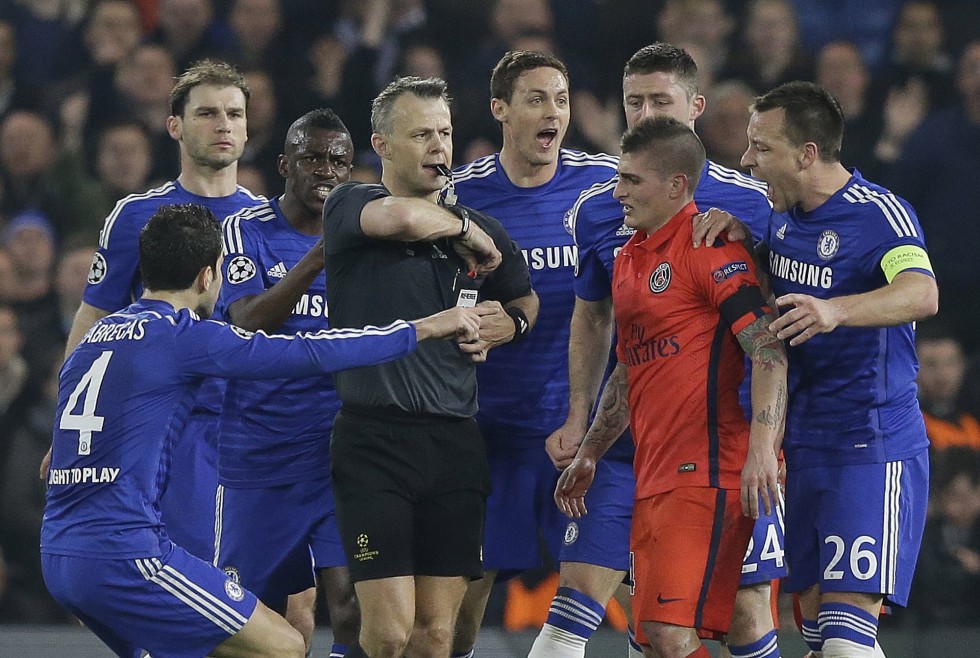
In sport what is more important: playing the game or playing games? Nowhere else but in soccer is this distinction more apparent, with plenty of cheating and gamesmanship instead of genuine sportsmanship and model behaviour.

Chelsea's siege on Dutch referee Bjorn Kuipers during their Champions League exit to Paris Saint-Germain last week comes as no huge surprise. It is simply the logical consequence of the ugly, unethical and underhanded approach that has been allowed to fester and flourish to alarming levels.
 
The dark arts—comprising cheating, provocation, intimidation, faking injury and childish behaviour—is now so endemic it is considered the main source of entertainment, with media reports barely touching on the final score and team performances.

In one camp, John Terry, Jose Mourinho, Gary Neville and others believe the dark arts are entirely acceptable, whereas the likes of Graeme Souness, Jamie Carragher and most referees prefer a cleaner, honest and straightforward approach. Spectators will probably support whichever camp so long as it benefits their favourite team.


 Zlatan Ibrahimovic gestures to the referee after a tackle on Chelsea midfielder Oscar, who appeared badly hurt, but was on his feet moments after a red card was issued. Photo: AFP   


Chelsea captain Terry defended his hounding of referees, saying: "Every other side is as bad as each other."

"It's part of the game. Once they're charging the ref, the only thing we can do is respond. You can't as a group of players let them surround the ref, trying to get our players booked. Once I go [to influence the referee], four or five go with me. It doesn't look good, but that's part of the game."

Mourinho, obviously, backs his captain since he instils this kind of attitude in all the teams he has coached. As a manager, he upholds his reputation as the master of dark arts, with eye gouging a particular speciality.

In contrast, Souness labelled Chelsea players "pathetic" for their antics. Souness, who cemented his reputation at Liverpool as a tough but honest player, harks back to the old-fashioned era when sportsmanship and camaraderie took priority over rivalry and winning at all costs.

However, in the modern era of professional athletes and ludicrous salaries, the game's values have become ridiculously warped.

When Oscar was apparently seriously injured in his clash with Zlatan Ibrahimovic, notice how none of the Chelsea players showed any genuine concern to the well-being of their Brazilian teammate.

Not one of them went to see how Oscar was because they were all focused on pressuring the referee. Oscar was exaggerating the seriousness of his injury and as soon as Ibrahimovic was sent off, he was back on his feet as if nothing had happened.

Suppose you and a friend are involved in a car crash with another driver, what would be the natural reaction? Would you be jumping and screaming at the traffic policeman to reprimand the driver causing the accident or would you be more concerned about your friend?
Chelsea manager Jose Mourinho, a 'master of the dark arts'? Photo: AP

Chelsea's behaviour reveals the sad, twisted values that have taken over the game, where gaining a favourable decision is more important than the safety of teammates and fellow professionals.

In a match I refereed recently, two players jumped up for the ball and collided in a fair challenge, with one player apparently coming off worse for wear. Because he screamed loudly and made a big fuss about having an injury to his face, I whistled to stop play so he could be checked.

When I told him there was no foul, he became even more animated and miraculously forgot about his so-called "injury".

As a referee, I was more concerned about his safety. However, this player was all about getting a free kick for himself and a card for his opponent.
Liverpool captain Steven Gerrard summed up the game's warped value systems by saying: "I think it's normal when you play games at that level. Players and managers want to win so much - players will try every trick in the book to try to get over the line and win matches.

"We've all been guilty of it throughout our careers by not always abiding by the rules."

The only way to appreciate this sentiment is that if we have all been taught to value only the destination and not to care about the journey in the "beautiful" game.


PUBLISHED : Thursday, 19 March, 2015

Sunday, 12 April 2015

Rational Ref: Professionals must remember only the ref can stop a match


Professionals must remember only the ref can stop a match

Professionals need to remember that only the referee can stop a match, even when a player goes down injured

Whatever happened to "play to the whistle"? By taking matters into their own hands and stopping play, players are only putting themselves in the dock, on the block, and up the proverbial garden path.

When a player apparently suffers an injury during play, referees are the only ones who have the authority to decide whether or not to stop a match. Players ignore this at their peril.

Tuesday's (20 November 2012) controversial goal by Shakhtar Donetsk against Nordsjaelland in the Champions League is a prime example. When a Nordsjaelland player went down injured, players voluntarily stopped play in the middle of the park. After the player had been taken off the pitch to receive treatment, the referee restarted play with a drop ball. It was uncontested and Shakhtar Donetsk midfielder Willian gently booted the ball back to his opponents' half. However, Willian's teammate, Brazilian Luiz Adriano, apparently did not realise a sporting gesture was being played out, and so ran on to the "pass" to the amazement of the static Nordsjaelland defenders, rounded the dismayed goalkeeper, and promptly scored.

Uefa has now charged Adriano with unsporting behaviour and he has been suspended for their next Champions League match (for "violation of the principles of conduct").

There are many levels of inquiry here, and one easy solution. First, in return for what most people perceive to be an unsporting goal, why did the Shakhtar Donetsk defenders refuse to allow their opponents a walk-in goal immediately after that misunderstanding?

"Half their team seemed to think [it would be fair], but the other half didn't," Nordsjaelland captain Nicolai Stokholm said. At that moment, Shakhtar Donetsk had no leader to tell the whole team what they should do. This would explain the team's mixed stance.

It also explains how seriously some players take their profession, with many having differing interpretations of how sporting behaviour fits into the game, if at all.

Second, why was Adriano seemingly unrepentant about his actions? "It was instinct, I see the ball and I dribbled and I scored a goal," he said. Adriano is basically saying a professional soccer player is supposed to win matches. Does this mindset override sporting gestures such as stopping play for an injured opponent?

Third, why did players stop play in first place? How did they know the player was injured and not faking injury? Are players trained in medical triage? With all these risks, why would professional players compromise themselves by taking up the referee's responsibility? It's not simply a matter of being sporting, since stopping play can also be trying to gain "brownie points" in the public eye.

And, why did the players not kick the ball out of play? They just stopped and looked around aimlessly, which reveals they really did not know what to do and were probably seeking guidance. Therefore, they should always "play to the whistle".

Players stopping play first came to prominence at the 1986 World Cup in Mexico, when Belgium played Spain in the quarter-finals. Even in the baking summer heat, and having to play extra time, whenever a player from any team went down his opponents would refuse to take advantage, and instead opted to kick the ball out of play. This was genuine and sincere "fair play".

But things have moved on since then, most notably professionalism and monetary rewards have brought increased cynicism and gamesmanship to the modern game.

This is why it is important to let one person, the match referee, decide whether or not to call a halt when a player is apparently injured. Referees will stop play only if, in their opinion, a player is seriously injured. A serious injury is something of the magnitude of a broken limb. However, judging by many players' reactions, it would seem a little knock or slap is plenty enough to stop a match.

At the amateur and parks level, stopping the game works beautifully for almost any injury, either real or apparent. But at the competitive and professional level, it is best left to the man in the middle to decide whether or not to stop play. This prevents players from duping opponents.

Remember the 2010 World Cup final between the Netherlands and Spain? No love was lost in this ultimately competitive match. With Spain eventually taking a 1-0 lead during extra-time, the Netherlands were frantically trying to find the equalizer. In the 120th minute, Spain's Fernando Torres pulled up apparently with a hamstring injury. The sporting thing to do would have been to kick the ball out of play. History shows the Netherlands did not give a fig about sportsmanship, as they continued to attack Spain's goal.

This week's lesson: At the professional level, sportsmanship is for suckers.

PUBLISHED : Friday, 23 November, 2012

Saturday, 31 January 2015

Rational ref: diving an art or cheating

Rational ref: diving an art or cheating

While some players consider falling over to be cheating, others consider it a skill of the game


To dive or not to dive, that is the question professional players have to ponder, particularly when prowling the penalty area. Diving, which match officials call simulation, is pretending to be fouled in an attempt to deceive the referee to gain a favourable decision. Some consider this to be cheating, while others believe it to be a useful skill.

Players with a reputation for going to ground easily include Liverpool's Uruguayan Luis Suarez, Manchester City's Argentinean Sergio Aguero and Manchester United's Ecuadorian Antonio Valencia. These high-profile foreign players contribute to the stereotype of "that type of player" who cheats.

Simulation came to be due to two broad schools of soccer culture. The first recognises committed, hard-grafting physical players and the other appreciates elegant, more-accomplished skilful players. The latter, being technically gifted and sometimes breathtaking to watch, are usually prone to being taken down a peg or two by the former.

Nobody likes to be publicly embarrassed by a piece of skill so those who are victims overcompensate for their insecurities by "mowing down" whoever they consider to be "show ponies". The flip side of this is that skilful players resent being kicked and physically intimidated and, as a matter of survival, learn the benefits of falling easily. It's an ongoing battle between players of differing skill levels, and keeps officials on their toes.

In last week's Merseyside derby (28 October 2012), the pre-match hype was focused on Suarez's habit of diving but ironically it was Englishman and Everton captain Phil Neville who was booked - correctly - for simulation, with Suarez's overall performance earning him man of the match.

Even so, some players believe it is their right to cheat. Aguero, without a hint of conscience, shifted the responsibility from players to match officials by saying: "We just play our game, and it's the referee's job to know who is tricking him and who is not." So, faced with players who cheat, the blame unfairly lies with referees for failing to detect divers. This is like saying shoplifting is acceptable providing one can get away with it.

If a player dives and succeeds, the most he can "steal" is a penalty plus a straight red card for his opponent. If a player dives and is caught, the most he loses is a yellow card. However, if he is already on a caution the risk is greater. This happened to Chelsea's £50 million (HK$623 million) striker Fernando Torres last weekend. He was sent off for receiving a second caution after referee Mark Clattenburg determined he dived against Manchester United.

Truth be told, Torres went down easily. Even though he had "nutmegged" his opponent, Jonathan Evans, the ball was already running away from him and covering defender Rio Ferdinand would have cleared the danger. Therefore, it was easier for Torres to "trawl" for a foul and go down.

"I'd say 75 per cent of people could stay on their feet, and if they get touched and go down it is almost, 'Hey, I got touched so it's OK to go down'," says ex-England striker Michael Owen.

Owen was honest enough to admit, in front of ex-referee Pierluigi Collina, that he could have stayed on his feet when he won crucial penalties against Argentina in the 1998 and 2002 World Cups.
Coaches are just as culpable as players who dive. It is accepted knowledge that former England manager Glenn Hoddle advised a young Owen to fall more often. "Sometimes Michael is too honest", said Hoddle in 1998 when he gave Owen his England debut at the age of 18.

In fact, young players naturally stay on their feet even though they are hacked, knocked and kicked about. The spirit and innocence of youth mean they just want to get on with playing without the theatre. With experience, cynicism and increasingly injury-prone bodies, the opportunity for ageing players to go down becomes ever tempting. Cue Neville.

It is this endearing youthful feature that suggests Lionel Messi is perhaps a better player than Cristiano Ronaldo. For the past year, both have been in imperious form, which has led many observers to claim it to be impossible to separate the two for the 2012 Fifa Ballon d'Or.

However, there is one noteworthy distinction. When tackled, Ronaldo tends to go down easily, while Messi chooses to ride the challenge and continue playing. By not complaining or cheating, Messi can claim the moral high ground because he is among the 25 per cent of players who stay on their feet.
Shakespeare would be proud: "The spurns that patient merit of th'unworthy takes."


PUBLISHED : Friday, 02 November, 2012

Saturday, 18 May 2013

Great Assistance From AR

The following incident occurred during the Copa del Rey final between Real Madrid and Atletico Madrid on Friday 17 May 2013. The Spanish Cup Final finished 1—2 aet. There were 6(?)YCs, 2RCs and Real Madrid coach Jose Mourinho was sent from the technical area.

In the 114th minute, Atletico Madrid's Gabi (red 4) fouls Real Madrid's Cristiano Ronaldo (white 7) by kicking him from behind and taking his legs out. Ronaldo reacts by flicking his left leg at the face of his opponent (which we will label the second foul). Initially, the Referee saw the first foul (Gabi's foul on Ronaldo) and played advantage because Real Madrid still had possession of the ball. Here are the freeze frames:


Referee plays advantage following a foul on Ronaldo (white 7)
AR1 looks toward Referee, who did not see Ronaldo kicking his opponent, and therefore flagged

Video can also be seen here:
Red card to Cristiano Ronaldo (Daily Motion)

Notice that the Referee did not know anything about the violent conduct even as he walked up to Ronaldo, and had to get confirmation from AR1 before showing the red card … to Ronaldo's back! Here are the freeze frames:


Never show a card to a player's back

When the Referee played advantage, Atletico Madrid's Adrian (red 7) then immediately fouled Real Madrid's Sergio Ramos (white 4), again from behind. This was Atletico's game plan since they were now winning 1—2, and wanted to wind down the clock and stop their opponents from playing football. Of course Ronaldo had to go for violent conduct, but the match officials should have been acutely aware of the negative tactics from Atletico Madrid, especially in the time after Atletico had taken the lead with their second goal.

However, this third foul was missed by the match officials because AR1 had flagged the second foul after carefully watching the Referee. AR1 was correct in his actions in assisting the Referee. Unfortunately, a side effect of this is that it actually compounded the situation because as the Referee played advantage he was then distracted by his AR1's flag and therefore missed this third foul.

After the third foul, the two players clash heads (Adrian and Ramos headbutt each other) and Ramos falls back theatrically. However, this piece of the action is completely missed by the match officials because of all the commotion coming from the technical areas. Here are the freeze frames:


In the aftermath of Ronaldo's violent conduct, Atletico's Adrian (red 7) fouls Real's Ramos (white 4) from behind. The two players then clash heads.

The funny thing about these incidents is that players and coaches only want to focus on the one incident that they perceive to have gone against them. They ignore everything else … even the major incidents like violent conduct. Players and coaches are so biased toward their own team, that they miss the bigger picture and only want the match officials to see only the foul and misconduct that has gone against their own team. It is funny, laughable and all so very sad when viewed from the armchair.

For example, let's look at the discussion between Ramos and Adrian about the third foul. Ramos simply wanted Adrian to acknowledge that he had fouled him from behind (which is a true fact). Adrian acts all innocent (many guilty players know how to do this) and says he didn't think it was a foul. Ramos insists it was a foul and shows Adrian the back of his foot where Adrian kicked him. Adrian continues to play innocent. Here are the freeze frames:


Players are liars

Notice also during this whole time, Red 8 is hovering next to Ramos to distract him and to support his teammate Adrian. Red 8 then talks about Ronaldo's kick at his captain because, yes, that was an injustice done to his captain Gabi. But that's already been taken care of because the Referee had already shown the red card. It's actually very entertaining watching all this; millionaires acting like children and only wanting things to go their own way without thought about the bigger picture.

In summary, match officials can only do what they can do (which is based on what they can actually see). This means AR1 did a great job in identifying the violent conduct.
Perhaps the 4th Official could have spotted the third foul? Had the 4th Official seen that and assisted the Referee, then that would have been great too. As it is, for this incident, only AR1 comes out looking good.

For all that other stuff (i.e. spotting misconduct in the technical area), it should be the responsibility of the competition organizer to use video footage to identify the players retrospectively and fine them for their unsporting behavior.
From the video, we see Real Madrid's Kaka stopping Atletico coach Diego Simeone. Simeone pushes Kaka back but then Real Madrid's Pepe gets in Simeone's face. Pepe is then pushed away by an Atletico substitute, and another Atletico substitute (red 16, I think) swings a punch at Pepe.

Looking at the positions of the match officials (R, AR1 and 4O) during all the commotion, it is quite impossible for them to see all the incidents that are happening. It is ridiculous to expect match officials to see and record everything. And this is why competition organizers should use video evidence to take retrospective action … and support match officials.

The 4th Official (red jacket) is to the left of the screen and the R & AR1 (blue) are to the right

Do not blame match officials for not being able to see everything that happens in and around the pitch. Instead, competition organizers should be helping and assisting match officials so that correct disciplinary action is awarded correctly to the offenders. By working together (i.e. competition organizers supporting match officials), offenders will not escape punishment and therefore will always think twice about their behaviour if they understand that video evidence will always be used to take retrospective disciplinary action.

Competition organizers should acknowledge that match officials are human and therefore cannot see and report everything that occurs in and around the field of play. They should therefore send a clear message to players and coaches that unsporting behaviour will not be tolerated by supporting match officials and using video evidence to take retrospective action against offenders.


Friday, 22 March 2013

Was Cuneyt Cakir Conscious Of Colluding With Collina?

Some readers have asked for an account on this blog regarding the highly-publicized fallout (see BBC Sport, The Telegraph) from Turkey Referee Cuneyt Cakir's decision to send off Nani in the UCL Round of 16 2nd Leg match between Manchester United and Real Madrid on Tuesday 5 March 2013. The match finished 1—2, with Real Madrid progressing 2—3 on aggregate. There were 5YCs and 1RC.

Referee Cuneyt Cakir sends off Manchester United's Nani (red 17). Pic courtesy of PA.

It is noticeable that many Referees (see here) have sided with Cakir's decision, claiming that it was a send off for serious foul play, while other Referees did not think the incident warranted a red card (see Dermot Gallagher). Also, with the exception of Roy Keane, the majority of players, ex-players and fans thought Cakir's decision was harsh. Here's HKRef's take on the incident:


First Consideration
Cakir sent off Nani for serious foul play, which means a player is dismissed for using "excessive force or brutality against an opponent when challenging for the ball when it is in play". The laws further state: "A tackle that endangers the safety of an opponent must be sanctioned as serious foul play."

The Nani—Arbeloa challenge. Pic courtesy of EPA.

Following these Laws to the letter, it is easy for everyone to understand why Cakir was not wrong to send off Nani. Cakir's view is Nani endangered the safety of his opponent.


Second Consideration
However, only a few days earlier in the English Premier League match between Stoke City and West Ham United on 2 March 2013, Stoke's Peter Crouch launched into a bicycle kick and connected flush with Matt Taylor's face, and knocked him out for a few seconds.

Stoke's Peter Crouch (red/white 25) connects with West Ham's Matt Taylor's jaw. Pics courtesy of PA.
West Ham's Demel (maroon 20) reacts in anger towards Crouch

Referee Jon Moss awarded a free kick to West Ham and was wrong not to caution Crouch.

To many referees this was a reckless challenge. "Reckless" is defined as a player who has "acted with complete disregard to the danger to, or consequences for, his opponent. A player who plays in a reckless manner must be cautioned."

The Laws state: "A scissors or bicycle kick is permissible provided that, in the opinion of the referee, it is not dangerous to an opponent."


Further Considerations
The Crouch—Taylor scenario also technically fits the criteria of serious foul play because the offender endangered the safety of his opponent. But Crouch's action had no malice or any intent to injure. Plus players react to and accept bicycle kicks all the time; we know this because such kicks are used frequently by players.

It is these two definitions — one for a sending-off, the other for a caution — that appear to contradict each other. For bicycle kicks, players intuitively know it is reckless because there is no intent to kick an opponent, only a complete disregard to, since the offender does not look at his opponent before executing the kick.  
Q: Did Crouch's bicycle kick endanger the safety of an opponent? If yes, then RC.


Now consider the Nani—Arbeloa challenge; was it reckless or serious foul play? Did Nani intend to kick Arbeloa with his studs exposed and was Nani looking at Arbeloa? Also, the reactions of the players told us that, at most, it was a reckless challenge. Had Cakir cautioned Nani for being reckless, he would not have been wrong.  
Q: Did Nani act with complete disregard to the danger to, or consequences for, his opponent? If Yes, then YC.


Conclusion

The problem perhaps lies with the Laws and the way different competition organisers interpret them. The argument that "Nani deserves a red card on the continent and only a caution in England" is ignorant.

We can see from the reaction of Real Madrid's players that in Spain Nani would not have expected to be sent off either. The respective Football Associations in England, Spain, Germany, France and the Netherlands would likely interpret Nani's challenge to be reckless.

But UEFA is the competition organiser of the Champions League. Its referees committee, headed by Pierluigi Collina, manages its interpretation of the Laws and relies on top FIFA match officials from Europe to implement them publicly. Apparently, Collina and his Committee view this type of challenge as serious foul play.

Therefore, Cakir had an incentive to exhibit boldness and send off Nani at Old Trafford because he knew Collina was assessing him, probably with May's Wembley final in mind. Collusion?


A Final Note
Looking at the slow motion replays, did anyone detect Nani apparently straightening his right leg in the split-second after the coming together of both players? In real time, it is hard to detect, but this could be Cakir's proper justification in issuing a straight red (providing, of course, that Cakir saw it in real time).


Saturday, 12 January 2013

Minor Contact May Cause Major Problems

The following incident occurred during a Copa Del Rey (King's Cup) round of 16 second-leg match between Real Madrid and Celta Vigo on Wednesday 9 January 2013. The match finished 4—0, with Real Madrid winning 5—2 on aggregate.

Real Madrid's Cristiano Ronaldo (white 7) races forward with the ball and does his trademark "skip" to simultaneously change direction of the ball and himself. Subsequently, the defender (red 2) tries to adjust himself accordingly. Here are the freeze frames:


Clash of thighs and knees here!


Full impact of downward force on left leg (red player)


Unfortunately, there was slight contact as the Celta Vigo defender's left knee brushed against Ronaldo's right thigh just before he expected to land on his left foot and push off hard to change his direction. At high speed, this alters certain trajectories of movement, so that now the defender's left leg has a more open (obtuse) angle than anticipated which cannot take the full impact of the downward force exerted on it. The left knee jarred and crumpled (plus the ankle may have also been sprained) and this is why the freak injury occurred.

Furthermore, Ronaldo's right leg trajectory was also altered, which is why he lost his footing and fell.

A freak injury caused by unexpected minor contact


The referee knew there was contact, and therefore played advantage when Ronaldo quickly got back on his feet and continued to attack toward goal.


Why post about this? In the EPL, there is much heated discussion about Tottenham Hotspur player Gareth Bale and his reputation for diving or going to ground easily. He has been cautioned five times since the beginning of the season, all for simulation. Some of his cautions were correct and some are debatable because there was contact before Bale went to ground.

This concept of "slight contact" having a significant effect on an athlete moving at high speed perhaps deserves more consideration. Match officials are always striving to improve their skills, and having more examples and research on this concept can help Referees better understand why some players may appear to go down easily at the slightest contact. Can slight contact really have a major impact on a player's movement? Further examples and research would benefit Referees who encounter such incidents at the highest (and fastest) levels.


References

Sunderland 1 Tottenham 2: Bale caught up in new diving storm but Spurs go marching on (Daily Mail)

Bale dives into face-to-face talks with ref Marriner as Spurs ace tries to get rid of his reputation (Daily Mail)


Wednesday, 7 November 2012

Why Lionel Messi Deserves 2012 FIFA Ballon D'Or


All things being equal (if this is actually possible) between Cristiano Ronaldo and Lionel Messi in 2012, there is one telling difference between these two magnificent players. 

The following incident is representative of the type of player Messi is, and shows his attitude towards playing the beautiful game in the right way. It occurred during the La Liga match between Barcelona and Celta Vigo on Saturday 3 November 2012. The match finished 3—1.

In the 38' Barcelona are leading 2—1. From a Barcelona long-ball clearance, Lionel Messi (#10) manages to put pressure on the second-last defender (blue #2). The defender subsequently failed to control the ball and then made a poor backpass, gifting Messi with an obvious goal scoring opportunity. Here are the freeze frames:


 Although Messi is fouled, he continues to play and breaks free to set up an obvious goal-scoring opportunity 

After 12 long seconds, the Referee finally comes into camera shot

Finally, after 20 seconds the one-man attack that is Lionel Messi is broken up ... as he is enveloped by 6 opponents


Celta Vigo's #2 was fortunate not to be sent off because Messi continued playing (and did not fall over easily). The #2 was also fortunate not to be cautioned by the Referee for his unsporting behaviour (probably because the Referee was so far behind play that he did not realise how serious the situation was). This also depends on what the AR communicated to the Referee. 

In similar situations, it is likely that Ronaldo would fall down easily, draw the free kick (or penalty), react with some theatre by complaining about being fouled, draw the red card for his opponent, and then take the free kick (or penalty). Is this the 'right' way to play the game?

As we have seen numerous times, Messi prefers to ride the challenges that come his way and just get on with playing. 


CRISTIANO RONALDO

2012 was yet another glorious year for the irrepressible Cristiano Ronaldo. With Portugal, he scored twice against the Netherlands and another against the Czech Republic to propel his side to the semi-finals of EURO 2012, while with Real Madrid, he won La Liga – scoring 46 goals along the way – and played a key role in their run to the Champions League semi-finals, where he scored twice in the second leg against Bayern Munich. Winner of the Ballon d’Or in 2008, he has again started this season as he means to go on, scoring the winner against Manchester City in the Champions League before claiming a hat-trick against Ajax. In domestic action, he also scored twice against Barcelona to become the first man to score at least one goal in six consecutive clásicos.

LIONEL MESSI

Even though Barcelona did not lift a major trophy in 2012 – the Copa del Rey aside – Lionel Messi continued to go from strength to strength, amassing goals and records along the way. His achievements in 2012 included becoming Barça’s all-time leading goalscorer in official matches when he scored his 233rd goal on 20 March, breaking the record for the number of UEFA Champions League goals in a single season (14) and, with his 72 goals in all competitions, he came close to breaking the record held by the legendary Pelé (75 goals). The three-time Ballon d’Or winner was no less impressive for Argentina either, helping them dominate the South American FIFA World Cup qualifiers.

If national coaches, captains and selected journalists (these are the ones who will be casting votes) cannot decide between the two best players of 2012 in Cristiano Ronaldo and Lionel Messi, then maybe they should consider the attitude of these players toward playing the beautiful game. In this light, the 25-year-old Argentinian deserves the FIFA Ballon D'Or for the fourth time. The result will be announced on 7 January 2013.


NOTE: There is an excellent Referee anecdote called "A Mix-up With Maradona" in Bob Evans' and Ed Bellion's book The Art of Refereeing, which is related to how the great Maradona (and now Messi) dealt with being fouled all the time.  


References