Showing posts with label Asia. Show all posts

Wednesday, 18 February 2015

Rational Ref: Humble coin toss a match-fixer's dream

Humble coin toss will confound fight against football graft

Seemingly simple flip of a disc will confound those battling graft in football, since there are no rules on how refs must conduct it


How much is a coin toss worth? Can foolishly faking a frivolous flip and flick of a thin metallic disc prove financially tempting? You bet. Five years ago, the going rate was 100,000 yuan (US$16,000).

This was the amount Chinese referee Huang Junjie accepted from fellow referee Zhou Weixin to rig the coin toss between Manchester United and FC Shenzhen in 2007. Huang fixed the flip to ensure Shenzhen kicked off the match in Macau.

Huang and Zhou admitted this in court when they became the first referees to face trial in December 2011, following a two-year crackdown on soccer corruption in China. Soon after, Lu Jun, a former World Cup referee, stood trial. Lu was previously considered China's most respected referee, nicknamed the "golden whistle" for his impartiality.

Lu was found guilty of accepting 350,000 yuan for fixing a match in 2003 and subsequently received a five-and-a-half year jail sentence. In an instant, China's golden match official joined the ranks of corrupt referees on the mainland, who are dubbed "black whistles". These infamous black whistles also received life bans.

In recent weeks, major organisations have declared match-fixing to be widespread. A report by Europol revealed about 700 matches worldwide, including Champions League ties and World Cup qualifiers, were suspected of having been fixed.

And last week, Interpol met with Fifa officials at a conference in Kuala Lumpur jointly hosted by the Asian Football Confederation to set tougher laws in the battle against criminal syndicates suspected of match-fixing.

The AFC announced it had established a task force that would collaborate with all stakeholders and educate member associations on ways to tackle match-fixing in Asia.

Rational Ref is keen to see what kind of role, and support, match officials will be given in this initiative to combat suspect practices. Take, for example, the rigging of the seemingly straightforward coin toss.

The tradition of the coin toss is based on Western culture. Observe most Western referees and they will place the coin on top of their thumb and forefinger to flick the coin up in the air. The coin will twist and twirl in a blur and then be caught in the same hand that flipped it. Without looking at the coin and in one smooth movement, the coin is slapped onto the back of the other hand and then revealed.

This is the standard protocol of the coin toss, providing you are British, Australian, Canadian or American. Last Tuesday night, Australian referee Chris Beath performed the standard coin toss as expected during the AFC Cup match between Kitchee and Churchill Brothers from India.

But watch referees from continental Europe, Asia or South America, and the coin toss action varies considerably. Some cannot flip the coin using their thumbs, some catch the coin with both hands, some catch and reveal using only one hand, some let the coin land on an open palm, and others will let the coin fall to the ground after throwing the coin up without imparting any spin. Some referees are just clumsy and fumble the coin toss.

Furthermore, the rulebook assumes all referees know how to flip a coin. It states: "a coin is tossed and the team that wins the toss decides which goal it will attack and the other team takes the kick-off".

Since there is no accepted coin toss protocol, criminal syndicates have benefited. For instance, what's to prevent referees from catching the coin in an open palm, seeing the result and then deciding whether or not to slap it over on the other hand, depending on the desired outcome? There have been occasions where Chinese referees catch the coin in the open palm, with the wrist slap being optional.

Details are unknown about the infamous coin toss at the Manchester United versus FC Shenzhen match. If the referee did not rig the actual toss, he could have easily used another suspect method.
Hypothetically, the referee, having gone through the motions of the coin toss, could quickly look at the result and declare Manchester United would choose ends, thus leaving FC Shenzhen to kick off, which was the prearranged outcome.

Any visiting player to China, such as 33-year-old Ryan Giggs five seasons ago, could easily dismiss this as a cultural peculiarity and in any case would just want to get the match started without fuss. In hindsight, we know it was an easy 100,000 yuan for a black whistle to make.

Hence, this simple example of a corrupt coin toss is just the tip of the iceberg for AFC's new task force.

Rational Ref reckons referees on the right side of the law can assist the task force in its fight against match-fixing. After all, referees are whistleblowers.


PUBLISHED : Friday, 01 March, 2013

Wednesday, 17 July 2013

Lebanese Referee Jailed in Singapore … Sings

The Lebanese Referee jailed in Singapore has revealed how match-fixers "advise" match officials how to rig games.

"The best way to rig a match [is] to award penalties"

Referees already know this ... and if you look at the example here of Niger Referee Ibrahim Chaibou on 1 June 2011, it is quite obvious that he is fixing the match. So what has FIFA or Interpol done about charging Chaibou?


Singaporean businessman and match fixer Eric Ding Si Yang. Pic from AFP


Related Posts

Suspect Referee Performance: Nigeria v Argentina

China's Golden Whistle Admits Accepting US$44,000 Bribe

Lebanese Referees Guilty of Accepting Sexual Bribes For Match Fixing


Reference

Referee given match-fixing tips on YouTube, court told (SCMP; paywall)

Jailed official tells court he received links from businessman on how to make 'wrong decisions'
Tuesday, 16 July, 2013, 3:59am

Agence France-Presse in Singapore

A Lebanese referee jailed for accepting sex to rig matches testified yesterday that a Singaporean businessman used YouTube to show him how to fix a game.

Ali Sabbagh, speaking on the first day of the trial of Eric Ding Si Yang, said the businessman sent him "20 to 30" YouTube links by e-mail to "teach me how to make wrong decisions".

"The videos had too many decisions where the decision made by the referee is not the right decision," he said.

Ding is accused of providing Sabbagh, 34, and two other Lebanese officials with women who gave them free sexual services before a match in Singapore in April..

Sabbagh and the other two officials were withdrawn from duty and placed under investigation before the match. He was found guilty in June and sentenced to six months in jail, while his assistants - Ali Eid and Abdallah Taleb - were also convicted and have since been released and deported.

Sabbagh said that in a series of e-mail exchanges late last year, Ding told him that the best way to rig a match was to award penalties. Sabbagh quoted Ding as saying that "nobody will stop you, nobody will do anything ... When the corner comes, just blow and say pushing and pulling ... If there is anything in the penalty area, you can blow your whistle".

He said Ding gave him assurances that he would not be asked to rig matches that would affect his career within the Asian Football Confederation (AFC).

Sabbagh, who is scheduled to be released from jail on August 3, told the court he was the one who first proposed that Ding "arrange for girls" when the three match officials were in Singapore for the AFC Cup tie between Singapore's Tampines Rovers and India's East Bengal in April.

Sabbagh said Ding asked them to choose between Colombian or Asian girls and "we all told him we want Asian girls".

He added that Ding had likely offered the free sexual favours with the expectation that they would help rig unspecified AFC Champions League matches to be held in South Korea, Qatar and Iran. "He [Ding] is very interested in these matches, there is too much spectators, there is too much goals," Sabbagh said in stuttering English.

Ding seemed relaxed but appeared to show disapproval at parts of Sabbagh's testimony.

He faces a maximum of five years in jail and fines of up to S$100,000 (US$80,000) for each of three counts of corruption. He separately faces two charges of stealing evidence and obstructing police after declining to disclose the password to his laptop computer. He denies the charges.


Thursday, 25 April 2013

Indecent Assault In Indonesia

The following incident occurred during an Indonesian Super League match between Persiwa Wamena and Pelita Bandung Raya on Sunday 21 April 2013. The match finished 1—2.

In the final 10 minutes of the match with the score balanced at 1—1, the Referee awarded a penalty to Pelita Bandung Raya. Persiwa Wamena's Pieter Rumaropen (green 10) was full of rage and approached the referee from behind to throw a left hook that broke his nose.

The Referee and his bloodied shirt

The Referee was admitted to hospital due to excessive bleeding from his nose. After a delay of 15 minutes, a replacement Referee resumed play. His first action was to send off Rumaropen.


Shocking Video : Punch Referee & Broke his nose ..Bleeding (YouTube)


Three years ago, HKRef observed the same Indonesian team when they visited Hong Kong. The same Edison Pieter Rumaropen is seen engaging in unsporting behavior (playacting and feigning injury). Watch the videoclip.


UPDATE: Apparently, the PSSI (The Football Association of Indonesia) has banned Pieter Rumaropen for life.


Related Posts

Life Ban for Chinese Player Who Attacked Referee

Player in Chile Gets 27-Match Ban for Strangling Referee


Saturday, 29 December 2012

Checking the Goal Net ... Supposedly

The following incident occurred during the EAFF qualifying round, hosted in Hong Kong, between North Korea and Australia on Wednesday 5 December 2012. The match finished 1—1, and there were 4 YCs.

Just before the second half begins, the match officials and the players have returned to the field of play. Take a look at the following videoclip of AR1:


Did you see what AR1 did ... or rather did not do?

The identity of AR1 is unknown. Unfortunately, the East Asian Football Federation website lacks many details and only named the match Referee as Wang Zhe (who is either from China or Taiwan). At a guess, I think AR1 was from Thailand because AR2 was from Taiwan ... since each MA were invited to provide only one R and one AR ... so there were no trios). In any case, the officiating at the tournament, held from 1-9 December, was shockingly poor and if anyone would like to learn from the mistakes of other match officials (those who have FIFA badges), then watching match videos of this EAFF qualifying tournament is a good place to start!

For Future Discussion
Match officials who have FIFA badges have a responsibility to carry out their duties to the best of their abilities. Too many times we have witnessed many match officials who flout this responsibility. There is a flaw (perhaps many flaws) in the blanket-wide nature and blanketing culture in allowing each MA throughout the world the same number of match officials to wear FIFA badges, even though this means that there is a huge variation in ability, talent and attitude which largely depends on the quality of national refereeing programmes and also perhaps exposure to regular quality domestic matches. Just watching the FIFA match officials selected for the EAFF qualifying round, who came from China, Japan, South Korea, Taiwan and Thailand, gave me concern about their ability, talent and attitude. This is a discussion for another time.

Happy New Year to everyone!!


Related News Story


Australia top standings as Hong Kong finish third in East Asian Cup qualifiers
Monday, 10 December, 2012, 12:00am
Chan Kin-wa kinwa.chan@scmp.com

Australia qualified for next year's East Asian Cup finals on goal difference yesterday, edging out North Korea at Hong Kong Stadium.

With North Korea beating Hong Kong 4-0 in yesterday's first match, the Australians, level on points and goal difference with the Koreans at the start of the day, had a clear target against Taiwan.


Their mission was completed early as they banged in five goals in the first half, finishing 8-0 winners.
"I feel sorry we could not score more goals in the first two matches against Guam and Taiwan," said North Korea coach Yun Jong-su. "The overall result is a bit lower than our expectations as we've failed to reach the finals."


Australia, who are playing in the East Asian Cup for the first time, join Japan, South Korea and China in July's finals. "It is a welcome opportunity for me to see some of the boys building for the future as our priority is to qualify for the World Cup finals," said coach Holger Osieck.


Friday, 9 November 2012

Capital Reward for Australia's Top Referee

Congratulations to top referee Ben Williams and his ARs Luke Brennan and Paul Cetrangolo for their prime appointment to the 2012 AFC Champions League final between Ulsan Hyundai (South Korea) and Al Ahli (Saudi Arabia) on Saturday 10 November 2012 at the Munsu Football Stadium in Ulsan, Korea.

Referee Ben Williams. Pic from here.


Related Post


Optimum Officiating: Tackling Time Wasting


Saturday, 18 August 2012

Multiple Motivations For South Korea Players To Win


Referee Ravshan Irmatov (red) took charge of the bronze medal match. AP photo.


There was some interesting incentives behind South Korea's 2—0 win over Japan at the Olympic Bronze Medal match on 10 August 2012. Perhaps this may have explained the unexpected result?

Motivation 1: to avoid 21 months of military service!

Motivation 2: to beat historical rivals Japan

Motivation 3: to gain a bronze medal

Granted, Japan also had Motivations 2 (i.e. historical rivals Korea) and 3, although they lacked Motivation 1.

Note: Will the South Korea player who displayed a political message after the win against Japan, and whose bronze medal has been withheld by the IOC, still be exempt from taking up military service?


Related Post  Political, Religious or Personal Statements


Reference

South Koreans celebrate military exemption

In overcoming rivals Japan for the bronze, Hong's men are free to skip joining the army for 21 months, enhancing their hopes of pursuing careers overseas
 SOCCER
Associated Press
Aug 12, 2012    

South Korea's players won bronze medals, but many admitted they were also celebrating a greater prize: the chance to skip military service.

Medal winners in South Korea are exempted from the 21 months of duty their fellow countrymen must do before they are 29 as their endeavours are seen as benefiting the country.

The 2-0 victory over Japan thus removed a major hurdle faced by many Korean footballers who hope to pursue a career in European leagues.

"I'm very happy to win the bronze medal and everybody here will now get a new chance by being exempted from military service", said striker Park Chu-young, who scored a stunning first goal. "That's what I'm really pleased about because that was our aim at the start of the tournament."

Kim Bok-yung, who has joined English Championship team Cardiff, said being able to skip military service "makes me as happy as winning the bronze medal."

"This is one of the happiest moments of my life," he said. "It is a big problem for Korean players, but now I have avoided it. I will have no problem staying in Europe."

Beating Japan was a motivation in itself for the players. The two countries are Asia's fiercest football rivals and duelling contenders for the title of the region's best team. Japan beat South Korea on the way to victory at last year's Asia Cup.

The bronze was South Korea's first football medal at the Games. Japan have also won a medal - also a bronze - in 1968, the last time an Asian team got an Olympic award.

When the final whistle blew, the players formed a circle in the middle of the pitch; some took their shirts off and traded them for Korean flags from the crowd. Coach Hong Myung-bo said he didn't dare go into the dressing room for 10 minutes after the match, such was the noise the team were making inside.

Japan, who looked tired in their semi-final defeat to Mexico just three days before, started the match brighter in front of 60,000 people at Cardiff's Millennium Stadium. South Korea showed signs of frustration, with three players booked in the first 35 minutes before Park's goal in the 38th changed things. The striker, who was a substitute in South Korea's 3-0 semi-final loss to Brazil and was almost not picked for the tournament, picked up a deflected clearance just inside his own half, ran past two retreating defenders and shot low past goalkeeper Shuichi Gonda.

Park signed for Arsenal last year, but has not made the first team. British media have reported he will be leaving the north London club before the new season begins this month. Asked about his future, he said "I don't really care about that at the moment. What I really need now is some rest and to enjoy this moment."

South Korea doubled their lead 10 minutes into the second half. After striker Yuki Otsu came close for Japan, keeper Jung Sung-ryong quickly kicked a ball upfield into the path of Koo Ja-cheol, who controlled with one touch then scored with his second. Gonda kept his side in the match minutes later, pushing a powerful shot from Kim onto the right post.

Japan made three changes in pursuit of a breakthrough, yet struggled against a well-drilled South Korea defence. Captain Maya Yoshida looked to have scored with a header in the 86th minute, but it was disallowed for a foul by Otsu on the goalkeeper.

Coach Hong, overseeing his last game for the under-23 side, said avoiding military service was a motivating factor, but noted the exemption was not only of individual benefit but "important for the future of the Korean football in general."


Tuesday, 21 June 2011

Optimum Officiating: Tackling Time Wasting

The following incident occurred during the Asian Champions League second-leg quarterfinal match between reigning champions Pohang Steelers of South Korea and Zob Ahan of Iran on 22 September 2010. The match finished 1—1, with Zob Ahan winning 3—2 on aggregate.

After scoring in the 80th minute to make it 1—1, Zob Ahan needed to keep the score as is to advance to the semifinal stage. Referees need to stay focused and understand that time wasting is a natural tactic or “trick” adopted by teams to “run down the clock” (match reports here and here).

However, what happened in the 86th minute was excessive play-acting, as shown by the following freeze frames:

Referee Benjamin Williams from Australia exhibited good officiating and good patience when he cautioned Mahdi Rajabzadeh (white #30) for unsporting behaviour.


With the excessive amount of rolling exhibited by Rajabzadeh, it was clearly obvious that he could have easily rolled out of the field of play (the touchline was less than a yard away) to receive treatment. Instead, he insisted on being stretchered off. Since the stretcher-bearers at the stadium used golf carts, this incident became a farce when the player was put on a stretcher, lifted up on to the golf cart and then driven a couple of yards forward over the touch line and off the pitch.

For his unsporting behaviour, Rajabzadeh received his second caution of the game and therefore a red card. Perhaps players like Rajabzadeh who like to perform theatrics at the expense of others should be made to feel embarrassed by their childish behaviour.

Even Zob Ahan coach Mansour Ebrahimzadeh admitted:
"If he was injured seriously there was nothing we can do about it but even for me, it was too much. I have to admit it. I think Rajabzadeh did the wrong thing.”
It's nice to hear coaches talking sense, but it would be even better if coaches showed that they genuinely mean what they say by taking action against their own players (i.e. with fines, reprimands).


Match Officials for Pohang Steelers (Kor) vs Zobahan (Iran)

Match Commissioner: Zachariah Joseph (Ind)

Referee Assessor : Samuel Chan Yam Ming (Hkg)

Referee : Benjamin Williams (Aus)

Assistant Referee 1 : Benjamin Wilson (Aus)

Assistant Referee 2: Denis Silk (Aus)

Fourth Official: Vo Minh Tri (Vie)


Related Post

Player's Theatrics

Monday, 6 June 2011

Suspect Referee Performance: Nigeria v Argentina

The following incidents occurred during the friendly match between Nigeria and Argentina on Wednesday 1 June 2011. The match finished 4—1.

There were two penalty decisions and I'll leave it to viewers (and to investigators of corruption) to decide whether something was suspect about Referee Ibrahim Chaibou's performance.

Nigeria 4-1 Argentina Friendly 01.06.11 (YouTube)


How would you rate the Referee's performance?


First Penalty
This actually looks half-credible but consider how easy it was for the Referee to give it. Look at the Referee's angle of view and now decide whether he actually saw the incident clearly.

What's the Referee thinking? $$$

Referee's non-standard positioning for a penalty kick


Second Penalty
The last goal of the match was highly suspect. There was 5 minutes of added time but the Referee continued after this and eventually in the 90+8 minute he awarded a penalty. He indicated the penalty was for handball, but even without replays it was clear no handball had occurred. Players were bemused and the Referee repeatedly indicated handball (more to convince himself than anyone else).

What's the Referee thinking? $$handball$$

Referee's non-standard positioning for a penalty kick (again)


SUMMARY

Much has been written about match fixing (among the best come from The Telegraph ... examples here, here and here), particularly from Asia. The reason is because in Asia there is a whole gamut of gambling options open (e.g. goals scored in first half, goals scored in second half, total goals scored) plus there are numerous betting outlets that help avoid alerting bookmakers in real time about significant swings in particular betting patterns.

After watching highlights of this match, I read a recent Telegraph story reporting that FIFA are indeed investigating this Nigeria and Argentina incident for match-fixing (news story here). Some quotes:

With Nigeria leading 4-0 there was a huge swing on some in-play gambling markets which appeared to anticipate a fifth goal.

With 90 minutes played referee Ibrahim Chaibou awarded five minutes of stoppage time but let play carry on until, in the eighth minute of additional play, he signalled a handball against Nigeria, awarding a penalty to Argentina.

Replays indicated the ball had hit one Nigerian player’s shin and diverted to another player, whom it hit in the stomach. The whistle appears to have been blown immediately after the ball hit the first player. Mauro Boselli, of Wigan, converted the penalty.

“With 86 minutes played the odds for over 4.50 [a fifth goal to be scored] were absolutely insane. The market was effectively saying it was odds against that there would be no more goals. It is hard to get an exact figure for how much would have been bet to force that kind of swing but we are certainly talking hundreds of thousands, possibly more than £1,000,000,” said Matthew Benham of SmartOdds, an online betting firm.

The referee involved, Chaibou, of Niger, was in charge of the Sept 7 friendly between Bahrain and a ‘fake’ Togo team, another game under Fifa investigation. That match was organised by Wilson Raj Perumal, a convicted match-fixer who is facing trial in a Lapland court after being charged with bribing players to fix games in the Finnish league. Telegraph Sport attempted to contact Chaibou last night but calls were not returned.


Related Post

China's Golden Whistle Admits Accepting US$44,000 Bribe

Tuesday, 18 January 2011

Iran’s Cool, Calm, Confident Referee

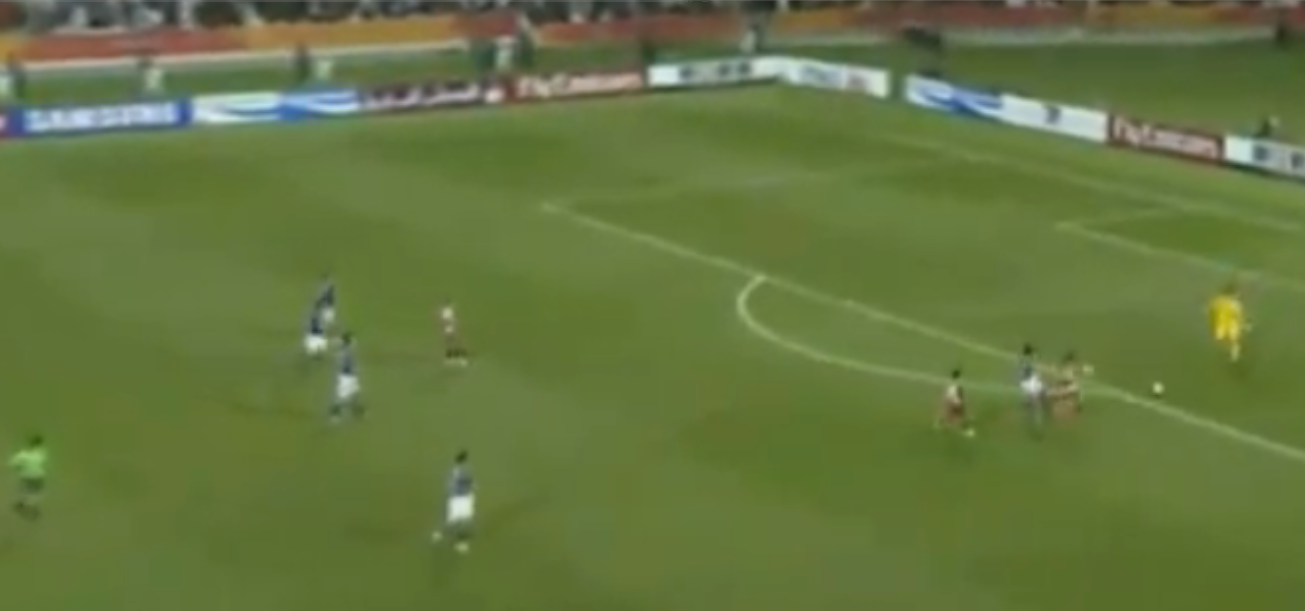
The following incident occurred during the second group stage match between Syria and Japan on 13 January 2011 at the Asian Cup in Qatar. The match finished 1—2.


In the 71st minute, a combination of defensive errors by Japan resulted in a situation where Iran referee Mohsen Torky made a tough decision. During the whole incident, the referee was composed, cool, calm and confident (at least on the outside). Please see the SUMMARY, after the freeze frames, to ponder and deliberate whether the referee made the correct decision.


Japan goalkeeper (yellow) is about to (mis)kick the ball with his left foot towards the Syria player standing in the middle of the field.

Did the Syria player (red with white boots) or Japan player (blue with black boots) kick the ball back toward the penalty area?

As the ball returns to the penalty area, the Japan goalkeeper (yellow) fouls the Syria player who is behind him and in an offside position.

Referee Torky ushers Japan coach off the pitch, while behind him players are surrounding the AR.

It took 5 minutes from the moment the Japan goalkeeper fouled a Syria player to the completion of the penalty kick.

Referee Torky decided that it was a Japan player who last touched the ball into the penalty area. Subsequently, the Syria player who was standing in an offside position behind the Japan goalkeeper, could legitimately play the ball. The Japan goalkeeper fouled the Syria player, and the referee awarded a penalty kick and then sent off the goalkeeper for DOGSO.


THE ISSUES TO CONSIDER


First and Foremost, the only real consideration to ACCEPT is that the referee at the time of the incident made a decision based on the best of his ability and experience. To his credit, he made the decision quickly and confidently. Furthermore, the referee kept cool, calm and composed throughout, despite how many times the players continuously argued with him and the fact that it took 5 minutes from the time of awarding of the penalty kick and send-off to the completion of the penalty kick. This is something POSITIVE to take from this incident. Torky was Composed and Confident, and remained Cool and Calm in the face of adversity.


The following issues are technical points, and should be taken in the context of being considerations only for post-match analysis. We have the benefit of repeat views, slow-motion replays, reverse backward, pause, magnification and several camera angles. Therefore:


1) Repeat views. Even after repeat views of the incident it is still not 100% clear which player—Syria or Japan—made the crucial touch that pushed the ball in to the penalty area. Without any definitive camera angles and close-ups, it could have been either player or both who touched the ball.


2) Pace of the ball and players’ body position. As the ball rebounds from the player(s) towards the penalty area, look at the pace of the ball. The pace of the ball indicates that there was good, solid contact (since the ball does not bobble up but instead rolls back along the ground at similar speed). Now look at the players. The Japan player, by desperately lunging, is overstretched and the weight of his left foot movement is mostly downward toward the ground rather than at the approaching ball. From simple mechanics, the ball would be hitting his foot (rather than his foot hitting the ball) and then would rebound (but this would not likely be a solid rebound and a “bobble” is likely). Contrast this with the Syria player who does not overstretch and appears to casually just jab (or toe-poke) the ball. From simple physics, the ball’s rebound movement implies that it made contact solidly and cleanly (i.e. the ball was kicked or toe-poked), mostly likely by the Syria player.


3) Players’ attitude and reactions. Now let’s look at the reaction of the two players. The Syria player had a casual attitude when competing for the ball. He did not appear too concerned about stretching himself, possibly because he knew he would get to the ball first (without overstretching himself). And, assuming he got to the ball first, because he could not control the ball (which rebounded from him right back to the penalty area), and since he knew that his team-mate was obviously in an offside position, he therefore wasn’t too concerned about heading enthusiastically towards goal. Furthermore, let’s assume it was the Japan player who actually played the ball back towards his own goal, then the Syria player’s reaction would have been to exploit the situation by either yelling at this team-mate and his team to play on, and/or he would do his utmost to move towards the goal and ball. The Syria player’s non-reaction perhaps tells us the real answer! But then again, the Syria player could have just been really tired (but these are meant to be professional players, so this explanation is probably difficult to accept).


In contrast, the Japan player was committed to tackling and winning the ball. He just kept on running into the penalty area after the ball, most likely because his commitment to trying to win the ball and his momentum carried him on into the penalty area. So either he didn’t touch the ball and didn’t think about the fact that an opponent was in an offside position and so continued running towards the ball, or he did touch the ball and thought he had better continue in his pursuit of the ball. Whatever scenario for the Japan player, it is difficult to fathom the real reason why he continued running into the penalty area after the ball. This is why it is better to look at the reaction of the Syria player.


Even another attacking Syria player (#6) closest to the AR stopped, and therefore possibly knew that his team-mate was in an offside position. Syria player #6 had the same thought (and similar viewing angle) as the AR. That is, both the AR and Syria #6 thought the ball was kicked forward by Syria and therefore the most forward Syria player was offside.


SUMMARY


The referee made his decision quickly, confidently and remained cool and calm to sell his decision. Whether it was the right decision, technically, is difficult to call. This is because, even after repeated views of the incident it is still not obviously clear which player—Syria or Japan—made the crucial touch that pushed the ball in to the penalty area.


Only with careful deliberation, countless replays, assessing factors for and against, and all the rest of the things we do in evaluating, can it be said that the referee probably got his decision more incorrect than correct. And if the referee was not 100% sure that the ball did come off the Japan player, then it would be a very brave referee indeed to make that call. As we saw, the referee made a bold decision and sold the decision well. He remained cool, calm, and confident and was very well composed. All credit to the referee. No one can really step in his shoes at that moment, so his brave decision must be applauded (and must be accepted by players, coaches, fans and everyone else).


Here are some videoclips of the incident:


This one in particular has a well-balanced and intelligent analysis, as well as some interesting comments and views.

SYRIA vs JAPAN 1-2 Full Highlights 13-01-2011 Japan 2-1 Syria


Kawashima Red Card Sent Off Controversy, Japan vs Syria (2-1) 2011 AFC Asian Cup Group B


Japan 2-1 Syria 2011 AFC Asian Cup Group B All Goals Full Highlights


NOTE: Another technical point is that the referee sent off the Japan goalkeeper for DOGSO. However the Syria player, who was behind the goalkeeper, was not heading towards goal. Technically, this is one of the conditions that referees are taught to use when considering whether there has been a denial of an obvious goal scoring opportunity. Common sense tells us that had the Syria player not been fouled, he would have had time to turn and create an obvious goal scoring opportunity before being challenged by other players. However it can be argued that, technically, the player was not heading towards goal.


Wednesday, 10 November 2010

Nishimura Gets 2010 AFC Champions League Final

Congratulations to Japanese referee Yuichi Nishimura, who has been appointed to officiate the AFC Champions League Final at the Tokyo National Stadium on Saturday 13 November 2010.

Japan's Toru Sagara and Toshiyuki Nagi will be the assistant referees, and Hiroyoshi Takayama will be the fourth official.

The final will be between Korea Republic’s Seongnam Ilhwa Chunma and Iran’s Zob Ahan.

[All together now … “no more” … otherwise you’ll probably get … another talking to]

It will be interesting to see whether Nishimura’s preferred policy of managing players with gentle talk rather than cards will be effective in this forthcoming high-stakes competitive match.

Tuesday, 12 October 2010

Referees and Handbags

Lots of handbags in the friendly match between Australia and Paraguay on Friday 9 October 2010. The match finished 1—0.

World Cup referee Yuichi Nishimura dished out only two yellow cards both to Paraguay (one for simulation to #3 Claudio Rodriguez in the 23rd minute and a caution to #2 Dario Veron for a reckless tackle on #10 Harry Kewell in the 85th minute), in what appeared to be a feisty-not-friendly and tough-not-technical match.

Here are the match statistics, with Paraguay committing twice as many fouls as the Socceroos.


It seems full-time professional referee Nishimura took up from where he left off at the World Cup in South Africa and managed the match by attempting to talk with players rather than hand out cards. This policy at the 2010 World Cup saw Nishimura rewarded with four matches and he was also the 4th Official in three matches including the World Cup final.

In this encounter between Australia and Paraguay, Nishimura's talk-but-no-cards policy meant that many players escaped sanctions with their provocative posturing, tough challenges and dangerous manhandling.

The following highlights (from videos here and here) show some examples of referee positioning and physical incidents of the spirited feisty encounter between the two teams:

1) (0:23)
Interesting position adopted by Nishimura. He has two options during this Australia attack. Option 1 is the standard run towards the D (which is how he is initially shaping his run), which gives him the external angle and also allows him to anticipate a cross into the penalty area. Option 2 is the run towards the AR (which is his eventual positioning), which enables him to observe play behind the players but gives him an internal angle and also puts him out of position if there is a cross into the penalty area.

2) (0:38)
For Australia’s goal, the Referee’s positioning makes it difficult for him to see the foul beforehand by the Paraguay defender. As the ball is crossed from the right, the Paraguay defender had no chance to reach the ball and instead bundles over the Australia attacker.
Fortunately, the ball falls to #3 David Carney who scores with a wonderful left-footed strike. However, whether the goal was scored or not, the question to ask is whether Nishimura (or his AR or 4th Official) spotted the foul.

3) (1:38)
For a friendly, there appeared to still be plenty of gamesmanship between the players. Australia #8 Luke Wilkshire clears the ball but Paraguay #18 Nelson Valdez leads with his studs and leaves them in. Valdez could have seriously injured his opponent. This is the reason why Wilkshire reacted, and then it went all “handbags”. Referee Nishimura eventually came on the scene and attempted to talk with both players. No cards and not even a warning to Valdez for his gamesmanship.

4) (2:22)
More feistiness occurs between the players because of the continued gamesmanship. Does Nishimura’s policy of just “talking with the players without using meaningful roadblocks” work? Here, the cause of this confrontation is due to Paraguay #20 Osvaldo Martinez striking his opponent Australia #17 Scott McDonald on the head with his right arm. As McDonald confronts his assailant, Paraguay #13 Enrique Vera rushes in and grabs McDonald’s throat using his left hand. Again, what does the Referee do? No cards and no warning to Martinez or Vera for their gamesmanship.

5) (2:57)
In the course of the match Australia players have shown that they have endured the gamesmanship and tolerated the physical knocks from Paraguay. However when it comes to Paraguay players being on the receiving end of some robust challenges, their tolerance is different. Paraguay #10 Edgar Benitez didn’t like the robust challenges he received and reacted by raising his right hand threateningly to grabbing the throat of the nearest Australia player to him (#8 Wilkshire), even though just earlier Benitez clearly pushed Australia player #13 Jade North in the back.

Perhaps this newspaper quote from Australia #10 Harry Kewell fairly sums up this feisty encounter:
Kewell found himself at the centre of attention from the Paraguayan players, who kept physically challenging him - although at least he didn't have his throat grabbed as teammates Scott McDonald and Wilkshire did. ''I think it was one of those games where the ref let a few tackles fly,'' Kewell said. ''But we're not one to back down from challenge. We give as good as we get.''


Kewell's comment that "the ref let a few tackles fly" is pretty much correct. The tone of the match is more to do with how the referee manages these incidents. There are pros and cons to "having a word" with players, but as soon as players sense that a referee is reluctant to issue cards that are warranted by the Laws, then all handbags and hell may break loose!

Furthermore, when guilty players quickly run away from incidents and from the referee despite the referee clearly whistling and signalling several times for the player to “come to him” (which happened frequently during the match), then the referee must adjust his management approach to the game. Unfortunately, Nishimura did not take this into account and players, mainly Paraguay players, and even the Paraguay coach, disrespected the referee's authority.

Wednesday, 22 September 2010

Not Optimum Officiating in the AFC Cup Part 2

The following incident occurred during a second-leg quarterfinal AFC Cup match between Muangthong United of Thailand and Al Karamah from Syria on Tuesday 21 September 2010. The match finished 2—0.

Football can be a controversial game, particularly if important decisions by match officials have an impact on the outcome. Last week, following the first-leg encounter between these two Asian football teams, HKRef mentioned the possibility that Al Karamah’s disallowed goal which was incorrectly ruled offside would prove significant. Well, it has.


Here are the highlights of the second-leg quarterfinal match:

AFC Cup Quarterfinals: Muang Thong United FC 2-0 Al Karamah 21/09/2010


The first goal for Muangthong United was a nicely-worked goal. There is no controversy here, and from the referee’s perspective it is always nice to be a nearby witness to a well-crafted football move that results in a goal.

However, the second goal is controversial for two main points.
First, it appears that the Muangthong United attacker (red) is guilty of simulation. Watch closely, as he intentionally drags his right foot as if “trawling” for a foul. However, this is the match referee's decision to give the penalty; the referee calls it as he sees it.
Second, the penalty kick should have been disallowed (and retaken) because it did not meet the requirements of Law 14.

Can you spot the breach in Law 14 from the following three pictures?

[The decisive spot kick; but should it have been allowed?]

The placement of the ball is clearly NOT on the penalty mark. Again, this is not optimum officiating.

The Match Officials were:

Match Commissioner
Lai Boon Teck (Sin)

Referee Assessor
Edward Lennie (Aus)

Referee
Choi Myung Yong (Kor)

Assistant Referee 1
Eun Jong Bok (Kor)

Assistant Referee 2
Choi Minbyoung (Kor)

Fourth Official
Kim Sang Woo (Kor)

Match reports can be found here and here.

Thursday, 16 September 2010

Not Optimum Officiating in the AFC Cup

The following incident occurred during a first-leg quarterfinal AFC Cup match between Al Karamah of Syria and Muangthong United from Thailand on Tuesday 14 September 2010. The match finished 1—0.

Watch the incident beginning from 0:30

Al Karamah 1-0 MTU_News


This incident occurred in the 14th minute when Al Karamah’s midfielder Mahmoud Al Mawas shot from distance and the ball cannoned off the crossbar. The rebound fell to Mohamad Al Hamwi who headed the loose ball into the net. The following four freeze frames show this.

[The ball is struck from a distance of over 30 yards. The ball's flight can be seen all the way to the crossbar.]

From the time the ball is struck from over 30 yards to the time it hits the crossbar, it is clear that Al Karamah players (blue) are all onside. However, the goal was incorrectly ruled out for offside. This means the AR was probably not fully focused or was poorly positioned.

Whether this disallowed goal proves significant or not may depend on the result of the second-leg quarterfinal AFC Cup match. Nevertheless, this is not optimum officiating.

The Match Officials were:

Match Commissioner
Abdulrazaq Mohamed Abbas Kamal (Bahrain)


Referee Assessor

Ali Tareq Ahmed Ali (Iraq)


Referee

Tan Hai (China)


Assistant Referees

Huo Weiming (China)

Su Jige (China)


Fourth Official

Muokhtar Saleh Ali Al-Yarimi (Yemen)


Match reports can be found here and here.

Saturday, 27 March 2010

AFC Cup 2010 South China v Persiwa Wamena

The following incidents of unsporting behaviour occurred during the AFC Cup group stage match between South China (Hong Kong) v Persiwa Wamena (Indonesia) on Tuesday 23 March 2010 at Siu Sai Wan stadium in Hong Kong. The attendance was 2,393 and the final score was 6—3.


23 Mar 2010 AFC Cup Simulation


Simulation is unsporting behaviour
In the 50th minute, South China player (red #9, Lee Wai Lim) controls the ball ahead of the Persiwa Wamena player (green) to put himself in an attacking position. A big hint for referees is that red #9 goes down too easily. The player could have stayed on his feet to either shoot at goal from a tight angle or place the ball across the face of goal for his teammate to tap in. But instead, he chose to fall over.

There is little need for unsporting behaviour, particularly at this stage of the match when South China is already 5—1 ahead.

When the Referee showed the yellow card, red #9 actually smiles sheepishly and hangs his head in shame because he knew he was caught cheating. Restart was an IFK to the defending team.


23 Mar 2010 AFC Cup GK shocking tackle Penalty


Goalkeeper’s shocking tackle
In the 70th minute, the South China goalkeeper (blue #17, Ho Kwok Chuen) makes a shockingly dangerous two-footed tackle on Persiwa Wamena player (green #50). He launches himself using his right foot, goes over the ball with his left foot, and then his whole weight appears to land on his right foot. This is probably the reason why he could not get up when he put his weight on his right foot. He clearly injured himself, and after receiving lengthy treatment was carried off the pitch on a stretcher.
Note:
Players are not allowed to receive treatment on the field of play. But exceptions apply when:
• a goalkeeper is injured
• a goalkeeper and an outfield player have collided and need immediate attention
• a severe injury has occurred (e.g. swallowed tongue, concussion, broken leg)

In similar situations goalkeepers would normally dive for the ball using their hands. Instead, this goalkeeper made a shocking tackle leading with his feet. Therefore a hint for referees is the aggressive nature of the South China goalkeeper’s challenge.

The Referee correctly awarded a penalty. In the match report, it was recorded that the Referee cautioned the GK. However, during the match the Referee did not show the yellow card to the GK on the field of play probably because the injured keeper could not stand up and was carried off on a stretcher. The challenge by the GK was at least a yellow card offence and perhaps could have been a red card. Restart was a penalty kick to the attacking team.


23 Mar 2010 AFC Cup Playacting Theatrics


Playacting is unsporting behaviour
In the 80th minute, Persiwa Wamena player (green #10, Edison Pieter Rumaropen) makes a meal out of an incident where there is little chance that he would be awarded a free kick or penalty. A big hint for referees is that the player moves to-and-fro (at least a dozen times), when surely if it was a serious injury the player would remain still (see also Player Theatrics by HKRef).

About 30 seconds after restart, green #10 is seen running up the touch line and re-enters the field of play near the halfway line. Perhaps the Referee should have cautioned the player for unsporting behaviour.

Match Report
South China 6-3 Persiwa Wamena (AFC news)
Tuesday, 23 March 2010 22:27

Hong Kong: Brazilian strike duo Tales Schutz and Leo each grabbed a brace as South China revived their AFC Cup Group G campaign with a thrilling 6-3 comeback win over Indonesia’s Persiwa Wamena at Siu Sai Wan Sports Ground on Tuesday.


After picking up just one point from their opening two games last year’s semi-finalists were behind after just six minutes as Pieter Rumaropen struck for Persiwa.


But a quick-fire brace from the returning Schutz turned the contest in South China’s favour before Leo (Leonardo Ferreira da Silva) and Kwok Kin Pong added to the lead before half-time.


Leo extended the advantage just after half-time and after Albertho Mambrasar and Lewis Weeks netted for Persiwa, Lee Wai Lim sealed the win in stoppage time.


After South China captain Chan Wai Ho wasted a glorious chance after just three minutes the visitors opened the scoring as a punch from South China goalkeeper Ho Kwok Chuen fell to Rumaropen on the edge of the area and the midfielder lifted the ball over the stranded custodian.


But South China were back on level terms after eight minutes when Schutz beat Persiwa goalkeeper Timotius Mote with a deft flick at the front post.


Mote only just turned Li Haiqiang’s long-range swerving free-kick onto the post after 11 minutes as the frantic start continued with end-to-end action.


And after 21 minutes South China completed the comeback as Schutz muscled his way through a crowd inside the area to send a stooping header past Mote from Li’s superb whipped in free-kick.


With several Persiwa attacks being halted by the off-side flag, Leo capitalised on the visitors’ inability to clear their penalty area 11 minutes later to fire a low shot across Mote and into the bottom corner to double the lead.


And just three minutes later Kwok raced into the area unmarked to head home Lee Wai Lun’s left wing cross to complete the emphatic comeback.


With just over a minute on the clock after the break Leo charged down an attempted clearance to race clear and skip round substitute goalkeeper Andre before rolling in his second into the empty net.


Leo was denied a hat-trick by Andre four minutes later before Mambrasar volleyed home from inside the area to give Persiwa faint hope six minutes before the hour mark.


And the visitors pulled another goal back with 15 minutes remaining as Weeks beat substitute goalkeeper Zhang Chunhui from the penalty spot after Ho was injured in bringing down Rumaropen.


But the visitors were unable to build on their quick-fire double and suffered a second defeat of the competition as Lee’s late header capped an enthralling contest.

Tuesday, 16 February 2010

China Wins 2010 East Asian Football Championship

Congratulations to China PR who emerged victorious and were the only unbeaten team during the 4-team 2010 East Asian Football Championship Finals held in Tokyo, Japan between 6 and 14 February 2010.

Here are the final table standings following 6 competitive games:


Perhaps not so widely known is that there were a total of 19 cautions and 2 send-offs: China PR picked up 6 cautions; Korea Republic had 5 cautions and 1 send-off; Japan had 4 cautions and 1 send-off; and Hong Kong picked up 4 cautions. As a result, Hong Kong were awarded the Fair Play Award for the EAFC 2010.

The Match Officials were:
Match Commissioner CHANG Chin Po /TPE
Strebre DELOVSKI /AUS

Matthew CREAM /AUS

Hakan ANAZ /AUS

ZHAO Liang /CHN

NG Kai Lam /HKG

CHOW Chun Kit /HKG

Ryuji SATO /JPN

Akane YAGI /JPN

KIM Jong Hyeok /KOR

LEE Jung Min /KOR


Here are the match highlights of the final match between Japan and Korea Republic:
Japan 1 v 3 Korea Rep : Match Highlights


China takes East Asian Championship (China Daily)
TOKYO: The China national football team emerged victors of the East Asian Football Championship beating a gritty China's Hong Kong team 2-0 at the National Stadium in Tokyo on Sunday to win the tournament with seven points from three games.

Second-placed South Korea, who were defending the title, helped China's plight with a convincing 3-1 win over arch rivals Japan in a hotly contested game that saw both World Cup-bound teams finish the game with only ten men.

"Being champions marks a change for Chinese football," said China's head coach Gao Hongbo following China being presented with the East Asian Football Championship trophy and a check for 500, 000 U.S. dollars at the tournament's presentation ceremony.

"Chinese football is underdeveloped compared to the likes of Japan and South Korea, but winning this tournament is not just about the national team, it's a reward for everyone working in China's football industry," he said.

"I'm extremely happy with the team's performance over the past seven months as our world ranking has improved by more than twenty places and winning the East Asian Football Championship represents the strength of Chinese football," said Gao.

China's 0-0 stalemate against a below-par Japan in their opener, which caused a stir for the host nation as the team and particularly head coach Takeshi Okada were booed off the pitch despite Okada's men beating Hong Kong 3-0 in their previous game, bolstered China's resolve ahead of their monumental clash with South Korea.

However, the result for Japan and the hammer-blow dealt to the hosts by South Korea on Sunday, resulting in Japan finishing in third place with four points, will be of grave concern for Okada with the World Cup in South Africa only four months away.

China, described as "vastly improved" by Okada following their opening tie, went on to thrash South Korea 3-0 in an historic victory that brought an end to 32-years of fruitless results against the Koreans, and a resounding second half performance on Sunday against bottom-placed Hong Kong was enough for China to take the title in 2010, having first won the tournament in 2005.

South Korean coach Huh Jong-moo applauded the performance of his players following their crushing defeat of Japan, saying it was: "A fantastic new year's gift for his team and the South Korean people," adding that the tournament had been a valuable opportunity to test new players in the absence of missing players in Europe and to evaluate the squad's strengths.

Meanwhile Japan's national team coach Takeshi Okada, seemingly loosing the public's faith in his ability to steer the team forward as indicated by more booing from the Japanese fans after Sunday's must-win game for Japan, apologized for not winning the tournament at home soil.

"We were extremely sorry not to win the tournament, said Japan coach Okada, adding that his team, hotly tipped from the get-go to win the tournament, ahead of their World Cup campaign, lacked urgency in their final game against South Korea.

"There is no magic solution and the team won't be overhauled, but we were too patient and needed to change our objective and apply more pressure when it was necessary," said Okada.

China's women's football team also ended their East Asian Football Championship campaign on a high on Saturday, disposing of bottom-placed Chinese Taipei with a comfortable 3-0 victory to secure second place in the tournament.