Showing posts with label Law 5. Show all posts

Thursday, 28 May 2015

Whose Blunder Is It Anyway?

Media reports have accused a Chinese goalkeeper of making a serious mistake. Sui Weijie's club Lifan has also fined him 50,000 yuan (about US$8,000) and faces a suspension. However, a bigger mistake was made by the match officials ... what was it?

Liaoning players (red) take a quick free kick against Lifan (white) in the Chinese Super League

You can see the video here (or watch below)


Reference
PUBLISHED : Tuesday, 26 May, 2015

Quenching his thirst while on duty proved costly for Chongqing Lifan goalkeeper Sui Weijie, who has been fined for sipping water as their opponents equalised in a Chinese Super League match.
 
Relegation-threatened Lifan were leading 1-0 seven minutes from time in Sunday’s match when hosts Liaoning took a quick free-kick and midfielder Ding Haifeng darted past a group of static defenders before slotting the ball into an empty net, with Sui stood motionless drinking next to the goal post.

Lifan have since slapped Sui with a 50,000 yuan fine and he faces suspension.

Alternative angle

"I made a terrible mistake in Sunday’s game and let go a full three points," Sui, who was confronted by Lifan supporters at Liaoning’s Shenyang Airport on Monday, was quoted as saying.

"I won’t repeat the same mistake and will never lose concentration."

And Sui is unlikely to be a popular man in the dressing room - management had promised players a 1 million yuan bonus for a win, which was reduced to 400,000 since they only drew.

Sui was questioned by the ICAC in 2010 while playing in Hong Kong for Happy Valley in a match-fixing scandal, but never charged. 


Monday, 18 May 2015

Rational Ref: Colourful shirts undermine a match official's authority, or do they?

Colourful shirts undermine a match official's authority, or do they?

Colourful shirts undermine a match official's authority, or do they?

 Australia's NRL referees will no longer wear pink jerseys. Photo: Getty Images

The term "Men in Black" is more likely to conjure up images of Will Smith blasting aliens into outer space rather than referees carding players off the soccer pitch. That's because the game's leading law enforcers are mostly kitted out in lemon yellow, lipstick red, sherbet blue and even fuchsia pink.

Over in the rugby world, Australia's NRL referees have ditched their colourful shirts claiming their "Pretty In Pink" tops undermine their authority. Even though rugby referees command far better respect from players, there could be some truth to their feelings of insecurity based on the colour of their shirts.

Rugby referees will now wear dark blue or black uniforms that, according to Tom Heenan from the National Centre for Australian Studies, are more likely to encourage discipline.

"One of the arguments is a stronger colour denotes a more disciplined culture, so therefore a navy blue would promote more discipline than a pink," Heenan said.

But psychologist Chris Pomfret of Condor Performance said there was no evidence the colour of a referee's uniform made any difference to how he was perceived. "I'm not aware of any evidence the colour pink would make any difference to how an official is perceived by the people they are officiating over, the crowd, coaches or any other observers," said Pomfret.

He said by agreeing to scrap the pink jersey this suggested the NRL was too concerned with what players, coaches and supporters thought of referees.

Arsenal's Alexis Sanchez (right) tries to place the ball past Crystal Palace goalkeeper Julian Speroni. Keepers who wear bright shirts increase their chances of putting off opponents. Photo: EPA  
"The colour of a uniform is irrelevant to the skill execution of referees, just the same as the colour of a jersey worn by players is irrelevant to their skill execution," he said. "In short, the colour of a uniform shouldn't matter as it doesn't directly impact on the performance of a referee, which ultimately has the most influence on their perceived credibility."

Scientific evidence suggests otherwise. Rugby referees are on to something and soccer referees can benefit from this kind of knowledge, too.

The science of colour psychology reveals that goalkeepers who wear bright flamboyant shirts may be better off than those wearing boring duller tops.

By heightening their opponents' perception levels, goalkeepers make themselves appear bigger than they really are. Goalkeepers wearing outlandish kits thus increase their chances of putting off their opponents who have only a split second to squeeze the ball past them and into the goal.

Liverpool's Daniel Sturridge (left) controls the ball as Blackburn's Adam Henley looks on. Photo: AP 
There is another a study that showed teams taking penalty kicks performed worst when the winning team's goalkeeper wore red, which appears to be a powerful colour for players.

In England, records since the second world war reveal teams wearing red have averaged higher league positions and have won more league championships than teams wearing other colours.
Also in cities with more than one team, the teams wearing red outperformed their rivals wearing other colours. Manchester United and Liverpool spring immediately to mind. In Hong Kong, South China are the most successful local club side ever.

New York Cosmos' forward Raul Gonzalez (centre) vies with South China Football Club's Chak Ting-fung and Bojan Malisic during the Lunar New Year Cup. Photo: EPA 
In 1996, Alex Ferguson famously changed his team's grey away kit at half-time following a humiliating 3-0 onslaught by Southampton. Wearing blue in the second half, they lost 3-1. Of five games ever played in their grey kit, United lost four and drew one.

Would the public (and criminals) take police and prison guards seriously if their uniforms were bright pink or fluorescent green? Of course not.

Referees should be known again as the Men in Black. Instead of referees having to change their shirt colours due to kit clashes with teams, organisers should insist all teams including their keepers do not wear black kits. Ultimately, whatever colour they wear, referees in the modern era still need all the help they can get to become more commanding and effective on the pitch.

PUBLISHED : Thursday, 12 March, 2015

UPDATE: Men dressed in red perceived as being more aggressive, study finds

Wednesday, 7 January 2015

Rational Ref: Horrid acts are no laughing matter


Rational Ref: Horrid acts are no laughing matter

Match officials should not be so reviled by fans, especially when they are injured during the course of their duty on the pitch


When something unpleasant happens to match officials fans go wild with delight and reporters have a field day writing about the misfortune inflicted on the man in the middle.

This happened last weekend when EPL referee Chris Foy was knocked out for a few seconds by a ball hitting him flush in the face in the first minute of the Newcastle and Swansea match. After the Newcastle medic checked him, he continued for 30 minutes, but something was not right, so stand-in referee Anthony Taylor replaced the dazed and confused Foy.

The feelings of schadenfreude espoused by everyone watching revealed just how hated match officials are. Does this antipathy tell us anything about soccer lovers and the society we live in?

In other sports, officials are not as intensely loathed. Those in tennis, snooker and golf are not regularly mocked, jeered and abused by players and spectators when they make decisions.

Seriously, contrast the crowd's pleasure at seeing referee Foy being hit in the head and concussed to the reaction of shock over the death of a keeper in Gabon after an opponent stepped on his head. Did anyone laugh? Keeper Sylvain Azougoui suffered serious head injuries that ultimately proved fatal.
 
Recall last season, when Swansea City's Ashley Williams deliberately kicked the ball with full force from close range at the head of Manchester United's Robin van Persie. Then United manager Alex Ferguson said Van Persie "could have been killed". "[It] was the most dangerous thing I've seen on a football field for many years. It was absolutely deliberate. The whistle has gone, the game has stopped and he has done that right in front of the referee… It was a disgraceful act," said Ferguson.

The FA did not take action against Williams, using the feeble excuse that referee Michael Oliver had cautioned both players, which meant the FA was "powerless" to take retrospective action on grounds of "re-refereeing" an incident.

Had Van Persie suffered a broken neck or even worse, it is certain action would have been taken against Williams, regardless of whether the referee had already "dealt with the incident".

A recent study showed that heading the ball is associated with clear risks of brain injuries, mainly because it increases the odds of head collisions with other players. Referees are trained to treat any impact to the head as a serious injury.

Players who deliberately kick, or attempt to kick at, opponents' heads must also be severely punished retrospectively by competition organisers.

Two years ago Mario Balotelli, then of Manchester City, was retrospectively sanctioned for his intentional stamp that narrowly missed the head of Scott Parker, who was playing for Tottenham Hotspur.

At the time, Balotelli, still immature at 21, denied he did anything malicious and referee Howard Webb had missed the incident. The FA suspended Balotelli for four matches and Manchester City did not bother to appeal against the charge of violent conduct, which spoke volumes.

Although it is impossible to know the intent of players, referees use a clever test. They ask themselves would the offender have acted in the same uncontrolled manner towards his teammate or even a family member. Although by no means foolproof, this is how experienced officials try to make sense of seemingly "innocent" incidents.

But they also need support in terms of retrospective action since referees cannot always see everything that happens on the pitch.

A blow to the head should be treated seriously. It is no laughing matter.

  • A final note: Fifa once again showed its technophobic paranoia when it pulled the plug on Australia's experiment in miking up A-League referees for its current end-of-season finals, which would have been a world first. The idea was that at key moments, the audio from the referee and linesmen would have been aired by broadcaster Fox Sports. This would have brought soccer in line with other codes such as rugby league, union and Aussie Rules.

Agree or disagree? Contact Rational Ref at rationalref@gmail.com

PUBLISHED : Thursday, 24 April, 2014

Thursday, 18 December 2014

Rational Ref: Beyond perfection, referees are the real superheroes

Rational Ref: Beyond perfection, referees are the real superheroes

Referees who display mortal weaknesses are abused or even vilified

Forget Flash, Spider-Man and Wolverine. Referees are the real superheroes in the world of soccer. And like these superhumans who do good deeds and fight for justice, referees are treated as freaks and mutants because they are seen to be different from normal human beings.

Referees are superhuman because there are certain expectations and high standards that they are held to. By the same token, they are also considered to be subhuman. There is no middle ground.

First, referees must have amazing powers of vision plus an extra pair of eyes in the back of their heads just in case they miss anything. If they fail to spot a ball entering the goal, which video cameras can easily confirm, then referees are simply useless and biased.

Referees are expected to spot the slightest contact between players, see through crowds, and identify all kinds of cheating. Referees are expected to perform to the same level as the multiple-camera systems dotted around the stadiums.

Second, they must be indestructible. Referees are not allowed to pick up injuries, whereas players get injured all the time. Injured players are permitted to be assessed by medical personnel on the pitch, are treated with sympathy when they suffer run-of-the-mill injuries, and are given the best medical care for their rehabilitation. Injured referees are just expected to pick themselves up and carry on officiating. If they pull a muscle or accidentally trip over, players, coaches and supporters will instantly be on their backs.

Third, referees must exhibit model behaviour. Referees cannot swear or use abusive language even though they are regularly subjected to vile torrents from players, coaches and supporters. It is ironic that mouthy players who verbally abuse referees suddenly become sensitive and offended by the words "shut up".

Many referees, for instance EPL referee Mark Clattenburg, tell wayward players to "shut it" and players become outraged. They respond with: "You can't talk like that to me" and "you can't tell me to 'shut up'". The hypocrisy exhibited by players and coaches is unbelievable.

Fourth, referees must be infallible. They cannot make mistakes such as forgetting their cards, pens or whistles. Any errors on their part are unforgivable and a deluge of abuse will come their way should they tie their bootlaces or replace a piece of broken equipment during a match.

Chelsea midfielder John Mikel Obi talks with referee Mark Clattenburg as Spanish midfielder Juan Mata looks on. Referees are expected to be superhuman. Photo: AFP 
Fifth, referees must be super conditioned and not need to rehydrate on the pitch. During a match, a referee can easily run more than 10km, which is similar to the distance covered by many players. Players will take any opportunity they can to grab a drink, such as when another player is being treated for an injury. Or players will run to the touchlines to grab a water bottle.

It is astonishing to see goalkeepers drinking far more than outfield players, even though keepers do not run around as much as referees, linesmen and players. Yet, if a referee grabs a drink, he is looked down upon.

Rational Ref has had players remark at half-time: "You need to drink water?" In such moments, it is obvious how some players feel about referees. It is an "us against them" outlook and the psychology of such group divisions has been well researched. This division is the basis of why players, coaches and fans consider referees to be subhuman.

Essentially, whenever authority figures come into the spotlight while performing their duties, they will inevitably be criticised and vilified. In light of Occupy Central, the police have similarly taken a bad rap for simply performing their duties according to the law. A recent poll has shown public sentiment towards Hong Kong police is even below that of the People's Liberation Army.

That's how crazy popular opinion can be when people do not understand the meaning of "rule of law". Before condemning and abusing the police for simply doing their jobs, supporters of the Occupy movement first need to brush up on the law. The parallel here is that referees officiate according to the laws of the game and are vilified because their actions are unpopular and misunderstood.

Referees know players, coaches and supporters give them a hard time. Although this kind of abuse and antagonism comes with the territory, it nevertheless does not make it right. Good behaviour and respect are far more important than cheating, abusing and winning at all costs. This is why referees are the real superheroes in the villainous and immoral world of soccer.

Agree or disagree? Contact Rational Ref at rationalref@gmail.com

PUBLISHED : Friday, 12 December, 2014

Newspaper Column

It has been a while since I last posted on this blog. One of the reasons is because I am now writing a weekly newspaper column, with the aim of raising awareness of the positive attributes of being a match official. Since there are still plenty of readers who still visit this blog, I will be uploading my articles here from time to time.

Please let me know if you find these articles about referees interesting. Further, if you would like to see certain topics raised and written about, you are welcome to make suggestions.

You can email me at rationalref@gmail.com

Thank you


Wednesday, 7 August 2013

RefCam: A Referee's Perpective

The following incidents occurred from the Referee's Perspective during the MLS All Stars match against Roma on Thursday 1 August 2013. The match finished 1—3, with 2 YCs.


Ref Cam: Sights and Sounds from the 2013 ATT MLS All-Star Game (YouTube)


Here's what Referee Hilario Grajeda looked like rigged up with the RefCam (which appears rather bulky).


From the start, Roma midfielder Miralem Pjanic (red 15) appears to be one of those players who persistently badger the referee to give things in their favour. Experienced Referees can spot these type of players a mile away.
 
C'mon Ref, what are you doing?


Later, Pjanic (red 15) fouls MLS All Stars captain Thierry Henry (blue 14). Pjanic looks at the Referee apologetically to make sure that he is not booked.
 Nice, clear and firm signal to indicate a direct free kick
 Don't book me Ref! I'm a good boy ... honest ...
Notice also the big screen from the Referee's view. A simultaneous double whammy!


Roma goalkeeper Morgan De Sanctis (grey) catches the ball and Referee Grajeda raises his ams with all fingers splayed out. He waits a second or two and then gives two thumbs up. What is this signal? What message is the Referee trying to communicate and are players paying attention to him?

 
 Wait ... wait ... goalkeeper has the ball ... wait ... thumbs up ...


In the 54', Pjanic (red 15) fouls Landon Donovan (blue 7) and Referee Grajeda, who appears (at least from the RefCam perspective) to be quite a distance away, cautions Pjanic.
 Is it clear to the players, match officials and spectators who the Referee has given a yellow card to?
Donovan takes exception to Pjanic's unfair challenge.


The RefCam is a great experience that the MLS (or PRO?) is offering to soccer fans. Letting people see what the referee sees … or doesn't see … can only be a good thing if we want to provide a better understanding of the important and fantastic work that Referees do. Let's see more RefCams!


Related Post
Able Referee Assistants Must Assist Referees Ably


Tuesday, 25 June 2013

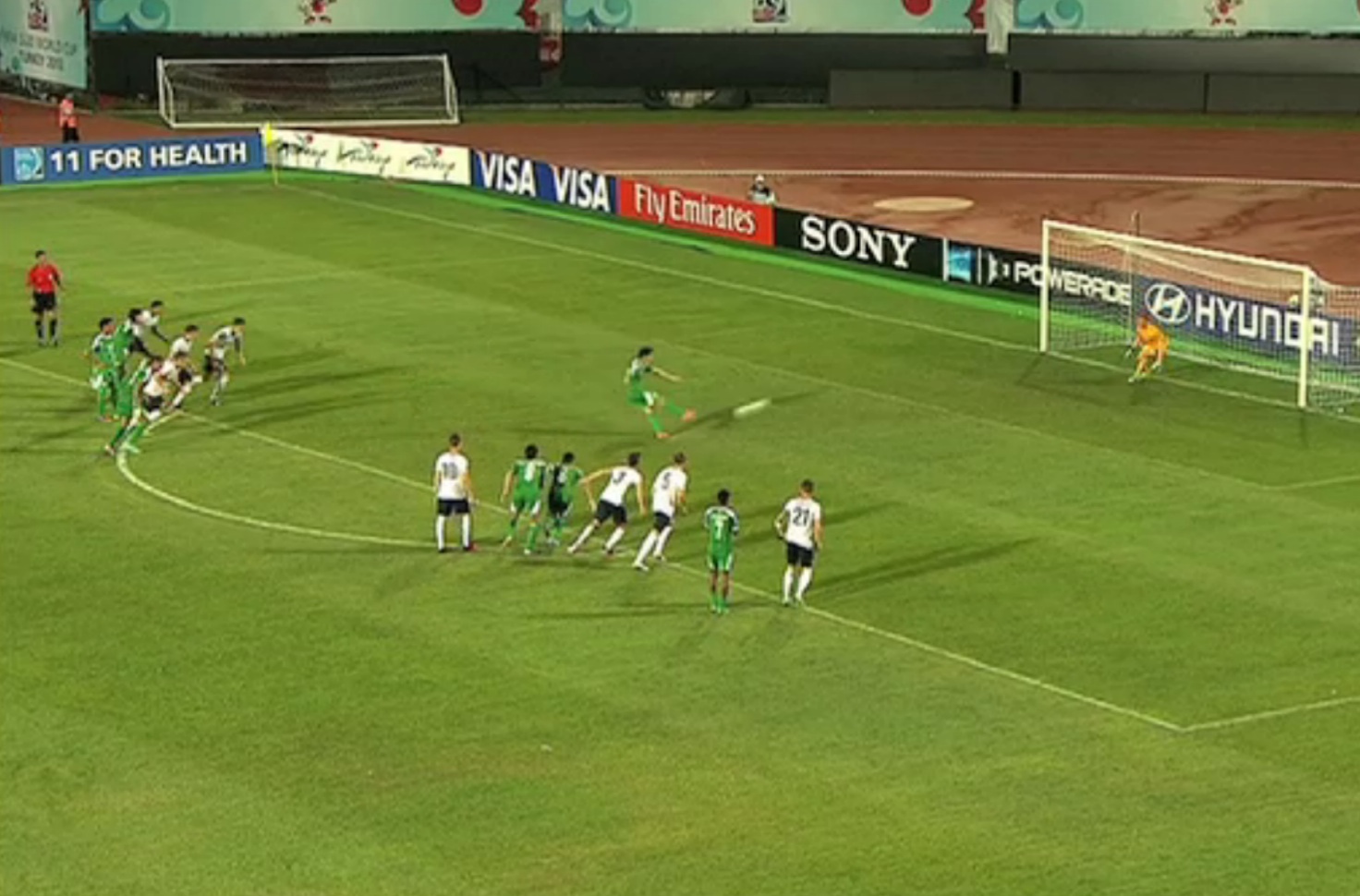
FIFA Guidelines For Referees: Positioning for a Penalty Kick

The following incident occurred during the FIFA U20 World Cup group match between England and Irag on 23 June 2013. The match finished 2—2, with 5 YCs.

In the 74', with the score at 2—0, Referee Roberto Garcia (Mexico) correctly awards a penalty to Iraq. Here is his correct positioning for the penalty kick.


Some of the comments from readers (who I assume are referees) for the recent post Positioning Guidelines for FIFA Referees reveal a surprising lack of basic knowledge of the LOTG.

Please consider why FIFA recommends Referees to stand approximately in this position for penalty kicks.

Next, consider why FIFA recommends Referees to stand in a different position for Kicks from the Penalty Mark.


FIFA Referees are supposed to have attained a certain standard of competency. Therefore, whenever inconsistencies are observed, the purpose of raising its awareness is so that the rest of us can learn from the mistakes of high-profile Referees (without, hopefully, performing the error ourselves).

We should also be concerned about why FIFA Referees are not consistent in their knowledge of the LOTG.
Who are the ones instructing the Referee instructors and assessing the Referee assessors?

The match officials were:
Referee: Roberto GARCIA (MEX)
Assistant Referee 1: Jose Luis CAMARGO (MEX)
Assistant Referee 2: Alberto MORIN (MEX)
Fourth official: Wilmar ROLDAN (COL)


Friday, 21 June 2013

Positioning Guidelines For FIFA Referees

The 2013 UEFA U21 European Championships held in Israel was home to some wonderful matches from players, some solid performances from match officials, and some fantastic entertainment in general for everyone involved.

For informative and insightful analyses, I suggest visiting The Third Team website. It is a great website looking at refereeing from Europe. They also have some dedicated and passionate "blog observers" who produce useful and helpful assessment reports.

My observation here is just a comment on the consistency of knowledge amongst all the upcoming referees from Europe. The natural assumption is that all FIFA referees are familiar with the LOTG—especially with the interpretations—and with special guidelines or directives that arise from time to time.

On this basis, it is puzzling to see the positioning of Referee Matej Jug (Slovenia) during penalty kicks. The following incidents occurred during the 2013 UEFA U21 Final between Italy and Spain on Tuesday 18 June 2013. The match finished 2—4, with 7 YCs.


Penalty One

In the 37', Referee Jug is perfectly positioned to make the correct call. Here are the freeze frames:


Notice the Italian players surrounding and hounding the Referee

Look at Referee Jug's positioning


Penalty Two

In the 64', Referee Jug is far behind from play as an Italy defender trips the Spain attacker. Here are the freeze frames:


A couple of seconds after the foul. Referee Jug comes into the frame. Who made the penalty call? The EAR or AR?


Referee Jug keeps his whistle in his mouth (see similar "whistle in mouth" case here). Something else (not a second whistle) dangles on the other end. What is it? It looks like a dog tag or key fob.

Again, notice the Referee's positioning


SUMMARY

Referee Matej Jug (Slovenia) and his colleagues who officiated at these U21 Championships are the next generation of top FIFA referees from Europe. They are currently categorized as Elite Development FIFA referees. The fact that there are still obvious inconsistencies with the interpretation of the LOTG should raise some concern. All match officials at international level should have sufficient training and knowledge to be consistently correct in the basic positioning concepts as described in the LOTG.

I can perhaps excuse the blatant performance of older match officials who stubbornly refuse to change their ways even in the face of the most up-to-date FIFA guidelines. The example here would be the stubborn and slovenly AR Arhar who previously worked with up-and-coming Slovenian Referee Damir Skomina (example here).

However, for Elite Development FIFA Referees, there can be no excuse for any inconsistencies with regard to the standard interpretations of the LOTG. If this basic procedure (i.e. positioning for a penalty kick) cannot be followed consistently amongst all FIFA referees, then what does it say about the referee assessors and instructors of the next generation of top FIFA referees? This blog has previously mentioned consistency problems amongst the next generation of referees (see here).


The match officials for the Final were:
Referee: Matej Jug (SVN)
Assistant Referee 1: Roland Brandner (AUT)
Assistant Referee 2: Vencel Tóth (HUN)
Additional Assistant Referee 1: Halis Özkahya (TUR)
Additional Assistant Referee 2: Ivan Kružliak (SVK)
Fourth Official: Ivan Bebek (CRO)
UEFA Referee Observer: Hugh Dallas (SCO)
UEFA Delegate: Petr Fousek (CZE)


Friday, 31 May 2013

New 2013 Adidas Referee Shirt

Here's the new 2013-2014 Adidas Referee Shirt which will apparently be used for the new season's UEFA Champions League:


The adidas referee kits used in the 2010 World Cup continue to be used in various domestic leagues as well as for official FIFA tournaments. For example, they are used in Australia's A-League and will no doubt be used for the upcoming Confederations Cup in Brazil.

UEFA appears to have the advantage over FIFA in promoting new adidas referee kits every year, and therefore has better opportunities to make more money.


Related Posts

Trendsetting: Referee Shirts

Not Convinced About Collina in Respect Campaign

The Heavy Side of Shirt Swapping


Thursday, 25 April 2013

Indecent Assault In Indonesia

The following incident occurred during an Indonesian Super League match between Persiwa Wamena and Pelita Bandung Raya on Sunday 21 April 2013. The match finished 1—2.

In the final 10 minutes of the match with the score balanced at 1—1, the Referee awarded a penalty to Pelita Bandung Raya. Persiwa Wamena's Pieter Rumaropen (green 10) was full of rage and approached the referee from behind to throw a left hook that broke his nose.

The Referee and his bloodied shirt

The Referee was admitted to hospital due to excessive bleeding from his nose. After a delay of 15 minutes, a replacement Referee resumed play. His first action was to send off Rumaropen.


Shocking Video : Punch Referee & Broke his nose ..Bleeding (YouTube)


Three years ago, HKRef observed the same Indonesian team when they visited Hong Kong. The same Edison Pieter Rumaropen is seen engaging in unsporting behavior (playacting and feigning injury). Watch the videoclip.


UPDATE: Apparently, the PSSI (The Football Association of Indonesia) has banned Pieter Rumaropen for life.


Related Posts

Life Ban for Chinese Player Who Attacked Referee

Player in Chile Gets 27-Match Ban for Strangling Referee


Sunday, 9 December 2012

EARs: Cherry Picking With Collina Part 1 of 2

UEFA believe in the use of additional assistant referees:

"Two extra pairs of eyes focusing on the penalty areas are of valuable assistance to the referees and strengthen the referee team in confidence and numbers, while allowing the game to flow." — Michel Platini, UEFA president


HKRef admires Pierluigi Collina as a top top Referee. In his present role as UEFA Chief Refereeing Officer, it is perhaps understandable that he is toeing the line (Platini's line) in its support of using extra match officials which UEFA calls additional assistant referees (see Now We See More). In this instance HKRef is skeptical about Collina's claims unless, as mentioned back in 2009 (see New Europa League will Trial "Five" Match Officials), UEFA truly reveals the datasets and statistical analyses of their "experiment". The fact that UEFA has promoted their pre-conceived conclusions without providing any solid evidence is perhaps another issue for discussion.


Aside: Once again, as a matter related to native English language tendencies, this blog insists on using the term Extra Assistant Referees (EARs) instead of AARs (see earlier explanation here). The choice in using "additional" is most probably a decision made by a non-native English speaker … since for native English speakers it is more natural and easier to use "extra" rather than "additional" in everyday use.


In UEFA's videoclip (see Additional assistant referees DVD for FAs) Collina says:
The main goal of having two more match officials involved in the match is to give the referee support in taking decisions when something occurs in and around the penalty area and not to control the goal line only.

There are very few occasions when it is not clear if the ball has crossed, or not, the goal line and there are many more occasions when the incidents take place in and around the penalty area and the referee has to take a decision when not in the best position, or condition, to do it.

Close to 1,000 matches since August 2008 have used additional assistant referees [EARs]
UEFA's graphic claims 1000+, when in fact it should be ~1000

Collina claims that the results achieved are:
1) a better assessment of incidents, particularly fouls, occurring in and around the penalty area with the referees not able to make a decision;

2) a reduction of incidents like holding, pulling and blocking at set pieces (corner kicks, free kicks) has been widely noticed as the additional assistant referees presence works as a deterrent. If you consider that in most matches around 10 corner kicks and 8 free kicks are taken towards the penalty area and that in most of these holding and blocking can occur, it is easy to see why the additional assistant referees presence is so important**; and

3) a better control of the goal line to determine whether the ball crosses the line.

But something else we identified as a result of additional assistant referees presence:

4) An improved standard of assistant referees decision and accuracy as they can now focus their attention on offsides only. We had more than 96% accuracy on about 430 offside decisions with 27 goals scored on difficult offside-onside positions


UEFA used a videoclip of this AR (above) making an offside decision. What a shame this AR did not use the standard protocol and raise his flag straight up.

Note: This fourth point is the only instance where UEFA uses a dataset and statistics [why doesn't UEFA share their other datasets?]. This means 413 offside decisions were correct, out of 430. This also means 17 offside decisions were incorrect during EURO 2012.


** Collina uses anecdotal evidence to persuade. He claims EARs have a deterrent effect. Where are the statistics that show the presence of EARs have a deterrent effect? How is this actually measured and concluded?
For instance (as above) he said: It is easy to see why the additional assistant referees presence is so important. This is called Cherry Picking. Whenever something occurs that supports your claims, you accept it into your results, but whenever something occurs that goes against your claims, you ignore it. For instance in this post, the example of AC Milan's Gianluca Zambrotta pushing an opponent in the penalty area goes against what Collina is claiming, and so is conveniently ignored. UEFA and Collina cherry pick in their support of the use of EARs.


Here are examples UEFA and Collina use in their videoclip to support the use of EARs:

1) EURO 2012 Italy v Croatia on 14 June 2012 at Municipal Stadium Poznan

EAR2 Mark Clattenburg spots and shouts: "defensive foul, defensive foul, defensive foul"

Referee Howard Webb says: "Yes, great play Clatts. We both saw that one. All nicely done" [This is what is heard from the videoclip]


This is UEFA's translation of Webb's English 

To European ears, "great play" magically becomes "great spotting". A native English speaker would never be caught saying "great spotting" (just as a native English speaker would much prefer to say "extra" instead of "additional").

Collina says, in all seriousness: "The voices are from the English match officials, with English subtitles."

Haha. Collina and UEFA are apparently so worried that Mark Clattenburg's Geordie (North-East) accent and Howard Webb's Yorkshire accent may not be so easily or universally understood, which is why they inserted English subtitles. Using that same "logic", this whole UEFA videoclip should have been subtitled because Collina's English accent (his English has a very strong Italian accent) may also not be so easily or universally understood. For example, Collina pronounces UEFA as sounding like "wafer".

And let's not get sidetracked with the humorous use, or non-use, of subtitles! Even though Collina is claiming that the EAR did a great job in identifying the foul, the fact is the Referee actually identified the defensive foul himself (this is what Webb clearly said on the communication system). So what is Collina's point?

Note: These are honest observations, and there is no intention of being disrespectful. If any reader has a problem with this blog's observations then they are welcome to leave this site.


Please see Part 2 of EARs: Cherry-Picking With Collina, where more examples will be presented.


Tuesday, 4 December 2012

Referee Mark Clattenburg Back In Command Part 1 of 2

The following incidents occurred during the EPL match between Arsenal and Swansea on Saturday 1 December 2012. The match finished 0—2, with 1YC.

This was Referee Mark Clattenburg's first match back in the middle following his forced 4-week hiatus due to Chelsea's poor and pathetic allegation that he used racist and 'inappropriate language' to Chelsea players in November's match against Manchester United. Clattenburg produced a commanding performance.


Incident One: Foul Identification

In the 5', Clattenburg showed he was still sharp and up to speed with the EPL as he spotted a foul by Arsenal defender Thomas Vermaelen (red 5) on Swansea attacker Michu (white 9). Here are the freeze frames:


Referee Clattenburg had to see through some players from about 20 yards away

Whether this tackle is considered careless or reckless depends on the standard imposed by the match referee. We know the EPL is a physical league with many Referees permitting tough challenges. Furthermore, this challenge occurred in the 5' and many experienced defenders "test the water" in the opening minutes of a match with heavy tackles.


Incident Two: Clattenburg's Characteristic Cowboy Crouch


In the 14', Arsenal goalkeeper Wojciech Szczesny pulls off a double save and the ball goes out for a corner. Here are some freeze frames:


Clattenburg has put himself in the standard position, and with his characterisic legs apart as if straddling a horse. This is perhaps related to his Classic Cowboy Crouch when he performs his duties as an EAR (extra AR).

Plus there is a potential pun about "Being put straight back on the saddle" that may be lost on Clattenburg's employers who unfortunately did not give the positive impression that they were supporting him in the face of, and subsequent failure of, Chelsea's racism charge.


Incident Three: Obstructing An Opponent

In the 51' Arsenal attacker Gervinho plays a quick one—two but is obstructed by Swansea defender Chico Flores. Here are the freeze frames:


Replays suggest it was a foul, but since Clattenburg was very close to the play he immediately put his hands behind his back to communicate to everyone that, in the opinion of the Referee, there was no foul.


The incident occurred outside the penalty area, so if a foul was awarded it would have been a DFK just outside the box.


Incident Four: No Penalty Call

In the 71', Clattenburg makes an excellent decision when Arsenal attacker Olivier Giroud is suddenly put through on goal. Swansea defender Chico Flores makes a last-gasp tackle. Here are the freeze frames:


Giroud has green-tipped boots and Flores has white-tipped boots, which helps reviewers and assessors when watching replays!


Clattenburg acknowledges his AR2, since there is clear communication between them. AR2 probably assisted by saying something like "no foul" or "no penalty".

Arsene Wenger thinks "penalty"

Arsenal manager Arsene Wenger appears mortified that nothing (no penalty, no red card) was given. From his view from the technical area (far away and possibly without the proper angle), it may have looked as though it was a foul.

This was a great call, and will be further mentioned when this post resumes in Part 2 of Referee Mark Clattenburg Back In Command.

Welcome back Clatts!