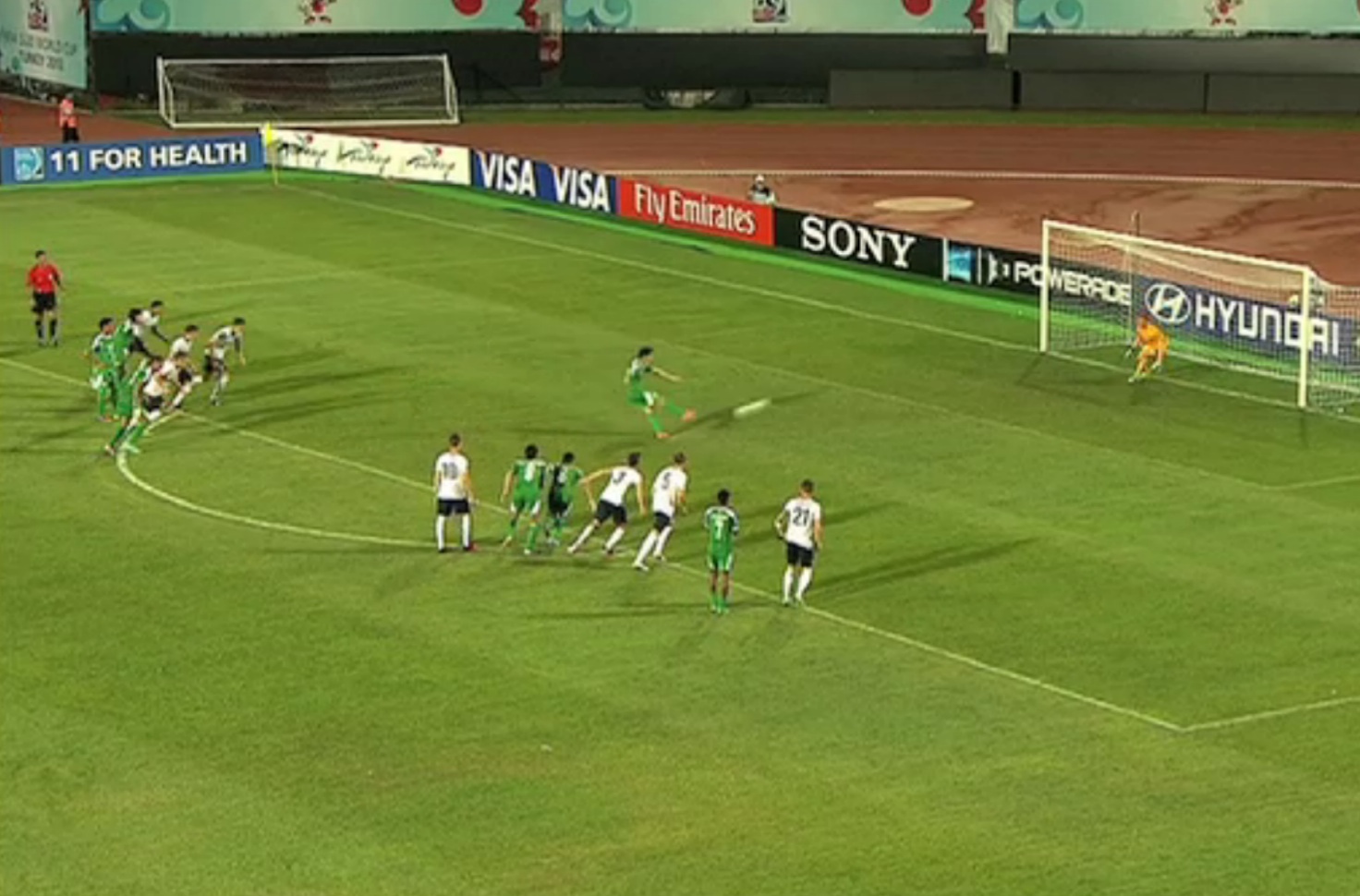
The following incident occurred during the FIFA U20 World Cup group match between England and Irag on 23 June 2013. The match finished 2—2, with 5 YCs.
In the 74', with the score at 2—0, Referee Roberto Garcia (Mexico) correctly awards a penalty to Iraq. Here is his correct positioning for the penalty kick.
Some of the comments from readers (who I assume are referees) for the recent post Positioning Guidelines for FIFA Referees reveal a surprising lack of basic knowledge of the LOTG.
Please consider why FIFA recommends Referees to stand approximately in this position for penalty kicks.
Next, consider why FIFA recommends Referees to stand in a different position for Kicks from the Penalty Mark.
FIFA Referees are supposed to have attained a certain standard of competency. Therefore, whenever inconsistencies are observed, the purpose of raising its awareness is so that the rest of us can learn from the mistakes of high-profile Referees (without, hopefully, performing the error ourselves).
We should also be concerned about why FIFA Referees are not consistent in their knowledge of the LOTG. Who are the ones instructing the Referee instructors and assessing the Referee assessors?
The match officials were:
Referee: Roberto GARCIA (MEX)
Assistant Referee 1: Jose Luis CAMARGO (MEX)
Assistant Referee 2: Alberto MORIN (MEX)
Fourth official: Wilmar ROLDAN (COL)
Tuesday, 25 June 2013
Friday, 21 June 2013
Positioning Guidelines For FIFA Referees
The 2013 UEFA U21 European Championships held in Israel was home to some wonderful matches from players, some solid performances from match officials, and some fantastic entertainment in general for everyone involved.
For informative and insightful analyses, I suggest visiting The Third Team website. It is a great website looking at refereeing from Europe. They also have some dedicated and passionate "blog observers" who produce useful and helpful assessment reports.
My observation here is just a comment on the consistency of knowledge amongst all the upcoming referees from Europe. The natural assumption is that all FIFA referees are familiar with the LOTG—especially with the interpretations—and with special guidelines or directives that arise from time to time.
On this basis, it is puzzling to see the positioning of Referee Matej Jug (Slovenia) during penalty kicks. The following incidents occurred during the 2013 UEFA U21 Final between Italy and Spain on Tuesday 18 June 2013. The match finished 2—4, with 7 YCs.
Penalty One
In the 37', Referee Jug is perfectly positioned to make the correct call. Here are the freeze frames:
Penalty Two
In the 64', Referee Jug is far behind from play as an Italy defender trips the Spain attacker. Here are the freeze frames:
A couple of seconds after the foul. Referee Jug comes into the frame. Who made the penalty call? The EAR or AR?
Referee Jug keeps his whistle in his mouth (see similar "whistle in mouth" case here). Something else (not a second whistle) dangles on the other end. What is it? It looks like a dog tag or key fob.
SUMMARY
Referee Matej Jug (Slovenia) and his colleagues who officiated at these U21 Championships are the next generation of top FIFA referees from Europe. They are currently categorized as Elite Development FIFA referees. The fact that there are still obvious inconsistencies with the interpretation of the LOTG should raise some concern. All match officials at international level should have sufficient training and knowledge to be consistently correct in the basic positioning concepts as described in the LOTG.
I can perhaps excuse the blatant performance of older match officials who stubbornly refuse to change their ways even in the face of the most up-to-date FIFA guidelines. The example here would be the stubborn and slovenly AR Arhar who previously worked with up-and-coming Slovenian Referee Damir Skomina (example here).
However, for Elite Development FIFA Referees, there can be no excuse for any inconsistencies with regard to the standard interpretations of the LOTG. If this basic procedure (i.e. positioning for a penalty kick) cannot be followed consistently amongst all FIFA referees, then what does it say about the referee assessors and instructors of the next generation of top FIFA referees? This blog has previously mentioned consistency problems amongst the next generation of referees (see here).
The match officials for the Final were:
Referee: Matej Jug (SVN)
Assistant Referee 1: Roland Brandner (AUT)
Assistant Referee 2: Vencel Tóth (HUN)
Additional Assistant Referee 1: Halis Özkahya (TUR)
Additional Assistant Referee 2: Ivan Kružliak (SVK)
Fourth Official: Ivan Bebek (CRO)
UEFA Referee Observer: Hugh Dallas (SCO)
UEFA Delegate: Petr Fousek (CZE)
For informative and insightful analyses, I suggest visiting The Third Team website. It is a great website looking at refereeing from Europe. They also have some dedicated and passionate "blog observers" who produce useful and helpful assessment reports.
My observation here is just a comment on the consistency of knowledge amongst all the upcoming referees from Europe. The natural assumption is that all FIFA referees are familiar with the LOTG—especially with the interpretations—and with special guidelines or directives that arise from time to time.
On this basis, it is puzzling to see the positioning of Referee Matej Jug (Slovenia) during penalty kicks. The following incidents occurred during the 2013 UEFA U21 Final between Italy and Spain on Tuesday 18 June 2013. The match finished 2—4, with 7 YCs.
Penalty One
In the 37', Referee Jug is perfectly positioned to make the correct call. Here are the freeze frames:
Notice the Italian players surrounding and hounding the Referee
Look at Referee Jug's positioning
Penalty Two
In the 64', Referee Jug is far behind from play as an Italy defender trips the Spain attacker. Here are the freeze frames:
A couple of seconds after the foul. Referee Jug comes into the frame. Who made the penalty call? The EAR or AR?
Referee Jug keeps his whistle in his mouth (see similar "whistle in mouth" case here). Something else (not a second whistle) dangles on the other end. What is it? It looks like a dog tag or key fob.
Again, notice the Referee's positioning
SUMMARY
Referee Matej Jug (Slovenia) and his colleagues who officiated at these U21 Championships are the next generation of top FIFA referees from Europe. They are currently categorized as Elite Development FIFA referees. The fact that there are still obvious inconsistencies with the interpretation of the LOTG should raise some concern. All match officials at international level should have sufficient training and knowledge to be consistently correct in the basic positioning concepts as described in the LOTG.
I can perhaps excuse the blatant performance of older match officials who stubbornly refuse to change their ways even in the face of the most up-to-date FIFA guidelines. The example here would be the stubborn and slovenly AR Arhar who previously worked with up-and-coming Slovenian Referee Damir Skomina (example here).
However, for Elite Development FIFA Referees, there can be no excuse for any inconsistencies with regard to the standard interpretations of the LOTG. If this basic procedure (i.e. positioning for a penalty kick) cannot be followed consistently amongst all FIFA referees, then what does it say about the referee assessors and instructors of the next generation of top FIFA referees? This blog has previously mentioned consistency problems amongst the next generation of referees (see here).
The match officials for the Final were:
Referee: Matej Jug (SVN)
Assistant Referee 1: Roland Brandner (AUT)
Assistant Referee 2: Vencel Tóth (HUN)
Additional Assistant Referee 1: Halis Özkahya (TUR)
Additional Assistant Referee 2: Ivan Kružliak (SVK)
Fourth Official: Ivan Bebek (CRO)
UEFA Referee Observer: Hugh Dallas (SCO)
UEFA Delegate: Petr Fousek (CZE)
Labels:
EURO,
FIFA,
Law 14,
Law 5,
referee consistency,
referee teamwork,
UEFA
Wednesday, 12 June 2013
Lebanese Referees Guilty of Accepting Sexual Bribes For Match Fixing
In April, news surfaced of the arrests of match officials from Lebanon who received sexual bribes in return for fixing matches. They were caught in Singapore prior to an AFC Cup match between Tampines Rovers (Singapore) and East Bengal (India).
Three months later, the match officials have been sentenced in Singapore. The two ARs, Ali Eid, 33, and Abdallah Taleb, 37, were sentenced to three months in jail. The judge deferred sentencing Referee Ali Sabbagh, 34, who is considered the "most culpable".
More must be done to track and hunt down the real perpetrators, such as Eric Ding Si Yang, 31, the Singaporean businessman who allegedly supplied the prostitutes, and his associates.
Related Posts
Reference
Lebanese referees admit agreeing to fix soccer match for sex in Singapore (SCMP; paywall)
Three months later, the match officials have been sentenced in Singapore. The two ARs, Ali Eid, 33, and Abdallah Taleb, 37, were sentenced to three months in jail. The judge deferred sentencing Referee Ali Sabbagh, 34, who is considered the "most culpable".
More must be done to track and hunt down the real perpetrators, such as Eric Ding Si Yang, 31, the Singaporean businessman who allegedly supplied the prostitutes, and his associates.
Related Posts
China's Golden Whistle Gets Jail Sentence
China's Golden Whistle Admits Accepting US$44,000 Bribe
Suspect Referee Performance: Nigeria v Argentina
Life Ban For Player Found Guilty of Match-Fixing in Hong Kong
Reference
Lebanese referees admit agreeing to fix soccer match for sex in Singapore (SCMP; paywall)
Tuesday, 11 June, 2013
Agence France-Presse in Singapore
Three Lebanese referees pleaded guilty yesterday to accepting free sex from a gambling-linked global syndicate in return for agreeing to rig a match.
A Singaporean district court judge jailed assistant referees Ali Eid, 33, and Abdallah Taleb, 37, for three months.
He deferred sentencing until today for referee Ali Sabbagh, whom prosecutors said was the most culpable.
The assistant referees broke down into sobs and repeatedly looked up as if to thank God when Judge Low Wee Ping said they could be freed by today, after remission for good behaviour and due to time already served while awaiting sentencing.
Turning to Sabbagh, 34, the judge said: "I need time to consider your sentence. I don't, for the moment, accept that you should be sentenced to six months."
Deputy public prosecutor Asoka Markandu described Sabbagh as the most culpable as he was the one who was approached by the syndicate and persuaded the two linesmen to accept the sexual bribe.
The three men were arrested and charged on April 4 with corruption for accepting sexual favours in exchange for agreeing to fix an unspecified match.
They had been abruptly pulled out of an Asian Football Confederation Cup match that they were scheduled to officiate on April 3 between the Singapore-based Tampines Rovers and India's East Bengal.
The three match officials were denied bail and have been detained at Singapore's Changi prison since April 4.
Eric Ding Si Yang, 31, a Singaporean businessman who allegedly supplied the prostitutes, has also been charged with corruption and granted bail.
Defence lawyer Gary Low cited his clients' previously unblemished records, their guilty pleas and the fact that their acceptance of the sexual bribe did not ultimately result in any football match being rigged.
"The gratification was arranged by Mr Ding Si Yang with a view to fixing a football match in the future," Low said. "Our clients did not reach an agreement with Ding to fix a particular football match.
"In these circumstances, our clients' conduct did not in any way affect or influence the outcome of any football match," the lawyer added.
Friday, 31 May 2013
New 2013 Adidas Referee Shirt
Here's the new 2013-2014 Adidas Referee Shirt which will apparently be used for the new season's UEFA Champions League:
The adidas referee kits used in the 2010 World Cup continue to be used in various domestic leagues as well as for official FIFA tournaments. For example, they are used in Australia's A-League and will no doubt be used for the upcoming Confederations Cup in Brazil.
UEFA appears to have the advantage over FIFA in promoting new adidas referee kits every year, and therefore has better opportunities to make more money.
Related Posts
Trendsetting: Referee Shirts
Not Convinced About Collina in Respect Campaign
The Heavy Side of Shirt Swapping
The adidas referee kits used in the 2010 World Cup continue to be used in various domestic leagues as well as for official FIFA tournaments. For example, they are used in Australia's A-League and will no doubt be used for the upcoming Confederations Cup in Brazil.
UEFA appears to have the advantage over FIFA in promoting new adidas referee kits every year, and therefore has better opportunities to make more money.
Related Posts
Trendsetting: Referee Shirts
Not Convinced About Collina in Respect Campaign
The Heavy Side of Shirt Swapping
Saturday, 18 May 2013
Great Assistance From AR
The following incident occurred during the Copa del Rey final between Real Madrid and Atletico Madrid on Friday 17 May 2013. The Spanish Cup Final finished 1—2 aet. There were 6(?)YCs, 2RCs and Real Madrid coach Jose Mourinho was sent from the technical area.
In the 114th minute, Atletico Madrid's Gabi (red 4) fouls Real Madrid's Cristiano Ronaldo (white 7) by kicking him from behind and taking his legs out. Ronaldo reacts by flicking his left leg at the face of his opponent (which we will label the second foul). Initially, the Referee saw the first foul (Gabi's foul on Ronaldo) and played advantage because Real Madrid still had possession of the ball. Here are the freeze frames:
Video can also be seen here:
Red card to Cristiano Ronaldo (Daily Motion)
Notice that the Referee did not know anything about the violent conduct even as he walked up to Ronaldo, and had to get confirmation from AR1 before showing the red card … to Ronaldo's back! Here are the freeze frames:
When the Referee played advantage, Atletico Madrid's Adrian (red 7) then immediately fouled Real Madrid's Sergio Ramos (white 4), again from behind. This was Atletico's game plan since they were now winning 1—2, and wanted to wind down the clock and stop their opponents from playing football. Of course Ronaldo had to go for violent conduct, but the match officials should have been acutely aware of the negative tactics from Atletico Madrid, especially in the time after Atletico had taken the lead with their second goal.
However, this third foul was missed by the match officials because AR1 had flagged the second foul after carefully watching the Referee. AR1 was correct in his actions in assisting the Referee. Unfortunately, a side effect of this is that it actually compounded the situation because as the Referee played advantage he was then distracted by his AR1's flag and therefore missed this third foul.
After the third foul, the two players clash heads (Adrian and Ramos headbutt each other) and Ramos falls back theatrically. However, this piece of the action is completely missed by the match officials because of all the commotion coming from the technical areas. Here are the freeze frames:
The funny thing about these incidents is that players and coaches only want to focus on the one incident that they perceive to have gone against them. They ignore everything else … even the major incidents like violent conduct. Players and coaches are so biased toward their own team, that they miss the bigger picture and only want the match officials to see only the foul and misconduct that has gone against their own team. It is funny, laughable and all so very sad when viewed from the armchair.
For example, let's look at the discussion between Ramos and Adrian about the third foul. Ramos simply wanted Adrian to acknowledge that he had fouled him from behind (which is a true fact). Adrian acts all innocent (many guilty players know how to do this) and says he didn't think it was a foul. Ramos insists it was a foul and shows Adrian the back of his foot where Adrian kicked him. Adrian continues to play innocent. Here are the freeze frames:
Notice also during this whole time, Red 8 is hovering next to Ramos to distract him and to support his teammate Adrian. Red 8 then talks about Ronaldo's kick at his captain because, yes, that was an injustice done to his captain Gabi. But that's already been taken care of because the Referee had already shown the red card. It's actually very entertaining watching all this; millionaires acting like children and only wanting things to go their own way without thought about the bigger picture.
In summary, match officials can only do what they can do (which is based on what they can actually see). This means AR1 did a great job in identifying the violent conduct.
Perhaps the 4th Official could have spotted the third foul? Had the 4th Official seen that and assisted the Referee, then that would have been great too. As it is, for this incident, only AR1 comes out looking good.
For all that other stuff (i.e. spotting misconduct in the technical area), it should be the responsibility of the competition organizer to use video footage to identify the players retrospectively and fine them for their unsporting behavior.
From the video, we see Real Madrid's Kaka stopping Atletico coach Diego Simeone. Simeone pushes Kaka back but then Real Madrid's Pepe gets in Simeone's face. Pepe is then pushed away by an Atletico substitute, and another Atletico substitute (red 16, I think) swings a punch at Pepe.
Looking at the positions of the match officials (R, AR1 and 4O) during all the commotion, it is quite impossible for them to see all the incidents that are happening. It is ridiculous to expect match officials to see and record everything. And this is why competition organizers should use video evidence to take retrospective action … and support match officials.
Do not blame match officials for not being able to see everything that happens in and around the pitch. Instead, competition organizers should be helping and assisting match officials so that correct disciplinary action is awarded correctly to the offenders. By working together (i.e. competition organizers supporting match officials), offenders will not escape punishment and therefore will always think twice about their behaviour if they understand that video evidence will always be used to take retrospective disciplinary action.
Competition organizers should acknowledge that match officials are human and therefore cannot see and report everything that occurs in and around the field of play. They should therefore send a clear message to players and coaches that unsporting behaviour will not be tolerated by supporting match officials and using video evidence to take retrospective action against offenders.
In the 114th minute, Atletico Madrid's Gabi (red 4) fouls Real Madrid's Cristiano Ronaldo (white 7) by kicking him from behind and taking his legs out. Ronaldo reacts by flicking his left leg at the face of his opponent (which we will label the second foul). Initially, the Referee saw the first foul (Gabi's foul on Ronaldo) and played advantage because Real Madrid still had possession of the ball. Here are the freeze frames:
Referee plays advantage following a foul on Ronaldo (white 7)
AR1 looks toward Referee, who did not see Ronaldo kicking his opponent, and therefore flagged
Video can also be seen here:
Red card to Cristiano Ronaldo (Daily Motion)
Notice that the Referee did not know anything about the violent conduct even as he walked up to Ronaldo, and had to get confirmation from AR1 before showing the red card … to Ronaldo's back! Here are the freeze frames:
Never show a card to a player's back
When the Referee played advantage, Atletico Madrid's Adrian (red 7) then immediately fouled Real Madrid's Sergio Ramos (white 4), again from behind. This was Atletico's game plan since they were now winning 1—2, and wanted to wind down the clock and stop their opponents from playing football. Of course Ronaldo had to go for violent conduct, but the match officials should have been acutely aware of the negative tactics from Atletico Madrid, especially in the time after Atletico had taken the lead with their second goal.
However, this third foul was missed by the match officials because AR1 had flagged the second foul after carefully watching the Referee. AR1 was correct in his actions in assisting the Referee. Unfortunately, a side effect of this is that it actually compounded the situation because as the Referee played advantage he was then distracted by his AR1's flag and therefore missed this third foul.
After the third foul, the two players clash heads (Adrian and Ramos headbutt each other) and Ramos falls back theatrically. However, this piece of the action is completely missed by the match officials because of all the commotion coming from the technical areas. Here are the freeze frames:
In the aftermath of Ronaldo's violent conduct, Atletico's Adrian (red 7) fouls Real's Ramos (white 4) from behind. The two players then clash heads.
The funny thing about these incidents is that players and coaches only want to focus on the one incident that they perceive to have gone against them. They ignore everything else … even the major incidents like violent conduct. Players and coaches are so biased toward their own team, that they miss the bigger picture and only want the match officials to see only the foul and misconduct that has gone against their own team. It is funny, laughable and all so very sad when viewed from the armchair.
For example, let's look at the discussion between Ramos and Adrian about the third foul. Ramos simply wanted Adrian to acknowledge that he had fouled him from behind (which is a true fact). Adrian acts all innocent (many guilty players know how to do this) and says he didn't think it was a foul. Ramos insists it was a foul and shows Adrian the back of his foot where Adrian kicked him. Adrian continues to play innocent. Here are the freeze frames:
Players are liars
Notice also during this whole time, Red 8 is hovering next to Ramos to distract him and to support his teammate Adrian. Red 8 then talks about Ronaldo's kick at his captain because, yes, that was an injustice done to his captain Gabi. But that's already been taken care of because the Referee had already shown the red card. It's actually very entertaining watching all this; millionaires acting like children and only wanting things to go their own way without thought about the bigger picture.
In summary, match officials can only do what they can do (which is based on what they can actually see). This means AR1 did a great job in identifying the violent conduct.
Perhaps the 4th Official could have spotted the third foul? Had the 4th Official seen that and assisted the Referee, then that would have been great too. As it is, for this incident, only AR1 comes out looking good.
For all that other stuff (i.e. spotting misconduct in the technical area), it should be the responsibility of the competition organizer to use video footage to identify the players retrospectively and fine them for their unsporting behavior.
From the video, we see Real Madrid's Kaka stopping Atletico coach Diego Simeone. Simeone pushes Kaka back but then Real Madrid's Pepe gets in Simeone's face. Pepe is then pushed away by an Atletico substitute, and another Atletico substitute (red 16, I think) swings a punch at Pepe.
Looking at the positions of the match officials (R, AR1 and 4O) during all the commotion, it is quite impossible for them to see all the incidents that are happening. It is ridiculous to expect match officials to see and record everything. And this is why competition organizers should use video evidence to take retrospective action … and support match officials.
The 4th Official (red jacket) is to the left of the screen and the R & AR1 (blue) are to the right
Do not blame match officials for not being able to see everything that happens in and around the pitch. Instead, competition organizers should be helping and assisting match officials so that correct disciplinary action is awarded correctly to the offenders. By working together (i.e. competition organizers supporting match officials), offenders will not escape punishment and therefore will always think twice about their behaviour if they understand that video evidence will always be used to take retrospective disciplinary action.
Competition organizers should acknowledge that match officials are human and therefore cannot see and report everything that occurs in and around the field of play. They should therefore send a clear message to players and coaches that unsporting behaviour will not be tolerated by supporting match officials and using video evidence to take retrospective action against offenders.
Tuesday, 30 April 2013
EARs Do Not See … or Hear … or Assist!
There is a dedicated Referees' Blog called The Third Team which produces excellent insight, great comments and useful assessment reports that can help any match official improve themselves. I thoroughly recommend The Third Team.
One example from The Third Team is an excellent analysis regarding Referee Victor Kassai's handling of the Bayern Munich and Barcelona Champions League semifinal first-leg match on Wednesday 24 April 2013. The match finished 4—0; there were 7 YCs.
HKRef would just like to highlight the incident leading up to Bayern Munich's third goal in the 73'. Here are the freeze frames:
Let's look at the Additional Assistant Referee or EAR (blue). During the play, what is he looking at?
The Additional Assistant Referee (or EAR) is simply ball-watching. He does not appear to take in the overall event that is developing in front of him. Only when Barcelona's Jordi Alba hits the ground does EAR1 turn his head quickly to glance back before following the ball again.
This is yet another example—to add to many others accumulated from nearly 1,000 matches (e.g. here, here and here)—that demonstrate the ineffectiveness of EARs. Players secretly laugh at UEFA's claim that the presence of extra match officials act as a deterrent to unsporting behaviour in and around the penalty area.
This blog's central thesis about EARs is:
Central Thesis
I feel sorry for Pierluigi Collina, chief refereeing officer at UEFA, having the task of promoting the use of EARs simply because his boss Michel Platini insists on using extra match officials. The use of EARs (and goal-line technology) is more a political agenda amongst those in the upper echelons of power, rather than a genuine attempt to really help match officials.
Ultimately, match officials require clear, consistent and credible support from competition organizers (e.g. taking effective retrospective action to punish players and clubs for unsporting behaviour) so that all players and clubs will eventually think twice before deciding to deceive Referees. If UEFA, FIFA and other competition organizers fully support Referees, and are seen to fully support Referees, by being willing to take retrospective action then in general players and clubs will automatically behave themselves and there will be more Respect for Match Officials. It is that simple.
The match officials were:
Referee Viktor Kassai (HUN)
Assistant referees Robert Kispal (HUN), Gabor Erös (HUN)
Fourth official György Ring (HUN)
Additional assistant referees Tamás Bognar (HUN), Mihaly Fabian (HUN)
NOTE
Although this blog is highly critical of the use of EARs, HKRef has thought about situations where EARs may indeed prove useful. Take a look at this analysis where EARs May Be Useful.
One example from The Third Team is an excellent analysis regarding Referee Victor Kassai's handling of the Bayern Munich and Barcelona Champions League semifinal first-leg match on Wednesday 24 April 2013. The match finished 4—0; there were 7 YCs.
HKRef would just like to highlight the incident leading up to Bayern Munich's third goal in the 73'. Here are the freeze frames:
Arjen Robben (red 10) scores Bayern Munich's third goal
Let's look at the Additional Assistant Referee or EAR (blue). During the play, what is he looking at?
Thomas Muller (red 25) deliberately bodychecks Jordi Alba (blue 18) who was focused on chasing Robben (red 10)
The Additional Assistant Referee (or EAR) is simply ball-watching. He does not appear to take in the overall event that is developing in front of him. Only when Barcelona's Jordi Alba hits the ground does EAR1 turn his head quickly to glance back before following the ball again.
This is yet another example—to add to many others accumulated from nearly 1,000 matches (e.g. here, here and here)—that demonstrate the ineffectiveness of EARs. Players secretly laugh at UEFA's claim that the presence of extra match officials act as a deterrent to unsporting behaviour in and around the penalty area.
This blog's central thesis about EARs is:
Central Thesis
My main argument is not the fact that EARs are ineffective and redundant (which, in many incidents, they are ) or that EARs do not help or enhance the game. It is worse than that and much more serious.
My main argument is the fact that EARs can have a detrimental effect on the performance of the match Referee and hence can contribute to ruining the game since match officials will be perceived to be making more, instead of less, errors.
I feel sorry for Pierluigi Collina, chief refereeing officer at UEFA, having the task of promoting the use of EARs simply because his boss Michel Platini insists on using extra match officials. The use of EARs (and goal-line technology) is more a political agenda amongst those in the upper echelons of power, rather than a genuine attempt to really help match officials.
Ultimately, match officials require clear, consistent and credible support from competition organizers (e.g. taking effective retrospective action to punish players and clubs for unsporting behaviour) so that all players and clubs will eventually think twice before deciding to deceive Referees. If UEFA, FIFA and other competition organizers fully support Referees, and are seen to fully support Referees, by being willing to take retrospective action then in general players and clubs will automatically behave themselves and there will be more Respect for Match Officials. It is that simple.
The match officials were:
Referee Viktor Kassai (HUN)
Assistant referees Robert Kispal (HUN), Gabor Erös (HUN)
Fourth official György Ring (HUN)
Additional assistant referees Tamás Bognar (HUN), Mihaly Fabian (HUN)
NOTE
Although this blog is highly critical of the use of EARs, HKRef has thought about situations where EARs may indeed prove useful. Take a look at this analysis where EARs May Be Useful.
Labels:
Champions League,
FIFA,
referee system,
referee teamwork,
UEFA
Monday, 29 April 2013
Penalize Players For Making Political, Religious, Personal Statements
The following incident occurred during the EPL match between Everton and Fulham on Saturday 27 April 2013. The match finished 1—0, with 4YCs.
Everton's Steven Pienaar is a serial offender in getting his religious message across whenever he scores. He usually pulls his shirt up over his head, as he did again last weekend.
Although Referee Jon Moss failed to show Pienaar a mandatory YC, the competition organizers and FIFA are more to blame for lacking the conviction to enforce the LOTG.
The LOTG state:
Related Post
Political, Religious or Personal Statements
Penalize players like Pienaar for making political, religious or personal statements. Pic courtesy Getty Images.
Everton's Steven Pienaar is a serial offender in getting his religious message across whenever he scores. He usually pulls his shirt up over his head, as he did again last weekend.
Although Referee Jon Moss failed to show Pienaar a mandatory YC, the competition organizers and FIFA are more to blame for lacking the conviction to enforce the LOTG.
The LOTG state:
Players must not reveal undergarments showing slogans or advertising. The basic compulsory equipment must not have any political, religious or personal statements.
A player removing his jersey or shirt to reveal slogans or advertising will be sanctioned by the competition organiser. The team of a player whose basic compulsory equipment has political, religious or personal slogans or statements will be sanctioned by the competition organiser or by FIFA.
Related Post
Political, Religious or Personal Statements
Subscribe to:
Posts (Atom)


