Sunday, 11 December 2011

Sebastian's Shameless Swandive

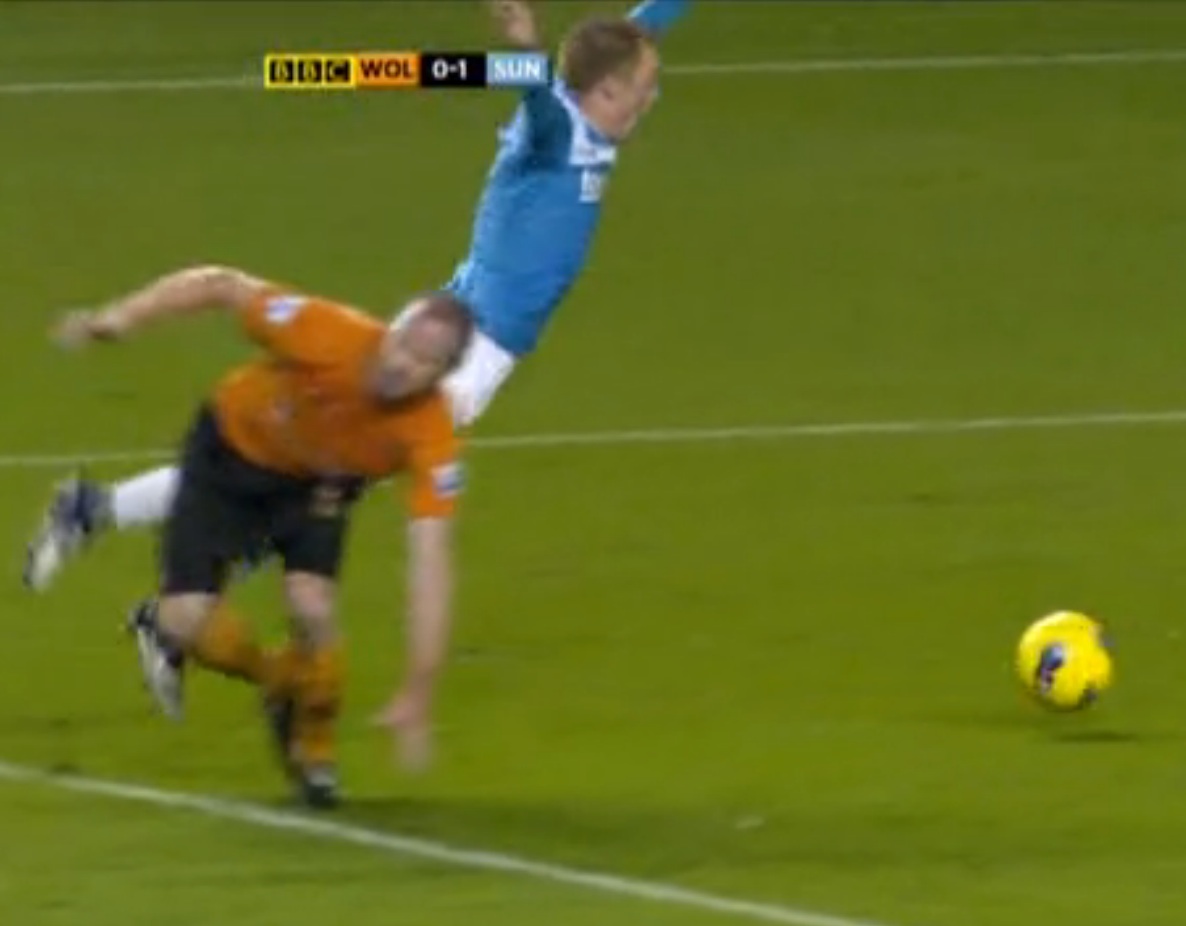
The following incident occurred during the EPL match between Wolverhampton Wanderers and Sunderland on Sunday 4 December 2011. The match finished 2—1.

In the 72', Referee Phil Dowd awarded a penalty to Sunderland's Sebastian Larsson (blue), who appeared to be tripped by Wolves' Jody Craddock (orange). Here are the freeze frames:

Wolves Jody Craddock (orange) appears to trip Sunderland's Sebastian Larsson (blue)


TV replays show there was no contact and Sebastian Larsson (blue) had dived in from outside the area


POST-MATCH ANALYSIS
Let's consider the facts and determine the correct decision to restart.

Fact: TV replays show Jody Craddock (orange) withdrew his right foot and did not make any contact with Sebastian Larsson (blue).

First, could the AR have helped in determining whether the incident occurred outside or inside the penalty area? If there was contact (and TV replays proved there was not), would it have occurred outside or inside? We know Referee Dowd awarded the penalty, but what did the AR see?

Second, did Referee Phil Dowd actually have an unobstructed view of the incident? In addition to the fact that the incident happened very quickly, a defending player also ran in between the Referee and the incident and may have obscured the Referee's line of vision?
Did Referee Phil Dowd have an unobstructed view?

At first look, and with another player perhaps getting in the way, the Referee felt he had enough information (and used all his experience) to award a penalty. Although the facts reveal it was the wrong decision to award a penalty, it is perhaps understandable why the Referee awarded a penalty. However, questions should be asked whether the Referee and/or the AR saw any contact?

Third, if the Referee knew there was no contact between the defender and attacker, whether outside or inside the area, what should have been the call?

If the Referee knows there was no contact and believes the attacker was looking for the foul, then the correct decision would be to caution the attacker for unsporting behaviour and award an IFK at the place of the incident to the defending team.

Saturday, 10 December 2011

Recognizing Head Injuries

The following incident occurred during the Champions League group match between FC Basel and Manchester United on Wednesday 7 December 2011. The match finished 2—1.

In the 9', two Manchester United defenders (Chris Smalling and Nemanja Vidic, in white) had a head collision and the ball rolled into the possession of the attacking team. Subsequently, the ball was crossed into the penalty area where a goal was scored. Here are the freeze frames:

Referee Björn Kuipers (Netherlands) did not recognise a clash of heads between two defenders (white) and instead followed the path of the ball. What has the EAR seen?


Question 1: What does the Referee need to consider during a head collision?

Question 2: What should have been the restart?

Regarding Injured Players, here are some of the Interpretations for "serious injuries":
o Play is stopped if, in the opinion of the referee, a player is seriously injured
o The referee must ensure an injured player is safely removed from the field of play
o A player is not allowed to receive treatment on the field of play

Exceptions to this ruling are to be made only when:
o a goalkeeper is injured
o a goalkeeper and an outfield player have collided and need immediate attention
o players from the same team have collided and need immediate attention [Effective 2010-2011 season]
o a severe injury has occurred, e.g. swallowed tongue, concussion, broken leg

Since the majority of Referees are not medical doctors or medically-trained, it is always safer to err on the side of caution especially when there is a clash of heads (hence, head injuries should be deemed a serious injury). A Referee who quickly stops play in response to seeing or being informed about a head collision will not—and should not—be criticised for stopping play. It would take a foolish and self-absorbed individual to criticise a match official for taking precautionary action regarding the safety of a player or players.

Aside:
If readers do not believe a head collision should be regarded as a "serious injury", then they should take a look at an interesting story about traumatic brain injuries which are associated with accumulated heading of the ball (Soccer is bad for your health?). If repeated heading with a relatively soft ball over a number of years is associated with developing brain injuries, then it is quite reasonable to consider that a heavy blow or impact to the head with a relatively hard object (such as an elbow, foot or head) may cause an acute and therefore serious injury. With head injuries, it is always safer to err on the side of caution.


A Robot EAR

Once again, here is another example that demonstrated the limitation of the extra assistant referee (EAR) and his supposed duties. More data to add to the ineffectiveness of EARs. There were two important incidents that occurred in front of the EAR, but the EAR assisted with only one of the incidents.

The EAR did NOT assist the Referee about the head collision

The EAR assisted the Referee about the whole of the ball crossing the goal line during Man Utd's (white) attack
[Note itvSport's incorrect scoreline]


Therefore there is NO difference in the role of installing goal-line technology and in using EARs. Both fulfill the criteria of telling the Referee that the whole of the ball had crossed the goal-line between the posts and under the crossbar. But don't forget, UEFA, FIFA and IFAB made additional claims about the use of EARs. For instance, they claimed that EARs would 'assist' the Referee in matters concerning the identification of fouls, misconduct and incidents in the penalty area and in having a preventative effect on fouls and misconduct in the penalty area.

The head collision incident provided a great opportunity for the EAR to assist the R in stopping the game so that two players could receive treatment for head injuries, but instead the EAR chose to be a 'Robot' who focuses only on the goal line. Contrast this to the one single isolated example of an effective EAR who was willing to take a public stand because he knew the R had missed something significant.

If we want match officials to act like unthinking robots, then the future direction may as well be to invent robots to officiate matches. Robots that will just follow the Laws absolutely and will have no capacity for common sense or initiative. But that's not the real issue here. The real issue is that all along sensible and rational people have been in favour of using goal-line technology at the highest levels of the game so that human Referees would be assisted in matters concerning the scoring of goals. However, the dinosaurs (Platini, Blatter, and their "yes" men) dithered, dallied and delayed by introducing EARs. They made claims about what the EARs would do, but in reality the EARs are just doing what unthinking Robots would be doing; to confirm whether the whole of the ball had crossed the goal-line between the posts and under the crossbar.

Thus, there is NO difference in the role of having goal-line technology and in using EARs. Their roles are the same; although they differ in their inherent accuracy levels and in FIFA's demands of accuracy standards. There is little doubt that goal-line technology will eventually be installed at the highest levels of the game. And history will show that the Powers That Be merely delayed the introduction of goal-line technology by playing around and making a pig's EAR of an 'experiment' that used additional extra assistant referees.

Note: This incident is also interesting because one of the EARs (Dutchman Bas Nijhuis) had only the week before been on the receiving end of a great call from an effective EAR. Surely the Dutch Referee team must have discussed the situation and agreed on a plan of action for something similar?


The match officials were:
Referee
Björn Kuipers (NED)
Assistant referees
Sander van Roekel (NED), Erwin Zeinstra (NED)
Fourth official
Eric Braamhaar (NED)
Additional assistant referees (EARs)
Bas Nijhuis (NED), Richard Liesveld (NED)

Friday, 9 December 2011

A Tale of Two ARs and Their Two Important Calls

The following incidents all occurred in the first half during the Champions League group match between Ajax and Real Madrid on Wednesday 7 December 2011. The match finished 0—3.

Ajax are wearing white/red shirts, and Real Madrid are in black.


No Offside One AR1 Call Correct
Correct no offside call and the score becomes 0—1.


No Offside Two AR2 Call INCORRECT
Incorrect offside call prevents the score being 1—1.


No Offside Three AR2 Call INCORRECT
Another incorrect offside call prevents the score being 1—1 (or 2—1).


No Offside Four AR1 Call Correct
Correct no offside call and the score becomes 0—2.


CONCLUSION

By the half-time interval, Ajax were unfortunately denied two goals (the ball was put in the net during both onside incidents) due to the poor performance of AR2 who incorrectly flagged offside. In contrast, Real Madrid scored two legitimate goals because AR1 was on top of his game during two similar onside incidents.

That was the crucial difference in the first half of the match; 0—2 and psychological advantage to Real Madrid instead of perhaps 2—2 and a match that could have gone either way.

A Tale of Two ARs

It was the best of times, it was the worst of times ...

AR1 (the best of times?)

AR2 (the worst of times?)

The match officials were:

Referee
Manuel De Sousa (POR)
Assistant referees
Bertino Miranda (POR), João Santos (POR)
Fourth official
Rui Manuel Gomes Costa (POR)
Additional assistant referees (EARs)
Artur Soares (POR), Carlos Xistra (POR)

Thursday, 8 December 2011

Political, Religious or Personal Statements

In addition to receiving a caution during the match for his goal celebration after he scored in the EPL match between Wolves and Sunderland on Sunday 4 December 2011, Sunderland's Kieran Richardson should be sanctioned post-match for his undershirt statement.

Players who intentionally flout the rules should be sanctioned by their clubs as well as by the competition organiser

The LOTG state:
Players must not reveal undergarments showing slogans or advertising. The basic compulsory equipment must not have any political, religious or personal statements.
A player removing his jersey or shirt to reveal slogans or advertising will be sanctioned by the competition organiser. The team of a player whose basic compulsory equipment has political, religious or personal slogans or statements will be sanctioned by the competition organiser or by FIFA.


Can we expect the FA and EPL to take action against Richardson, and also against Sunderland? Or will FIFA step in?

Furthermore, since players are employees, perhaps their clubs (i.e. their employers) should take responsibility for the behaviour of their players and fine them. This makes sense since players (employees) are, and are seen to be, representing their club (employer). Clubs would not be wrong to impose a fine on their employees. This will make their players think twice before deciding to break the rules and promoting their own self-interests before that of their clubs.

Wednesday, 7 December 2011

Cynical Challenges Creeping In

From a safety point of view, I have never liked it when players use the bottom of their boots to play the ball. And for what it is worth, from an aesthetic perspective, it also looks rather ugly, uncouth and inelegant.

The following incident occurred during the EPL match between Manchester City and Norwich City on Saturday 3 December 2011. The match finished 5—1.

Early in the match, Norwich forward Steve Morison (yellow) steered the ball towards the penalty area but his heavy touch meant the ball was running away from his control. In seeing the Manchester City goalkeeper Joe Hart come off his line to intercept, Morison rather cynically challenged for the ball with his studs up. Here are the freeze frames:

Norwich forward Steve Morison (yellow) cynically challenges for the ball, thereby potentially endangering the safety of his opponent

At the very least, Referee Howard Webb should have awarded a free kick to Man City. It is technically correct to deem the goalkeeper had possession of the ball, since the ball is in contact with the goalkeepers' hand and the ground.

If enough Referees identify such challenges and act on them—by awarding a DFK or IFK plus any appropriate sanctions—players may eventually think twice before making cynical challenges. This blog advocates the message of "Studs Alert: Stamp Out Stamping".


For further consideration, let's have a look at previous examples posted on this blog.

Example One Evan's Eviction
This is an example of Manchester United defender Jonathan Evans maliciously stamping his presence in the game. Referee Andre Marriner correctly sent off Evans.

Example Two Nasty Tackles 2010-11 EPL Tackles Round 36
Unfortunately, these nasty tackles in various EPL matches were not appropriately dealt with by the respective Referees.

Example Three Sorensen's Safety
Chelsea's Salomon Kalou's cynical challenge ensured that Stoke's Danish goalkeeper Thomas Sorensen missed out on the 2010 World Cup finals.


Players making cynical challenges endanger the safety of their opponents. Such players will invariably use the excuse that they were "going for the ball", but Referees (and others who appreciate the Beautiful Game) understand the real reason why players make these cynical challenges. The reason is this: If the unsporting player loses out in the 50-50 challenge for the ball that is a mere inconvenience, but what really matters is that he has made sure he has not lost out in the real challenge that counts (i.e. the physical and/or psychological challenge with his opponent).

It is a player's choice whether he (and she) chooses to challenge for the ball either cynically or sportingly. A good rule of thumb for Referees to judge cynical challenges is to always consider whether the same player would do exactly the same if his opponent was actually his fellow team-mate, a relative or a good friend.

Let's Stamp Out Stamping

Related Posts (search for: stamp)

Recognizing Player Behaviour: 1991 FA Cup Final

Tuesday, 6 December 2011

What Does It Take To Be a Good EPL Referee?

Perhaps lessons in media studies?

There were two controversial decisions related to DOGSO during two English premiership matches on Saturday 3 December 2011. They were:

1) The EPL match between Newcastle United and Chelsea, Refereed by 43-year-old Mike Dean; and

2) The EPL match between Tottenham Hotspurs and Bolton Wanderers, Refereed by 28-year-old Stuart Attwell.


In the 4' of the Newcastle United and Chelsea match, Chelsea defender David Luiz (blue) tackled Newcastle striker Demba Ba about 25 yards from the Chelsea goal. Here are the freeze frames:


Decision: Referee Mike Dean awards a yellow card for what appears to be DOGSO.


In the 18' of the Spurs and Bolton match, Bolton defender Gary Cahill (blue) tripped Spurs midfielder Scott Parker near the halfway line. Here are the freeze frames:


Decision: Referee Stuart Attwell sends off Cahill for what appears to be DOGSO.


Technically, both incidents fulfill the criteria for denying an obvious goal scoring opportunity to an opponent. So why did only one of these two EPL Referees show a red card? I would argue the main difference between the two incidents relates, not on the technicalities of DOGSO but, to the age and experience of the two EPL referees. Why? Perhaps because the older, more experienced EPL Referee understands 'media studies'.

Even ex-EPL Referee Graham Poll firmly believes in Referees giving full consideration to the consequences related to the media, both in terms of football providing a positive TV spectacle and in terms of reducing negative media coverage. See example here.

Also see example here when 2010 WC Final and EPL Referee Howard Webb decided not to send off Holland's Nigel de Jong in the 29' of the WC Final against Spain. Again, was this decision influenced by consideration to the consequences related to the media?

Back to the premiership. Viewed in the context of 'football being an entertainment business', we can see that Mike Dean can be seen as a 'good' EPL Referee because in not applying the LOTG too strictly he chose not to "ruin a spectacle" (as defined by the Powers That Be). And 'green' Stuart Attwell has yet to learn this because he decided to follow the LOTG to the letter with little or no regard to the media and entertainment industries. Is this what it really takes to be a 'good' EPL Referee?

Those who have heard experienced EPL Referees discussing this will know the answer!

Those who are yet to be convinced should follow the career of Stuart Attwell closely and, in the years ahead, observe how many similar DOGSO incidents will result in send-offs and how many in cautions. If current EPL 'policy' is maintained, Attwell's future stats on DOGSO incidents will lean more towards yellows than reds. It might also be revealing to see what Mike Dean's and other senior EPL referees' stats are on DOGSO incidents.

The leniency shown by EPL Referees has been mentioned before (please see Many Missed Red Card Incidents In One Match). If such a 'policy' or 'directive' exists, this enforced leniency is significantly different to that of soft-option Refereeing which appears to be based mainly on incompetence. That said, perhaps the majority of football fans may not know, or even care, about such a difference!?

Monday, 5 December 2011

Double Dutch and the Double Arm Signal

This post is a question about the double arm signal that Referees use.

During the Europa League group match between Tottenham Hotspurs and PAOK on Wednesday 30 November 2011, an incident occurred in the 77' and the Dutch Referee displayed the following double arm signal:
Referee Bas Nijhuis (Netherlands) as mentioned in Incident Two of In one EAR, out the other EAR


During the Europa League group match between Celtic and Atletico on Wednesday 30 November 2011, another Dutch Referee displayed the same signal.

Was this a Foul or an Advantage?

In the 66', Celtic's Samaras (green) is fouled right in front of Referee Eric Braamhaar (Netherlands) who immediately whistles for a DFK. The Referee also makes a double arm signal. Here are the freeze frames:

In fact, had the Referee not whistled then his double arm signal to signify advantage would have been appropriate since it can be seen that Celtic could have continued their attacking move. Hypothetically, after the attacking move is completed and the ball goes out of play, the Referee would then have the right to go back to the offender and caution him before play restarts.

It appears this double arm signal used to signify a free kick is common amongst Referees from the Netherlands. Can someone please confirm? Perhaps Dutch Referee can comment? It is always nice to have some 'cultural exchange', haha!

This double arm signal used to indicate a direct free kick is potentially very misleading because the standard FIFA signal for advantage is also a double arm signal. Why choose to unnecessarily complicate things?

Note: The meaning of the term Double Dutch is "something that is nonsense; gibberish - a language one cannot understand".


The match officials for the Celtic and Atletico fixture were:

Referee
Eric Braamhaar (NED)
Assistant referees
Arend Brink (NED), Wilco Lobbert (NED)
Fourth official
Maarten Ketting (NED)
Additional assistant referees (EARs)
Pol van Boekel (NED), Serdar Gözübüyük (NED)


A correct decision

Also during the Celtic and Atletico match, in the 13' the R had a good view of Celtic player (green 10) using his arms to help climb above an opponent and head the ball into the goal.

Referee Braamhaar spots a foul during a corner kick

The R correctly denied the 'goal' and awarded a DFK to the defending team.